The Great Permian Migration: What 11,002 Well Permits Reveal About 2025
Real data. No scraping required.
The Story Nobody's Telling
While politicians chant "drill, baby, drill" and analysts debate OPEC+ quotas, the actual drilling permit data tells a different story entirely. One that most market participants are missing because the data is buried in 27 different state agency databases, each with its own arcane format.
We pulled every well permit filed in the United States in 2025. All 11,002 of them. The numbers reveal a tectonic shift in American oil and gas development—but not for the reasons you'd expect. This isn't simply a story of geological depletion. It's a story of regulatory arbitrage, capital strikes, and a looming hydrological crisis that threatens to cap Permian growth regardless of oil prices.
The Headline
New Mexico drilling permits more than doubled year-over-year (+107%), while Texas permits fell -26%. Wyoming—once a major drilling state—saw permits collapse -99.8%, from 4,819 in 2024 to just 9 in 2025. But Wyoming didn't run out of oil. Operators ran out of patience with new regulations.
This isn't noise. This is a signal.
The Physics of the Permian Migration
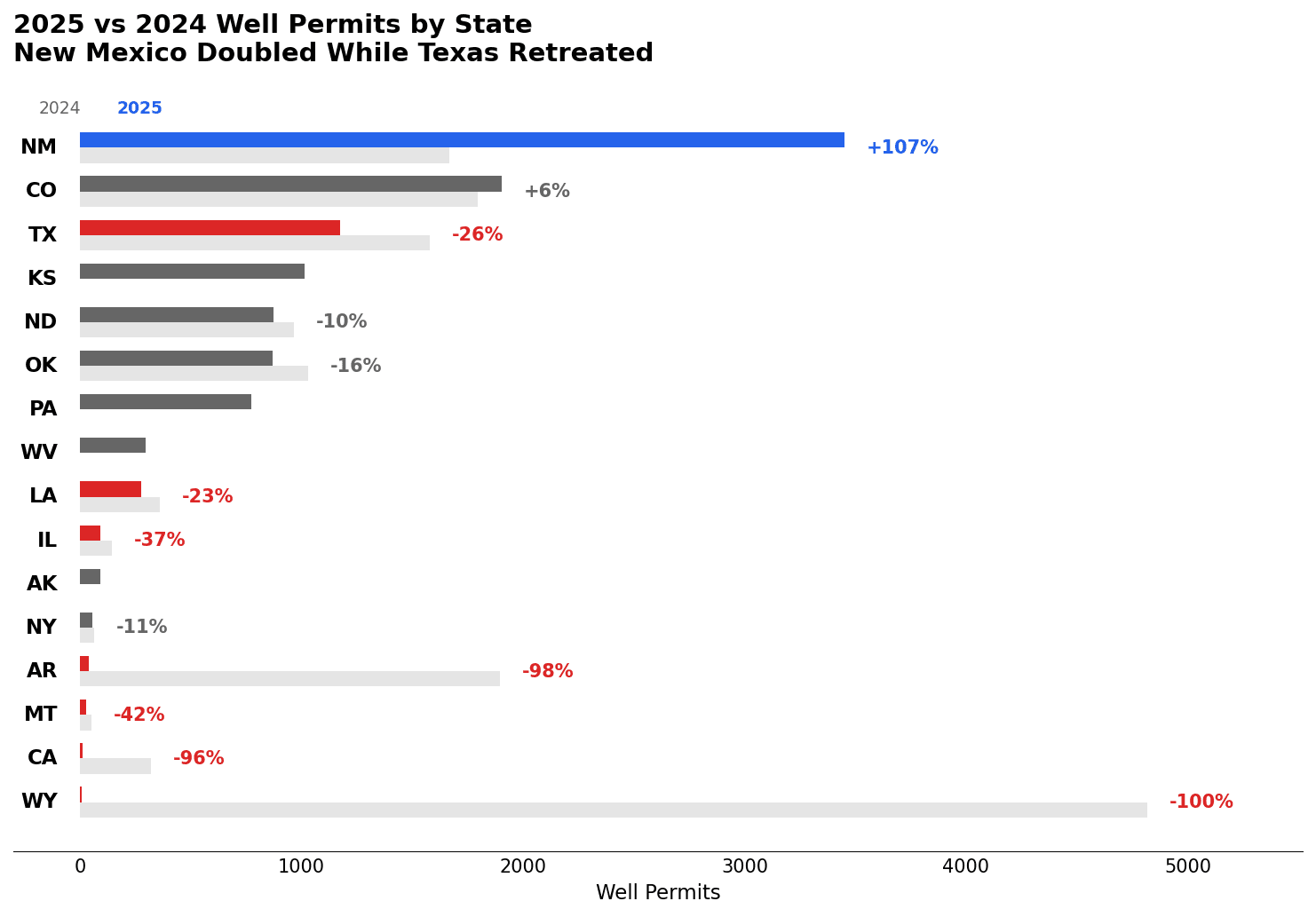
Year-over-Year State Comparison: New Mexico Doubled While Texas Retreated
Let's start with what the data actually shows:
| State | 2024 | 2025 | YoY | Driver |
|---|---|---|---|---|
| NM | 1,668 | 3,452 | +107% | Pre-regulatory stockpiling |
| CO | 1,796 | 1,904 | +6% | Steady state |
| TX | 1,581 | 1,174 | -26% | Midland Basin maturation |
| KS | 0 | 1,016 | NEW | New data coverage |
| ND | 965 | 873 | -10% | Technology-driven recovery |
| OK | 1,032 | 870 | -16% | Capital discipline |
| WY | 4,819 | 9 | -99.8% | Regulatory capital strike |
| CA | 322 | 13 | -96% | State drilling moratorium |
The first-order interpretation—operators concentrating where economics are best—is incomplete. The 2025 data reveals something more complex: a bifurcated migration driven by regulatory arbitrage and hydrological physics.
The Delaware Basin straddling the Texas-New Mexico border offers superior well productivity and—critically—less mature development than the Texas Midland Basin. But the permit surge in New Mexico wasn't organic growth. It was a defensive maneuver.
The Wyoming Capital Strike: A Regulatory Autopsy
Critical Correction: Wyoming's collapse was not geological depletion. It was a capital strike triggered by two pieces of state legislation.
Senate File 0015: The Pits Rule (Effective July 1, 2025)
SF0015 amended the Wyoming Oil and Gas Conservation Commission's authority to regulate "noncommercial reserve pits and produced water retention pits" located off-lease. Historically, Wyoming operators—particularly smaller independents—relied on these pits for low-cost disposal of drilling fluids and flowback water.
The new regulation forced a moratorium on pit usage while operators negotiated compliance frameworks. For many small operators, the loss of the "pit option" necessitated a switch to closed-loop systems or commercial trucking, raising breakeven prices beyond viability.
Senate File 0020: Bonding Reform (Effective July 1, 2025)
Simultaneously, SF0020 mandated a "bonding pool" and authorized assessments on production (up to 0.5 mills) to fund plugging of orphaned wells. The immediate requirement for operators to demonstrate "good standing" and potentially post additional financial assurance created a permitting logjam.
The Result
October 2025 saw 498 Oil APDs in Wyoming. November 2025 saw 132—a 73.5% month-over-month collapse. This wasn't depletion. This was rational economic behavior in response to regulatory uncertainty.
Outlook: Expect a rebound in late 2026 as bonding pool mechanics are finalized and operators adjust to the "no-pit" reality. The resource remains; the rules changed.
The New Mexico Surge: Regulatory Arbitrage in Action
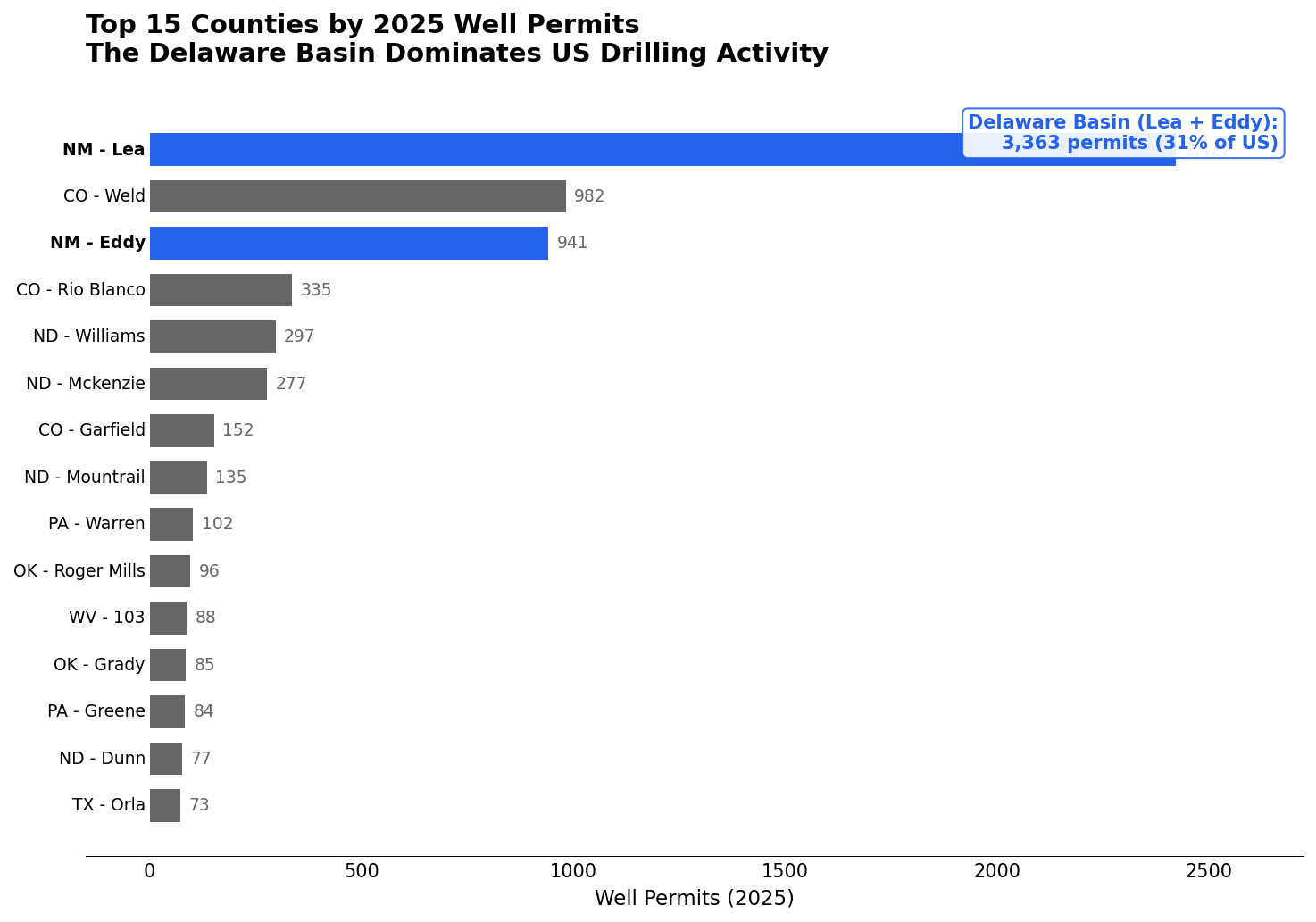
Top 15 Counties by 2025 Well Permits: The Delaware Basin Dominates US Drilling Activity
If Wyoming was the victim of regulatory friction, New Mexico was the beneficiary of regulatory arbitrage. The 4,274 approved permits in 2025 weren't organic growth—they were a defensive stockpile.
The Pre-Regulatory Rush
Two specific deadlines drove the Q3/Q4 permit surge:
November 1, 2025: New Hearing Submission Rules
The New Mexico Oil Conservation Division announced new e-filing requirements and significantly more upfront data for any application requiring a hearing. Operators flooded the OCD with applications in October to grandfather projects under the old protocols.
December 1, 2025: Compulsory Pooling Evidentiary Standards
The OCD changed evidentiary requirements for compulsory pooling applications—the lifeblood of horizontal drilling in New Mexico. Operators aggressively filed pooling applications before the cutoff.
The "Trump Bump" on Federal Lands
Superimposed on state-level dynamics was the macro-political shift:
- Royalty Rate Rollback: The administration rolled back the federal royalty rate to 12.5% (from 16.7%), instantly improving NPV of every federal well in the Delaware Basin.
- Chaco Canyon Reversal: The move to revoke the drilling ban in the 10-mile buffer zone signaled the federal government was "open for business."
The result: A 73% increase in approved APDs on federal land between January and October 2025. But this "won't necessarily translate to immediate oil production"—operators are building defensive inventory moats against future political volatility.
Delaware Basin Dominance
County-Level Concentration
- Lea County, NM: 2,422 permits (22% of all US permits)
- Eddy County, NM: 941 permits
- Weld County, CO: 982 permits (DJ Basin)
- Texas Permian counties combined: ~100 permits
Two New Mexico counties account for more than 30% of all US drilling permits. That's not diversification—that's concentration risk amplified by regulatory optionality.
The Water Crisis: The Kill Switch Nobody Models
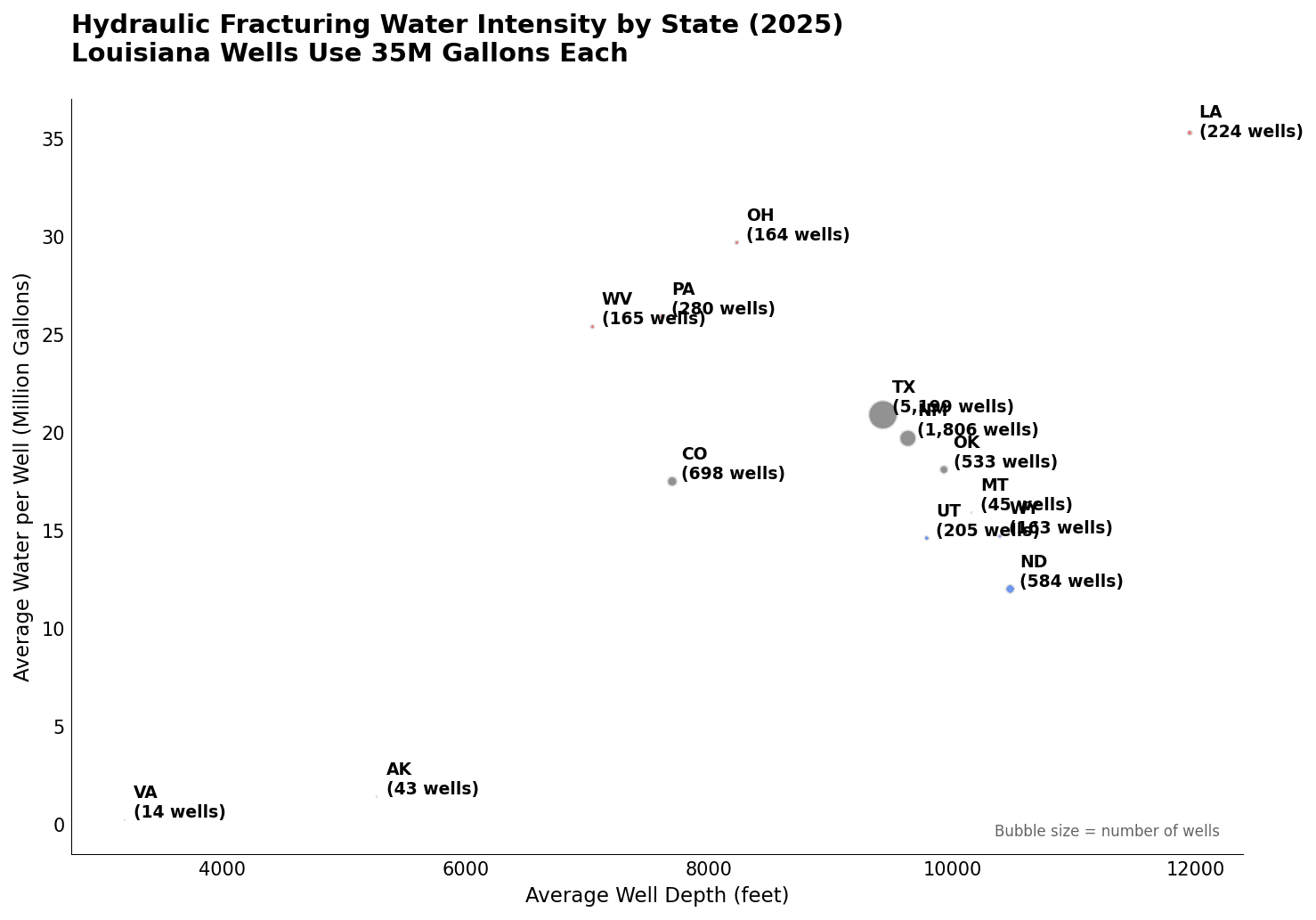
Hydraulic Fracturing Water Intensity by State (2025): Louisiana Wells Use 35M Gallons Each
This is the most critical section. In 2025, the Delaware Basin effectively reached its hydrological limit, fundamentally altering the economics of extraction.
The 4:1 Imbalance
The Delaware Basin is unique in its water intensity. For every barrel of oil produced, the basin yields approximately 4 barrels of produced water.
The constraint: Historically, this water was injected into deep Saltwater Disposal (SWD) wells. However, the sheer volume of injection has linked directly to induced seismicity across West Texas and New Mexico.
The ceiling: In 2025, regulators imposed stricter limits on injection volumes and pressures in key seismic cluster zones. This created a production ceiling. If an operator cannot dispose of the water, they cannot produce the oil.
FracFocus Reveals the Scope
| State | 2025 Frac Jobs | Avg Depth | Avg Water/Well | Produced Water |
|---|---|---|---|---|
| TX | 5,200 | 9,429 ft | 20.9M gal | ~4:1 (High) |
| NM | 1,806 | 9,634 ft | 19.7M gal | ~4:1 (High) |
| LA | 224 | 11,949 ft | 35.3M gal | Negligible |
| PA | 280 | 7,617 ft | 25.9M gal | Moderate |
| ND | 584 | 10,474 ft | 12.0M gal | Low |
Louisiana wells require 35 million gallons of water per well for the initial hydraulic fracture—that's 54 Olympic swimming pools. But here's the critical difference: Haynesville wells produce very little wastewater during the production phase.
The Haynesville Arbitrage
The migration of capital toward the Haynesville Shale is the market's direct response to the Permian water crisis.
Delaware Basin
High ongoing Operating Expense (LOE) burdened by water disposal costs for the life of the well
Haynesville
Water cost is front-loaded (sourcing frac water) but long-term disposal liability is minimal
The Disposal Ceiling is the Production Ceiling
This cannot be overstated: The Permian cannot grow indefinitely because there is literally nowhere to put the water. The cost of moving produced water via pipeline to non-seismic disposal areas has skyrocketed, eroding the basin's cost advantage. No amount of deregulation can solve the physics of induced seismicity. The "4:1 Water Ratio" in the Delaware is the single most important statistic for the future of US shale.
Who's Drilling? The Operator Landscape
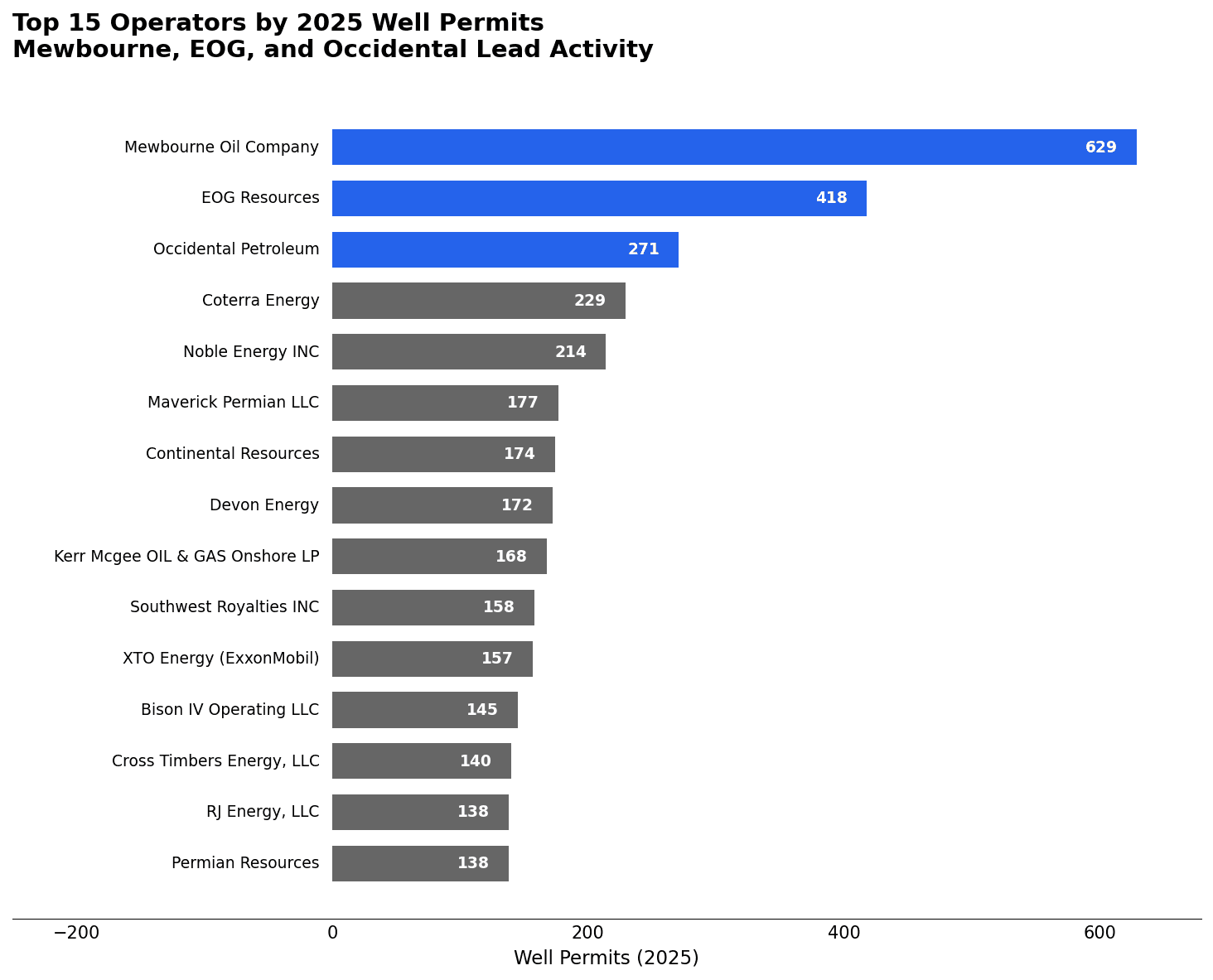
Top 15 Operators by 2025 Well Permits: Mewbourne, EOG, and Occidental Lead Activity
The operator data reveals consolidation and disciplined capital allocation:
- 1. Mewbourne Oil Company — 629 permits
- 2. EOG Resources — 418 permits
- 3. Occidental Petroleum — 271 permits
- 4. Coterra Energy — 229 permits
- 5. Noble Energy — 214 permits
Notice who's not at the top: the supermajors. ExxonMobil (via XTO) filed 157 permits. Chevron doesn't appear in the top 25. The majors have shifted to a "returns over growth" strategy, deploying "Cube Development" where they drill multiple wells into multiple benches (Wolfcamp A, B, C, Bone Spring) simultaneously.
This has implications for supply response: the majors have capital to surge activity if prices spike, but independents running current drilling programs are more constrained by hedging positions and credit facilities.
The Monthly Signal: Something Happened in October
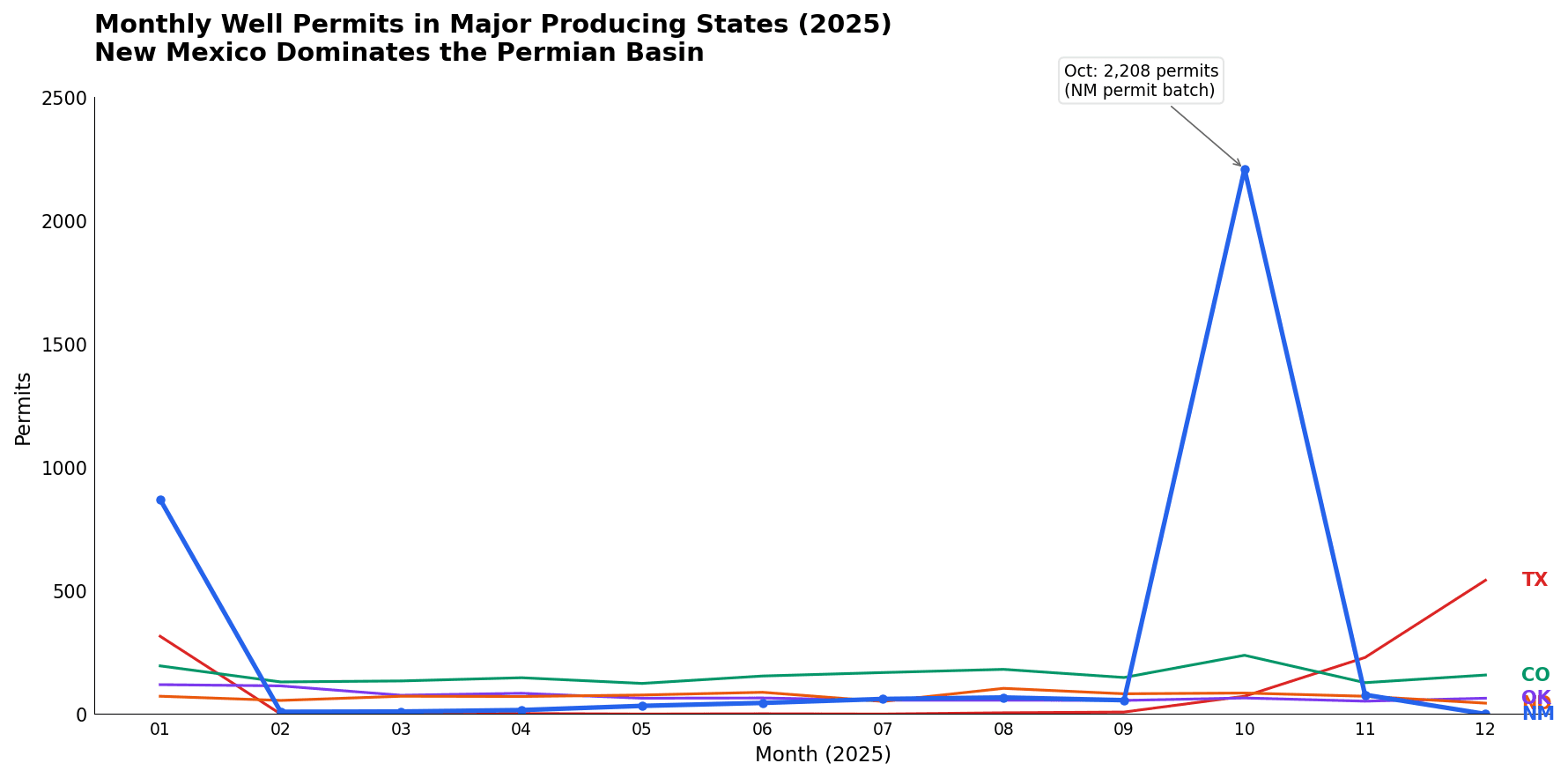
Monthly Well Permits in Major Producing States (2025): New Mexico Dominates the Permian Basin
The monthly permit data reveals the regulatory calendar at work. New Mexico permits spiked dramatically in October 2025—2,208 permits in a single month, more than 10x the monthly average.
This wasn't organic activity. It was batch processing of applications filed before the November 1 OCD rule change. Even setting October aside, New Mexico's baseline activity exceeded Texas's every single month of 2025.
The trend line is clear: the center of gravity in US oil production is moving west—driven by regulatory windows, not just geology.
Paper Barrels vs. Wet Barrels
A critical nuance: the "11,002" figure represents paper barrels—potential future production—rather than immediate activity.
In 2025, the ratio of permits to spuds (wells actually started) degraded significantly. In Kansas, drilling permits dropped 44% year-over-year while actual wells drilled dropped only 35%—the "conversion rate" of permits to wells is falling.
On federal lands in New Mexico, operators are stockpiling permits as defensive inventory—hedges against future political volatility rather than immediate drilling commitments. A significant portion of these permits will sit on the books as DUC (Drilled but Uncompleted) inventory or simply as undrilled options.
Implication
The 11,002 permits don't guarantee a supply wave. They represent a portfolio of options that operators will exercise based on price signals, regulatory certainty, and—critically—water disposal capacity.
How a Developer Actually Accesses This Data
Here's the dirty secret of energy data: every state publishes well permit information, but no two states use the same format.
Texas RRC
Fixed-width files via MFT download. Multi-record formats that must be joined by API number.
Oklahoma OCC
ArcGIS REST API with pagination limits. Wells can target up to 117 different formations.
New Mexico OCD
ArcGIS API, but different field names than Oklahoma. Date formats vary by endpoint.
FracFocus
500MB ZIP file containing 3 separate CSVs that must be joined for complete records.
Option A: Build It Yourself
# Texas RRC (fixed-width file parsing)
import ftplib
ftp = ftplib.FTP('ftpsoftware.rrc.texas.gov')
# ... 200 lines of format parsing ...

# Oklahoma OCC (ArcGIS pagination)
while True:
    response = requests.get(
        "https://gis.occ.ok.gov/arcgis/rest/services/...",
        params={"resultOffset": offset}
    )
    # ... handle pagination, rate limits, format variations ...

# Time to implementation: 4-6 weeks
# Maintenance burden: Ongoing (APIs change, formats update)
Option B: Use Unified API
import requests

# Authenticated well-permit listing. Filter with state_code, days, page, per_page.
response = requests.get(
    "https://api.oilpriceapi.com/v1/drilling-intelligence/well-permits",
    headers={"Authorization": "Token YOUR_API_KEY"},
    params={
        "state_code": "TX",
        "days": 90,
        "per_page": 1,
    }
)

permits = response.json()
What the Data Means for 2026
The permit data is a leading indicator—but it's a portfolio of options, not a production guarantee. The 2025 data tells us:
The analysts looking only at rig counts and EIA forecasts are missing the spatial and hydrological dimensions of US oil production. The permit data reveals where the next million barrels per day will—or won't—come from.
Try the Data
Start with 50 requests/day on the Free plan. Test the published well-permit listing and 27-state coverage.
- 2,091,607+ well permits (27 configured states)
- Normalized operators; freshness varies by state
- Drilling intelligence: rig counts, DUCs
- Full API access for 7 days
- 10,000 requests
- No credit card required
- All endpoints unlocked
Sources & Methodology
- Texas Railroad Commission — rrc.texas.gov
- Oklahoma Corporation Commission — occeweb.com
- New Mexico Oil Conservation Division — ocd.state.nm.us
- Wyoming Oil and Gas Conservation Commission — wogcc.wyo.gov
- FracFocus Chemical Disclosure Registry — fracfocus.org
- EIA Drilling Productivity Report — eia.gov/petroleum/drilling
- Wyoming Senate File 0015 (Pits Rule) — Effective July 1, 2025
- Wyoming Senate File 0020 (Bonding Reform) — Effective July 1, 2025
- New Mexico OCD Hearing Submission Rules — Effective November 1, 2025
- New Mexico OCD Compulsory Pooling Standards — Effective December 1, 2025
Charts follow Edward Tufte's principles for quantitative information display: high data-ink ratio, direct labeling, small multiples for comparison, and annotations for context.
Data current as of January 2026. All permit counts from OilPriceAPI aggregated state agency data.