If you use the wrong fuel surcharge method, your freight bill can be off fast. In this guide, I’d sum it up like this: LTL and parcel usually use a percentage of net linehaul, while truckload usually uses a per-mile formula tied to diesel price, base price, MPG, and miles.
Here’s the short version:
- I’d use percentage-of-linehaul when the carrier publishes a fuel table by diesel price band.
- I’d use per-mile when the contract says fuel is based on benchmark diesel price - base price, divided by MPG, then multiplied by billable miles.
- I’d keep benchmark price, base price, and linehaul in separate fields.
- I’d check for 4 common billing problems: stale base price, wrong MPG, missed weekly index updates, and double-charging fuel.
- I’d make sure FSC applies to net linehaul, not the full invoice, unless the contract says otherwise.
A few numbers stand out. Older contracts often use a base fuel trigger around $1.20 to $1.25 per gallon. Truckload MPG assumptions often fall between 5.5 and 6.5 MPG. And in the sample math, a 28.5% surcharge on a $300.00 net linehaul adds $85.50, while a per-mile example at 500 miles adds $200.00.
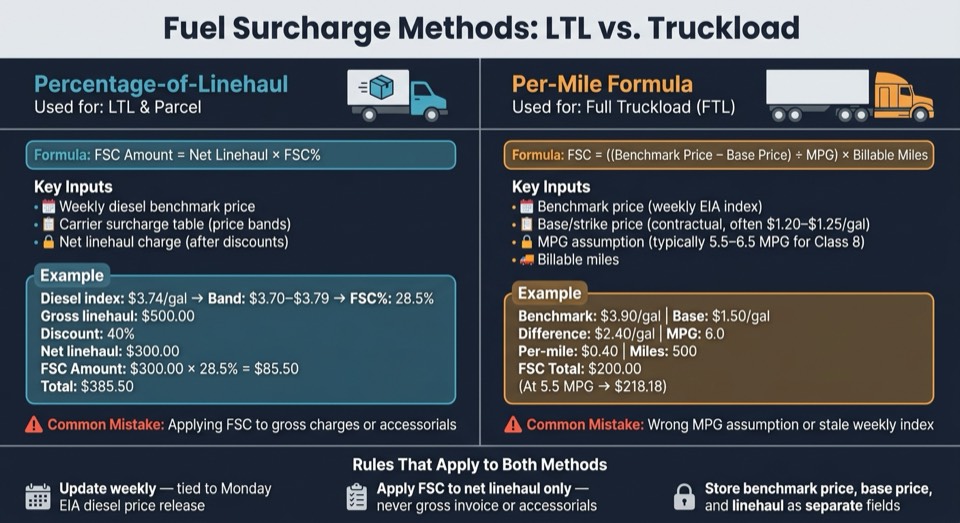
Fuel Surcharge Methods: Percentage-of-Linehaul vs. Per-Mile Formula
How to Calculate Fuel Surcharge (FSC) for Freight Cost in Excel, Cents per Mile Step-by-Step Example
sbb-itb-a92d0a3
Quick Comparison
| Method | Used for | Main formula | Main inputs | Common billing issue |
|---|---|---|---|---|
| Percentage of linehaul | LTL, parcel | Net linehaul × FSC% | Diesel band, carrier table, net linehaul | Applying FSC to gross charges or accessorials |
| Per-mile | Truckload | ((Benchmark - Base) ÷ MPG) × Miles | Benchmark price, base price, MPG, billable miles | Wrong MPG or wrong mileage source |
If I were setting this up in a TMS, spreadsheet, or rating tool, I’d focus on one thing first: make the weekly diesel price data current and tie it to the right contract rule. That’s where many invoice errors start.
Fuel Surcharge Basics for U.S. Trucking, LTL, and Parcel
Before you run any FSC calculation, it helps to slow down and sort out three terms that often get lumped together. They sound similar, but each one does a different job in the math.
Benchmark Price, Base Price, and Linehaul Are Three Different Inputs
The benchmark price is the weekly diesel index that drives the surcharge. In the U.S., that usually means the weekly U.S. Energy Information Administration (EIA) national average retail diesel price, published each Monday.
The base price, sometimes called the strike price, is the fixed contract threshold. It represents the fuel cost already built into the linehaul rate. So the surcharge only starts once the benchmark price moves above that number. Many older shipper contracts use a trigger around $1.20 to $1.25 per gallon.
The linehaul charge is the freight rate before accessorials. If the fuel surcharge uses the percentage method, the charge applies to the net linehaul amount, not the full invoice total.
That separation isn't just bookkeeping. Store the benchmark price, base price, and linehaul as separate fields so the rating engine can use the right weekly index and keep accessorials out of the FSC. This matters because rating tools and APIs need the right weekly price, the right contract threshold, and the right invoice basis before they can calculate the surcharge correctly.
| Input Field | Type | Role in the Calculation |
|---|---|---|
| Benchmark Price | Variable (weekly) | Current diesel price used to drive the surcharge |
| Base Price (Strike Price) | Fixed (contractual) | The floor; FSC starts above this level |
| Linehaul Charge | Variable (per shipment) | Basis for percentage-method FSC; excludes accessorials |
| MPG Factor | Fixed (contractual) | Assumed fuel efficiency used in per-mile formulas |
| FSC Amount | Calculated output | Stored separately for transparency and dispute resolution |
Where Each Method Is Typically Used
LTL and parcel usually rely on a percentage-of-linehaul method because the surcharge moves with the billed freight charge. Truckload usually uses a per-mile method because the load itself is priced by distance.
Here’s the simple split:
- LTL and parcel: carriers publish a surcharge table that links diesel price bands to a percentage of the net linehaul charge. When the benchmark price moves into a new band, the percentage changes too.
- Truckload: contracts often use a per-mile formula tied to distance and MPG. The formula pulls from the benchmark price, base price, agreed MPG assumption, and the billable miles for the shipment.
Most fuel surcharge programs reset each week, usually on Monday or Tuesday, using the prior Monday’s EIA price. That means there’s always a built-in lag. So if your rating system updates late - or pulls the wrong week’s index - you can end up with the wrong FSC even if the formula itself is right.
With those inputs nailed down, the next step is the percentage-of-linehaul fuel surcharge calculation.
How to Calculate the Percentage-of-Linehaul Fuel Surcharge
For LTL and parcel, the carrier publishes a table. Your job is simple: find the week's diesel band, grab the listed percentage, and apply it to net linehaul. Put another way, use the carrier's surcharge table to match the weekly diesel index to a percentage, then apply that percentage to net linehaul.
Formula and Steps for Applying a Surcharge Table
FSC Amount = Net Linehaul Charge × FSC%
The FSC% comes from the carrier's published table. Here's the process:
- Match the week's diesel index to the carrier's price band, then apply the listed FSC percentage.
- Use net linehaul after discounts; do not apply FSC to the gross linehaul.
- Exclude accessorials unless the contract includes them.
Illustration: Percentage Applied to a Linehaul Charge
Illustration only - these numbers are examples, not current market data.
Suppose the diesel index is $3.74/gallon. In a sample surcharge table, the $3.70–$3.79 band carries a 28.5% FSC. Your gross linehaul is $500.00, and your negotiated discount is 40%, which leaves a net linehaul of $300.00.
FSC Amount = $300.00 × 28.5% = $85.50
That puts the total freight charge for this shipment at $385.50 before any accessorials. If diesel hits $3.80, the shipment moves into the next band, and a higher FSC kicks in.
System Notes for Analysts and Developers
Store each band as a min/max price range with a percentage and an effective date. Use the contract's governing date, usually the pickup date, to select the weekly index.
Apply the FSC only to line-item codes marked as linehaul. Accessorials should use separate flags so the rating engine skips them on its own.
For implementation examples, see the Excel guide, Google Sheets walkthrough, Python tutorial, Node.js tutorial, and API documentation.
Specify whether the carrier rounds or truncates at band boundaries. That small rule can change invoice totals.
Truckload often uses a different per-mile method, which depends on miles and MPG.
How to Calculate the Per-Mile Fuel Surcharge
Unlike the percentage-of-linehaul method, truckload FSC usually relies on a direct per-mile formula tied to fuel price and trip distance.
Formula Inputs: Benchmark Price, Base Price, MPG, and Billable Miles
FSC = ((Benchmark Price − Base Price) ÷ MPG) × Billable Miles
The math happens in three simple steps:
- Fuel price difference - Subtract the base price from the current benchmark price. Most contracts use the weekly U.S. On-Highway Diesel Fuel Prices report as the benchmark.
- Surcharge per mile - Divide that fuel price difference by the agreed MPG assumption.
- Total surcharge - Multiply the per-mile result by the total billable miles for the load.
MPG is a contract term, and a lower MPG means a higher surcharge. That’s why it helps to lock the MPG assumption into the contract from the start. Industry-standard assumptions usually fall between 5.5 and 6.5 MPG for a loaded Class 8 truck.
Billable miles should also be defined upfront. In most cases, that means dispatched, practical, or billable miles based on one named mileage guide or routing system.
It also helps to spell out the governing release date and whether the final number is rounded or truncated.
Once those inputs are set, the calculation becomes pretty straightforward.
Illustration: Per-Mile Surcharge for a Truckload Move
Illustration only - these numbers are examples, not current market data.
Suppose your contract uses a base price of $1.50/gallon and an MPG assumption of 6.0. The week’s benchmark price comes in at $3.90/gallon, and the haul covers 500 billable miles.
- Fuel price difference: $3.90 − $1.50 = $2.40/gallon
- Surcharge per mile: $2.40 ÷ 6.0 = $0.40/mile
- Total surcharge: $0.40 × 500 = $200.00
Now change just one input: MPG. Using the same $2.40/gallon price difference with a 5.5 MPG assumption gives:
$2.40 ÷ 5.5 = $0.436/mile, or $218.18 total.
That small shift shows why MPG matters so much. A lower MPG assumption pushes the FSC higher, even when fuel price and miles stay the same.
Comparison Table: Percentage-of-Linehaul vs. Per-Mile
The table below shows how per-mile FSC differs from percentage-of-linehaul pricing.
| Feature | Percentage-of-Linehaul | Per-Mile |
|---|---|---|
| Formula type | Percentage applied to base rate | Dollar amount per mile traveled |
| Primary freight mode | LTL, parcel | Full truckload (FTL) |
| Required inputs | Benchmark price, surcharge table, linehaul charge | Benchmark price, base price, MPG, billable miles |
| Update cadence | Weekly or monthly | Weekly, usually tied to the EIA Monday release |
| Auditability | Moderate - requires carrier-specific tables | High - uses public indices and simple arithmetic |
| Common failure points | Applied to accessorials; revenue-based scaling ignores actual fuel burn | Wrong MPG assumption; mileage source mismatch |
Common Fuel Surcharge Mistakes and How to Prevent Them
Once the formula is set, most FSC problems come down to bad inputs or charges applied the wrong way. The pattern is pretty simple: percentage-based programs usually go wrong because of the charge base, while per-mile programs usually break because of MPG inputs or old fuel data.
Stale Base Price, Wrong MPG, and Missed Weekly Updates
A stale base price can throw off the whole surcharge. This usually happens when a system keeps using an old contract threshold instead of the one in the current agreement. A simple fix is to store contractual baselines in a dedicated master file, separate from the rating engine.
Wrong MPG inputs create the same kind of mess for per-mile programs. If the MPG number is off, the fuel recovery will be off too. Check the MPG input against the exact contract terms or equipment profile, not a fleet-wide average.
Weekly manual updates are another weak spot. If no one updates the diesel index on time, pricing goes stale fast. Automating the refresh from the weekly diesel index and storing that result in the contract record cuts out that failure point.
Applying Fuel Charges Twice or to the Wrong Invoice Components
Most FSC disputes come from two mistakes: double-charging and using the wrong base.
Double-charging happens when a fuel surcharge line item gets added to a spot rate that was already quoted as all-in. Before adding any FSC, check whether the rate confirmation says "plus fuel" or "including fuel." If the rate is all-in, turn off FSC for that load.
The other issue is applying FSC to the wrong invoice amount. A common mistake is using the gross invoice total instead of net linehaul. That can push the surcharge too high. Your TMS should limit the charge base to fuelable line items only.
At scale, these errors pile up. A correct formula matters, but so does a correct charge base.
Diagnostic Table and API-Based Update Workflow
Use the table below to match each mistake with its impact and fix.
| Mistake | Business Impact | Likely Root Cause | Prevention Step |
|---|---|---|---|
| Stale base price | Overpayment or under-recovery of costs | Manual entry errors; missed contract renewal updates | Store contractual baselines in a centralized master file |
| Wrong MPG assumption | Distorted per-mile surcharge recovery | Using fleet averages instead of contract-specific terms | Validate MPG inputs against specific contract IDs |
| Missed weekly update | Using outdated index prices | Manual update process | Automate index refreshes via API on Monday/Tuesday |
| Double-charging | Paying fuel twice on a single shipment | Applying FSC to "all-in" or "bundled" spot rates | Flag "all-in" rate types to bypass FSC calculation |
| Wrong charge base | Inflated surcharge amounts | Applying % to gross total instead of net linehaul | Configure TMS to exclude non-fuelable accessorials |
Automating the weekly price refresh removes the most common stale-data problem. Pull the latest price with the request below, then map it to your FSC table or contract logic:
GET https://api.oilpriceapi.com/v1/prices/latest
Authorization: Token YOUR_API_KEY
That API pull can keep rating engines, dashboards, and invoice checks tied to the same weekly index. Full endpoint details are in the API documentation. Code integrations and spreadsheet setups are covered in the linked tutorials for Python, Node.js, Excel, and Google Sheets.
Use a variance flag to route billed FSC differences for review.
Conclusion: Pick the Right Method and Keep Your Inputs Current
Use percentage-of-linehaul for LTL and parcel, and per-mile for truckload. The right method depends on how the shipment is billed. For LTL, shared-trailer mileage allocation is hard to apply in practice. For truckload, per-mile links fuel recovery more directly to distance traveled and fuel burn.
That choice matters. But in day-to-day billing, old inputs often cause the bigger problems. A stale base price, the wrong MPG assumption, or a missed weekly index update can quietly throw off every fuel surcharge you calculate.
The fix is pretty simple: keep your base price, MPG, and refresh timing lined up with the contract, then automate the weekly update. That’s the cleanest way to keep the input current and avoid small errors that spread across a lot of invoices.
If you need live fuel prices inside a TMS, dashboard, or audit tool, OilPriceAPI’s REST API can keep weekly diesel inputs current in your rating, audit, or dashboard workflow. Setup guides are available for Python, Node.js, Excel, and Google Sheets. You can also find full endpoint details in the API documentation. Get a free API key at oilpriceapi.com.
FAQs
How do I know which fuel surcharge method my contract uses?
Check your rate confirmation or shipping contract. It should spell out the fuel surcharge method, the base fuel price, and the index date used in the math.
Common methods include per-mile, percentage-of-linehaul, and a sliding scale schedule. If the contract feels vague, compare your carrier invoice against those details to see which method is being applied.
What counts as net linehaul for fuel surcharge calculations?
Net linehaul is the base freight rate for moving goods before fuel surcharges and other accessorial fees, like liftgate service or residential delivery.
If the fuel surcharge is percentage-based, apply it only to the base linehaul amount. And in most cases, carrier-negotiated discounts apply to the linehaul rate, not to the fuel surcharge.
Which shipment date should determine the weekly diesel index?
Define the shipment date in your contract to avoid disputes. Diesel prices can shift within a single week, so even a small timing gap can lead to arguments.
If you use the weekly EIA index released on Mondays, spell out exactly which date controls the price. For example, say whether the index is tied to the shipment’s pickup date, delivery date, invoice date, or a fixed day of the week.