In 2025, accessing precise, real-time commodity data is critical for traders, analysts, and developers. APIs offering customizable market data have become essential tools, enabling users to track live prices, analyze trends, and make informed decisions. Here's what you need to know:
-
Key Features to Look For:
- Real-time and historical data access for commodities like crude oil, natural gas, gold, and more.
- Customization options to filter data by commodity, currency (e.g., USD), and timeframes.
- Easy integration via RESTful APIs with JSON or CSV formats.
- High reliability with uptime guarantees (e.g., 99.9%) and fast response times (<50ms).
- Top API Example: OilpriceAPI stands out with features like U.S.-specific drilling data (e.g., rig counts, frac spreads), 96-month futures data, and cost-effective pricing starting at $15/month.
-
Pricing and Plans:
- Affordable options compared to platforms like Bloomberg Terminal, which costs $25,000 annually.
- Plans tailored for different needs, from basic real-time data to advanced analytics and enterprise support.
For U.S.-based users, APIs that align with local standards (e.g., USD pricing, MM/DD/YYYY formats) and offer seamless integration are ideal. Choosing the right API can provide the data precision and speed needed to stay competitive in a fast-paced market.
An In-Depth Look at Commodity APIs from cmdty by Barchart

What to Look for in Commodity Data APIs
Choosing the right commodity data API is a decision that requires careful thought. A poor choice can lead to integration challenges, unreliable data, and missed opportunities in trading. Here’s what professionals in the US should focus on when evaluating their options.
Data Coverage and Variety
A solid commodity API should provide data on key markets that influence the US economy. For instance, WTI Crude Oil, Natural Gas, RBOB Gasoline, and Heating Oil are essential for energy trading, while Gold remains a trusted asset for hedging against inflation and market instability.
OilpriceAPI stands out by offering real-time data for these critical commodities. Additionally, it provides exclusive US-focused insights, such as a weekly updated US Rig Count (540 active rigs) and data on 295 active frac crews operating in the Permian Basin. This type of detailed, region-specific data gives users an edge over general commodity feeds.
Some APIs also support 170+ global currencies (including USD and cryptocurrencies), making them versatile for both domestic and international markets. This flexibility is particularly helpful when analyzing global supply chains or managing currency risks along with commodity positions. These features enable comprehensive real-time and historical analyses.
Real-Time and Historical Data Access
Real-time data is essential for staying on top of market changes and making quick decisions, especially in trading and risk management. Historical data, on the other hand, helps with identifying trends, backtesting strategies, and understanding long-term market cycles.
The speed and precision of updates are critical. Some APIs offer data updates as frequently as every 60 seconds with an accuracy of 2 decimal points. For traders, having market data refreshed every 5 minutes, coupled with sub-second API response times, can mean the difference between profit and loss.
OilpriceAPI delivers both real-time and historical data, empowering users to perform accurate trend analysis and backtesting. Timely and precise data ensures professionals can apply specific filters to extract deeper insights.
Customization and Filtering Options
Precision is key when analyzing commodities. APIs should allow users to filter data by commodity codes and currencies, such as WTI_USD for West Texas Intermediate Crude priced in US Dollars. This enables highly focused analyses.
Advanced filtering options are particularly useful for futures trading. For example, accessing data for specific contract months allows for detailed term structure analysis, real-time calendar spreads, and evaluations of contango or backwardation scenarios. These features provide actionable insights for informed decisions.
Currency flexibility is another critical feature for US markets. APIs that automatically convert prices to USD using current exchange rates streamline workflows by eliminating the need for separate currency conversion steps.
Easy Integration
APIs designed with RESTful architecture and JSON data formats integrate seamlessly into existing systems. Clear documentation, sample code, and client libraries for popular programming languages (like Python, JavaScript, and Java) make the setup process faster and easier.
OilpriceAPI simplifies integration with well-structured documentation and client libraries, following their philosophy of "Simple API. Live data. 5-minute integration". This makes it an efficient choice for US-based teams.
Reliability and Data Accuracy
Reliability is non-negotiable when working with commodity data. Commodities-API, for example, boasts a 99.99% uptime over the past year, demonstrating its dependability. Look for APIs with similar uptime guarantees and response times under 50ms.
Security is equally important, especially when dealing with sensitive trading data. Leading APIs use bank-grade encryption (e.g., 256-bit SSL) and adhere to US data standards. These measures ensure data integrity and compliance.
Fast response times are crucial for trading efficiency. APIs with average response times of 50ms or less ensure that price updates are delivered without delay, helping traders make timely decisions. OilpriceAPI’s strong uptime, fast response, and robust security make it a reliable tool for US-based analysts and traders.
Top-tier APIs also localize their data for US users by incorporating USD currency symbols ($), MM/DD/YYYY date formats, comma-separated thousands, and support for both metric and imperial units. They also align with US spelling conventions and financial system standards, ensuring smooth integration and usability.
OilpriceAPI: Complete Commodity Data Solution
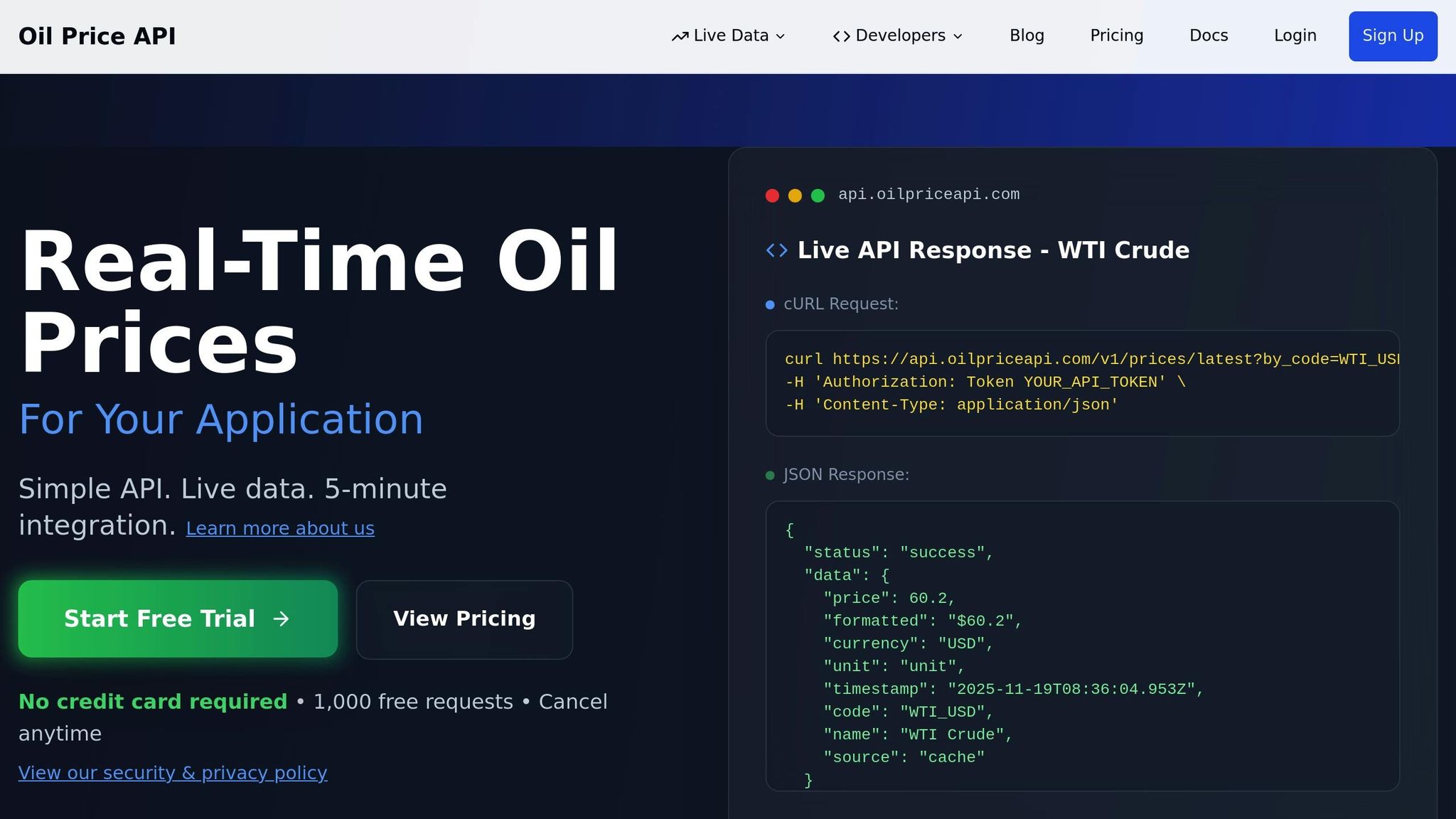
OilpriceAPI has emerged as a go-to platform for commodity data in 2025, offering a cost-effective alternative to the Bloomberg Terminal. With annual pricing between $1,500 and $3,000, it provides institutional-grade data at a fraction of Bloomberg's $25,000 yearly fee.
Data Coverage and Features
OilpriceAPI delivers comprehensive data on key commodities that drive the U.S. market. Users can access both real-time and historical information on Brent Crude Oil, WTI Crude Oil, Natural Gas, Gold, RBOB Gasoline, and Heating Oil. Each data point includes live prices, currency formatting (USD), units (e.g., per barrel or per MMBtu), timestamps, commodity codes, and names.
For traders, the ICE Brent Futures API stands out, covering 96 contract months and enabling advanced analysis of calendar spreads, contango, and backwardation. This depth supports sophisticated trading strategies.
The Reservoir Mastery tier provides exclusive drilling data, such as a weekly U.S. Rig Count (540 active rigs) and Permian basin frac spreads (295 active crews). This specialized intelligence offers energy companies actionable insights while cutting costs by up to 98% compared to traditional sources.
OilpriceAPI ensures reliability with a 99.9% uptime SLA, redundant infrastructure, and global CDN support, making it a dependable choice for critical operations.
Customization and Filtering Features
OilpriceAPI shines with its flexible data filtering options. Users can pinpoint specific commodity data using targeted codes like WTI_USD for West Texas Intermediate Crude priced in U.S. dollars. For instance, a cURL request with the code WTI_USD returns JSON-formatted data, including the price ($60.09), currency (USD), and timestamp (2025-11-18T17:48:08.162Z).
The platform's subscription tiers cater to different needs. Professional traders benefit from futures data spanning 96 contract months for detailed curve analysis, while energy sector users can access drilling intelligence like rig counts and frac activity in regions such as the Permian. Historical data is also available through the Production Boost plan, enabling users to analyze trends and backtest strategies. These customization options allow for precise and efficient data analysis.
Integration and Developer Support
OilpriceAPI’s developer-friendly design ensures seamless integration. With RESTful architecture, JSON formatting, and a 50ms response time, it’s quick and easy to get started. Authentication is straightforward, requiring only an API token in the Authorization header.
Support scales with subscription tiers. The Exploration plan includes basic email assistance, while the Production Boost plan adds priority email support. The Reservoir Mastery plan steps it up with 24/7 priority support and a dedicated account manager for enterprise customers. Additional resources, from FAQs to integration tips, have helped over 83 companies trust OilpriceAPI for their data needs.
Subscription Plans and Pricing
OilpriceAPI offers three subscription tiers to suit varied requirements:
- Exploration Plan: $15/month, includes real-time oil prices, basic email support, and 99.9% uptime. Annual subscriptions get a 25% discount.
- Production Boost Plan: $45/month, includes 50,000 API requests per month, priority email support, and access to historical data.
- Reservoir Mastery Plan: $129/month, includes 250,000 API requests per month, 24/7 priority support with a dedicated account manager, and exclusive drilling intelligence data.
A free trial is available, offering 1,000 requests without requiring a credit card. This allows users to test the platform’s integration and data quality before committing to a plan.
sbb-itb-a92d0a3
Feature and Customization Comparison
Comparison Table
Here's a breakdown of the features and capabilities of each API:
| Feature | OilpriceAPI | Commodities-API | FMP | Polygon.io |
|---|---|---|---|---|
| Data Coverage | Brent Crude, WTI, Natural Gas, Gold | Energy, metals, agriculture, FX (170+ currencies) | Metals, energy, agriculture | U.S. stocks, commodities |
| Filtering and Customization Options | Commodity code filtering (e.g., WTI_USD), 96 contract months for futures, drilling intelligence (e.g., U.S. Rig Count, Permian Frac Spreads) | Time-series filtering, currency conversion | 1-min, 5-min, 1-hour intraday charts, batch processing | Real-time, historical, tick-level data |
| API Performance | 50ms response time, 99.9% uptime | 99.99% uptime over 12 months | Up to 3,000 calls per minute (premium plans) | Varies by subscription tier |
| Integration Support | REST JSON, SDKs, detailed documentation | REST JSON, SSL encryption | REST JSON, chart integration | REST, WebSocket, comprehensive documentation |
| Pricing (USD) | $15–$129/month | $49.99/month or $99.99/year | Free tier (250 calls/day), paid tiers available | $0–$1,999/month |
| Historical Data | Real-time and historical data available on paid plans | Time-series data included | Up to 30 years of historical data | Extensive historical coverage |
Each API has its own strengths. For example, OilpriceAPI offers deep insights into the energy sector, including detailed data on ICE Brent Futures (96 contract months) and drilling intelligence like weekly U.S. Rig Count (540 active rigs) and Permian Basin frac spreads (295 active crews). Commodities-API, on the other hand, casts a wide net, offering midpoint rates (average of bid and ask prices) and currency conversion across 170+ global currencies, including cryptocurrencies.
FMP's Commodity APIs are tailored for high-frequency trading, offering intraday charts at 1-minute, 5-minute, and 1-hour intervals, along with batch processing for both real-time and historical data analysis. Premium users can make up to 3,000 API calls per minute and access historical data spanning 30 years. Meanwhile, Polygon.io specializes in U.S. market data, providing real-time streaming through WebSocket and extensive historical data for analysis.
US Market Requirements
When it comes to serving U.S.-based applications, specific formatting and compliance needs set the bar higher, and not all APIs meet these standards equally.
For instance, OilpriceAPI simplifies operations by providing data in standard U.S. energy units - barrels for oil, MMBtu for natural gas, and troy ounces for gold. This eliminates the hassle of conversions, making it a great fit for domestic applications. Additionally, its timestamps, like "2025-11-18T17:48:08.162Z", align with U.S. date and time formats, ensuring precise tracking for compliance and auditing.
Regulatory compliance is another key factor. U.S. financial applications often require clear data sourcing and transparent audit trails. OilpriceAPI addresses this need by offering commodity codes such as "WTI_USD" and "BRENT_CRUDE_USD", which provide reliable tracking for compliance reporting.
Finally, the U.S. tech ecosystem leans heavily on REST APIs with JSON formatting for seamless integration. OilpriceAPI caters to this demand with its "5-minute integration" approach, supported by detailed documentation and practical code examples, enabling developers to get up and running quickly.
Conclusion
When it comes to selecting a commodity data API in 2025, the key lies in precision, seamless integration, and dependable performance (think 99.9% uptime). The ability to pull specific data - like the commodity code "WTI_USD" or 96 contract months for futures analysis - can significantly enhance the speed and accuracy of decision-making.
APIs that support REST JSON, paired with clear documentation and SDKs, make deployment and maintenance much easier. It's also critical that these APIs provide transparent data sourcing and adhere to U.S.-specific standards. This includes using familiar energy units, such as barrels for oil or MMBtu for natural gas, and ensuring timestamps are formatted correctly. These details can prevent costly conversion errors and keep everything compliant.
Take OilpriceAPI, for example. It checks all these boxes by focusing exclusively on energy market data. Features like drilling intelligence for U.S. Rig Count and Permian Basin frac spreads make it a standout option. With plans starting at $15 per month and enterprise solutions offering 99.9% uptime, it delivers professional-grade capabilities without unnecessary complications. This streamlined focus highlights how specialized tools can meet market demands effectively.
FAQs
What should you look for in a commodity data API in 2025?
When picking a commodity data API in 2025, prioritize customization and filtering options. These tools let you adjust the data to match your exact requirements, whether it's monitoring specific commodities or studying price trends over a period.
It's also important to look for an API that delivers real-time updates alongside historical data, giving you a complete picture for analysis. A straightforward interface and dependable performance are equally critical to ensure smooth integration with your existing processes.
Why is access to real-time and historical commodity data important for traders and analysts?
Accessing both real-time and historical commodity data is essential for traders and analysts. Real-time data keeps decisions aligned with the latest market conditions, while historical data reveals patterns and trends that support accurate forecasting.
Together, these insights help users make informed choices, fine-tune their strategies, and adapt quickly to market shifts - whether they're monitoring crude oil, natural gas, gold, or other commodities.
What key customization and filtering features make commodity data analysis more effective?
When it comes to analyzing commodity data effectively, having the ability to customize and filter information is key. These features let users adapt the data to match their specific requirements. For example, being able to access both real-time and historical pricing for commodities like Brent Crude or WTI empowers users to identify trends and make well-informed decisions.
OilpriceAPI makes this process straightforward by delivering data in an easy-to-read JSON format. It also includes filtering options like commodity type, currency (USD), and other parameters, ensuring users receive precise and relevant insights tailored to their needs.