Real-time commodity data APIs give businesses instant access to pricing for oil, gold, natural gas, and more. These tools are critical for making faster, data-driven decisions. APIs like OilpriceAPI offer frequent updates, high accuracy, and easy integration with U.S. systems, helping companies automate procurement, manage risks, and build custom dashboards. Here's a quick breakdown:
- Key Features: Real-time updates (as fast as every minute), historical data, JSON/CSV format, and RESTful endpoints.
- Top Benefits: Automate processes, track price trends, and improve decision-making.
- OilpriceAPI Highlights: Tracks Brent Crude, WTI Crude, gold, and more, with 99.9% uptime and updates every 5 minutes. Pricing starts at $15/month with a free trial available.
For U.S. businesses, these APIs ensure compatibility with local standards like dollar formatting and MM/DD/YYYY dates. Whether you're in energy, agriculture, or finance, commodity APIs simplify workflows and provide reliable market insights.
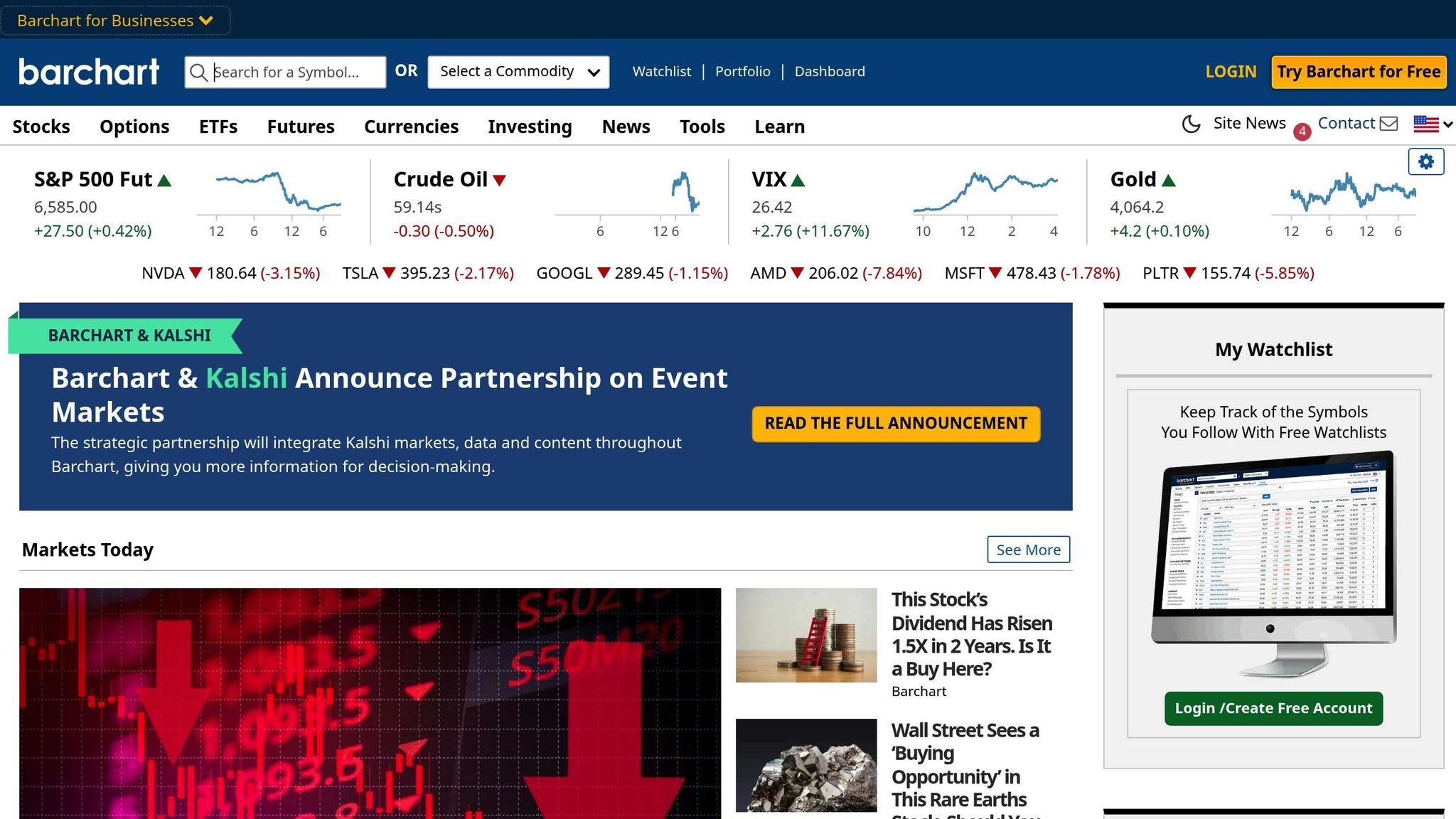
An In-Depth Look at Commodity APIs from cmdty by Barchart
OilpriceAPI: Complete Solution Overview
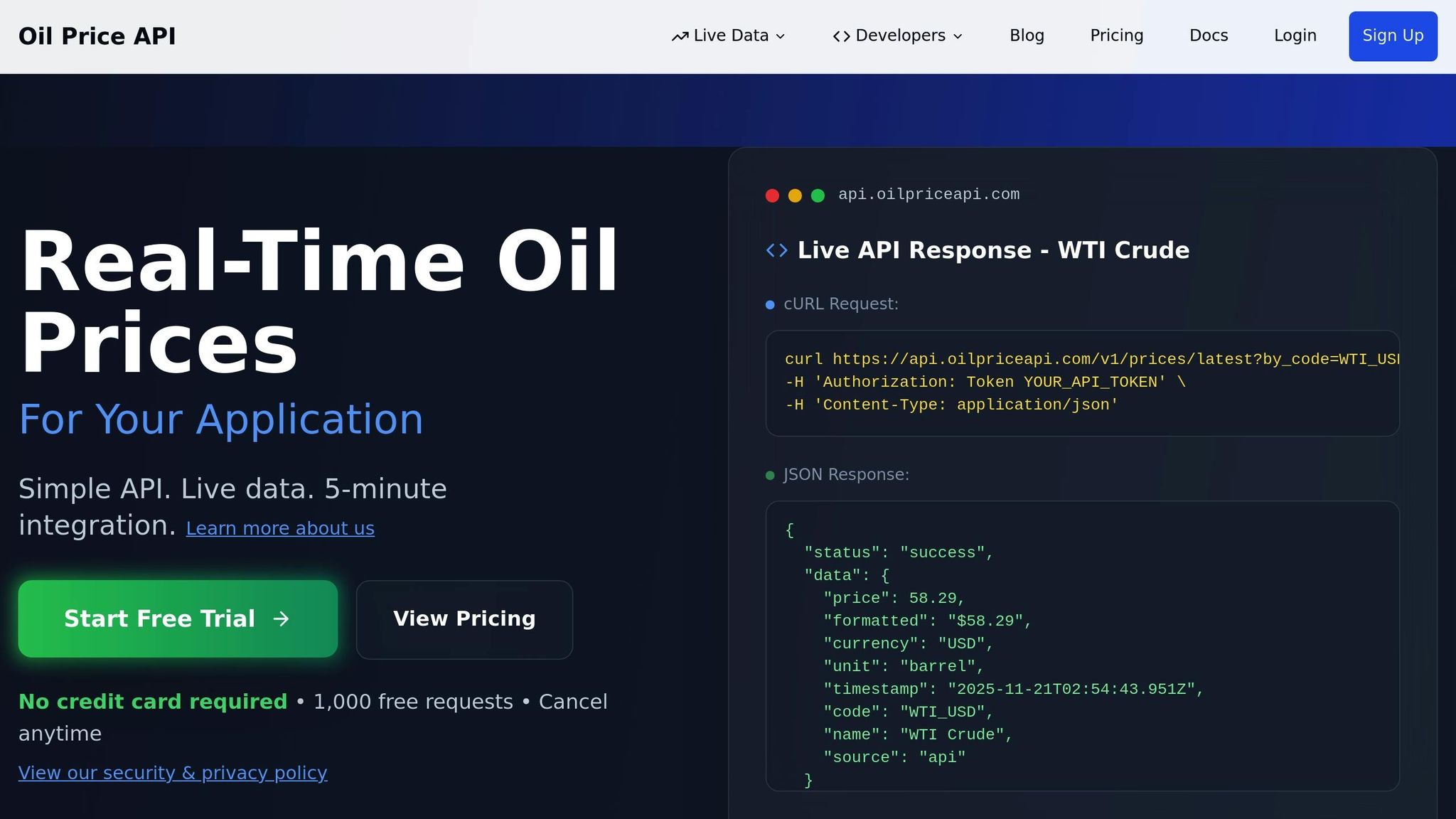
OilpriceAPI is designed to meet the needs of U.S. businesses by providing real-time commodity price data through a user-friendly JSON REST API. With seamless integration capabilities, it’s a practical choice for companies looking to enhance their systems with reliable market data.
OilpriceAPI Features
OilpriceAPI tracks six key commodities: Brent Crude, WTI Crude, Natural Gas, Gold, RBOB Gasoline, and Heating Oil. These data points are particularly valuable for businesses in the energy sector, offering critical insights into market trends.
Updates occur every 5 minutes, with an average response time of just 50 milliseconds, ensuring trading systems and automated tools receive the most current pricing without delay.
The platform boasts a 99.9% uptime, backed by robust infrastructure and a global content delivery network. This reliability ensures uninterrupted data flow, which is vital for businesses that depend on continuous updates.
OilpriceAPI’s RESTful architecture, comprehensive documentation, and software development kits (SDKs) make integration quick and straightforward, minimizing setup time.
For advanced users, the platform provides an ICE Brent Futures API, which includes 96 consecutive contract months, real-time calendar spreads, and in-depth contango/backwardation analysis. These features support complex trading strategies that require detailed market insights.
OilpriceAPI Use Cases
The platform’s technical capabilities translate into real-world applications that deliver measurable benefits:
- Trading Systems: Real-time data feeds empower algorithmic trading platforms to make accurate, automated decisions and execute trades based on the most recent commodity prices.
- Risk Management: Teams can monitor price fluctuations and adjust strategies in real time to mitigate risks. Historical data also supports backtesting and stress testing for more robust risk evaluations.
- Financial Reporting: By automating the inclusion of live commodity prices into reports and dashboards, businesses can reduce manual errors and ensure their financial documents reflect current market conditions.
- Custom Dashboards: Analysts and executives can create dashboards that visualize price trends, historical comparisons, and market signals, aiding in strategic decision-making.
These use cases highlight how OilpriceAPI can streamline operations and provide actionable insights for businesses.
Benefits for U.S. Users
OilpriceAPI is tailored to the U.S. market, offering features that align with domestic industry standards and needs.
For example, the Reservoir Mastery plan includes exclusive U.S. drilling intelligence, such as U.S. Rig Counts and Permian Frac Spreads, which are invaluable for energy companies monitoring domestic production.
The platform is also cost-effective, making high-quality commodity data accessible to smaller businesses and independent analysts.
| Plan | Cost | API Requests | Key Features |
|---|---|---|---|
| Exploration | $15 | Basic | Real-time data, 99.9% uptime, email support |
| Production Boost | $45 | 50,000 | Historical data, priority support |
| Reservoir Mastery | $129 | 250,000 | Drilling intelligence, 24/7 support, account manager |
A free trial with 1,000 requests (no credit card required) allows businesses to test the service before committing. Integration with popular analytics tools and trading platforms ensures smooth adoption, with the JSON format and RESTful design fitting seamlessly into modern workflows.
Features to Look for in Commodity Data APIs
When choosing a commodity data API, it's crucial to focus on features that ensure performance, reliability, and seamless integration. Below, we explore key aspects to consider, including technical precision, developer-friendly tools, and compliance with U.S. standards.
Data Accuracy and Update Frequency
In fast-moving markets, precision is everything. Look for APIs that provide data accurate to two decimal points for essential commodities like oil, gold, and natural gas.
Equally important is the update frequency. APIs should refresh data at least every 60 seconds, with some offering WebSocket streaming for ultra-low latency - down to 170ms. High-performance APIs also deliver sub-second response times, such as top-of-book messages within 500ms. To ensure reliability, prioritize APIs with:
- Uptime close to 99.99%
- Regular audits and cross-source data verification
- Bank-grade encryption for secure data handling
Integration and Developer Features
For smooth integration, RESTful APIs are often the best choice, especially for systems commonly used in the U.S. Comprehensive, developer-friendly documentation is invaluable. Features like quick start guides, detailed endpoint descriptions, and code samples can significantly speed up implementation and reduce complexity for development teams.
APIs that support multiple programming languages, such as Python, JavaScript, and C++, are particularly versatile. Additional features to look for include batch request capabilities, support for various data formats (like JSON and CSV), and built-in technical indicators for advanced visualization.
| Feature | Importance | What to Look For |
|---|---|---|
| Documentation | Critical | Quick start guides, endpoint details, and authentication steps |
| Response Format | High | Compatibility with JSON, CSV, and other formats |
| Programming Support | High | SDKs for Python, JavaScript, C++, and sample code |
| Authentication | Medium | Simple token-based or API key authentication |
U.S. Standards Support
To cater to U.S. markets, APIs should adhere to specific standards, including dollar formatting (e.g., $1,234.56), MM/DD/YYYY date formats, and imperial measurement units where applicable. Compliance with financial and privacy regulations in the U.S. is equally essential, as is access to U.S.-specific data points for deeper market insights.
APIs that meet these benchmarks, such as OilpriceAPI, enable U.S. businesses to create secure, compliant, and reliable commodity data solutions tailored to their needs.
sbb-itb-a92d0a3
Building Analytics with Real-Time API Data
Real-time commodity data APIs transform raw market data into actionable insights. By connecting these APIs to visualization tools and cloud platforms, businesses in the U.S. can create advanced analytics systems. These systems help track price changes, uncover trends, and support critical decisions. This seamless integration makes it possible to build dynamic, real-time dashboards that deliver valuable market intelligence.
Creating Commodity Price Dashboards
To build effective commodity price dashboards, you need to combine frequent data updates with easy-to-use visualization tools. Modern APIs typically deliver data in JSON format with fast refresh rates, ensuring dashboards stay up-to-date in real time.
The success of a dashboard often depends on the granularity and formatting of the data. Leading commodity APIs provide intraday charts at intervals like 1-minute, 5-minute, and 1-hour, enabling businesses to visualize both short-term price movements and longer-term trends. For U.S. users, data should be displayed in familiar formats, such as dollar values (e.g., $1,234.56), MM/DD/YYYY dates, and units like barrels for oil or ounces for gold.
Adding technical indicators can take dashboards to the next level. Many APIs include tools for integrating moving averages, volatility bands, and momentum indicators directly into price charts. This combination of real-time data and advanced analytics transforms dashboards into powerful tools for market insights.
For businesses that need ultra-fast updates - like those involved in high-frequency trading - WebSocket streaming offers near-instantaneous data delivery. This feature is essential for environments where even a split-second delay could impact decisions.
Of course, security is a top priority, especially when dealing with sensitive financial data. Encrypted connections ensure that real-time data streams remain secure throughout the visualization process, protecting businesses from potential breaches.
Cloud-Based Data Integration
Cloud services add another layer of efficiency and scalability to API integration. Leading U.S. cloud providers like Amazon Web Services (AWS), Microsoft Azure, and Google Cloud Platform (GCP) offer managed tools to automate data ingestion, processing, and visualization - all while cutting infrastructure costs.
Serverless architectures are particularly effective for handling commodity data. For example, an AWS Lambda function could pull real-time oil prices from OilpriceAPI, store the data in Amazon RDS, and visualize it with Amazon QuickSight. This setup eliminates the need for server management and scales automatically to handle fluctuations in data volume during trading hours.
Similarly, Azure Logic Apps can streamline workflows by automating data flows from APIs to Power BI dashboards. These cloud-native tools simplify integration and reduce maintenance, ensuring smooth operations with minimal manual intervention. They also deliver high availability and strong security, making it easy for teams to collaborate across locations.
Cost efficiency is another major advantage of cloud-based solutions. With pay-as-you-go pricing models, businesses can adjust data usage based on actual needs rather than committing to fixed capacity. This flexibility is especially useful for companies with seasonal commodity exposure or fluctuating analytical demands.
Cloud platforms also come with built-in security features that help meet U.S. financial regulations. Tools like AWS IAM, Azure Active Directory, and Google Cloud IAM provide role-based access controls, ensuring only authorized users can access sensitive data. When combined with API authentication, these features create a robust security framework without requiring custom development.
For businesses that rely on both real-time and historical data, cloud storage solutions open the door to deeper analytics. For instance, a dashboard could display current gold prices alongside five-year historical averages, automatically flagging deviations and triggering alerts when prices move outside expected patterns. This capability helps businesses identify seasonal trends and anticipate future price shifts with greater accuracy.
Choosing the Right API for Your Business
Selecting the right API is a key step in refining your commodity data strategy. The choice you make will influence everything from the accuracy of your data to how smoothly it integrates with your existing systems. To make an informed decision, it's important to evaluate a few critical factors before committing to an API solution.
When comparing APIs, prioritize the following features: frequent data updates for accuracy, 99.9%+ uptime for reliability, seamless RESTful integration backed by detailed documentation, support for U.S. standards like USD formatting and MM/DD/YYYY dates, and bank-level security with token-based authentication. These elements ensure your analytics systems remain dependable during high-stakes market events and integrate effortlessly with your business workflows.
Integration with U.S.-based systems is especially important for real-time dashboards and analytics. Top-performing APIs offer JSON responses, SDKs for widely-used programming languages, and quick-start guides that enable full setup in just minutes. This kind of streamlined implementation reduces development time, lowers costs, and helps avoid reporting errors.
Developer support and documentation also play a huge role in the success of your API integration. APIs that provide responsive customer support, thorough resources like SDKs and sample code, and detailed reference materials help reduce the risks of integration hiccups and simplify long-term maintenance.
A hands-on trial is a great way to test an API’s capabilities. For example, OilpriceAPI offers a free trial with 1,000 requests, allowing you to evaluate its data quality and performance without any upfront commitment. Testing the API in your specific technical environment ensures it will meet your needs and integrate effectively.
Lastly, take a close look at scalability and pricing. Choose an API that aligns with your growth plans so your business can continue accessing reliable commodity data as your needs expand.
Next, we’ll dive into how these evaluation criteria can drive actionable strategies for growing your business.
FAQs
How can businesses benefit from using real-time commodity data APIs?
Integrating real-time commodity data APIs, such as OilpriceAPI, gives businesses a solid edge by enabling smarter, data-driven decisions. With access to accurate and up-to-the-minute pricing for key commodities like Brent Crude, WTI, Natural Gas, and Gold, companies can adapt swiftly to market shifts and fine-tune their strategies for better outcomes.
These APIs simplify price analysis, cut down on manual work, and provide the critical insights businesses need to remain competitive in rapidly changing markets.
What should you look for in a commodity data API tailored to U.S. markets?
When selecting a commodity data API for U.S. markets, it's crucial to focus on real-time accuracy to keep up with the latest price fluctuations. This ensures you won't miss critical market movements. The API should also be reliable and capable of scaling to meet enterprise-level requirements, particularly if you're incorporating it into dashboards or visualization platforms.
Ease of integration matters too. Prioritize APIs with a developer-friendly setup, including clear documentation and support for JSON REST formats, which can streamline the process. Additionally, having access to both real-time and historical data is key for performing in-depth analyses and making well-informed decisions.
How does OilpriceAPI protect data and comply with U.S. standards?
OilpriceAPI places a strong emphasis on keeping your data secure. It uses advanced encryption methods to protect sensitive information, whether it's being transmitted or stored. By following industry best practices and aligning with U.S. data protection standards, the platform ensures user privacy and the safety of financial data.
Built with businesses in mind, OilpriceAPI offers dependable and secure access to both real-time and historical commodity price data. This focus on security and compliance allows users to seamlessly integrate the API into their tools and workflows with peace of mind.