Henry Hub is the central reference point for natural gas pricing in the U.S., influencing everything from household energy bills to industrial costs. Located in Erath, Louisiana, it connects major pipelines and serves as the official delivery point for NYMEX natural gas futures contracts. Here's what you need to know:
- What It Is: A key hub for natural gas trading, owned by Sabine Pipe Line LLC.
- Why It Matters: Prices at Henry Hub reflect supply, demand, weather, storage levels, and LNG exports, shaping energy costs nationwide.
- Seasonal Trends: Prices peak in winter due to heating demand and drop in spring and fall. Summer sees spikes from air conditioning needs.
- Price Drivers: Extreme weather (cold snaps, hurricanes) and LNG exports can cause significant volatility.
- Global Role: With rising LNG exports, Henry Hub prices increasingly impact international markets.
For traders and energy companies, Henry Hub pricing provides a reliable benchmark to manage risk, plan procurement, and track market dynamics.
How Henry Hub Pricing Works
Henry Hub pricing relies on two key markets working together to determine natural gas values across North America. The spot market addresses immediate delivery needs by reflecting the current balance of supply and demand, while the futures market provides insight into expected prices for future deliveries. This dual-market system has cemented Henry Hub’s position as the leading benchmark for natural gas trading. Let’s dive into the specifics of the futures contracts that underpin this pricing system.
Henry Hub Futures Contract Details
The NYMEX Henry Hub Natural Gas futures contract serves as the standard for U.S. natural gas trading. It is priced in US dollars per million British thermal units (MMBtu) and allows trading for delivery up to 18 months into the future. This setup offers market participants flexibility for both hedging and speculative purposes. Daily transactions are coordinated with an 11:30 a.m. CT deadline, while physical delivery is supported by the Sabine Pipe Line, which can handle up to 1.8 billion cubic feet per day (Bcf/d) upon contract expiration.
Spot Prices vs Futures Prices
Spot and futures prices play distinct roles in the natural gas market. Spot prices reflect real-time supply and demand conditions, while futures prices represent market expectations for future values.
- Daily Spot Prices: These are calculated using a volume-weighted average of transactions reported to Platts, capturing the daily midpoint of activity.
- Monthly Spot Prices: For longer-term benchmarks, the Platts monthly bidweek index averages transaction data during the bidweek period.
Futures contracts, on the other hand, act as financial tools that allow traders to secure prices in advance of physical delivery. Together, these pricing mechanisms provide a comprehensive view of market dynamics.
What Drives Henry Hub Prices
Henry Hub prices are shaped by the ongoing interplay of supply and demand. In the spot market, prices are directly influenced by current physical conditions. Meanwhile, futures prices factor in broader market expectations about future supply, demand, and other influencing factors. This pricing framework is critical for traders and businesses using Henry Hub data to manage risk and develop strategic plans. These drivers provide the foundation for examining seasonal and strategic trends in the sections ahead.
Seasonal Patterns and Price Changes in Henry Hub
When you dive into the mechanics of natural gas pricing at Henry Hub, it’s impossible to ignore the role of seasonal trends. These patterns are tied directly to the ebb and flow of energy consumption across the United States, driven largely by heating in the winter and cooling in the summer.
Seasonal Price Patterns at Henry Hub
Henry Hub prices follow a predictable annual cycle reflecting weather-driven energy needs. Winter months see the highest prices as heating demand skyrockets across homes and businesses. Typically, prices peak between late October and mid-November when colder weather grips much of the country.
"When it comes to natural gas prices, traders see regular patterns of price fluctuation throughout the year. These patterns reflect the seasonal changes in weather." - CME Group
On the flip side, spring and fall are the "shoulder seasons" when demand for natural gas drops significantly. With heating needs tapering off and cooling demands not yet in full swing, prices tend to hit their lowest points during these periods. This often happens at the tail end of winter, as storage levels are depleted from months of heavy consumption.
Summer brings a different story. While heating demand disappears, electricity use for air conditioning surges, making power generation the main driver of natural gas consumption. For example, the EIA projects that Henry Hub spot prices will average $4.10/MMBtu in 2025 and rise to $4.80/MMBtu in 2026, reflecting increased summer power-sector demand. By mid-June 2025, electric power consumption had already jumped 9% week-over-week, marking the start of the peak summer usage period. With production expected to dip slightly, prices are anticipated to climb further as air conditioning demand grows.
While these seasonal patterns provide a framework, unexpected weather events can disrupt this rhythm entirely.
What Causes Price Volatility
Seasonal trends may set the stage for Henry Hub pricing, but extreme weather events can send prices soaring beyond normal fluctuations. Two major culprits are cold snaps and hurricanes, both of which disrupt the market in unique ways.
Cold weather events hit both supply and demand simultaneously. Frigid temperatures drive up heating needs, while "freeze-offs" at wellheads halt gas extraction, tightening supply. A striking example occurred during February 2025, when a severe cold snap sent the Henry Hub spot price to $7.78 per MMBtu - nearly double the March 2025 futures price of $4.28 per MMBtu. This price surge paralleled nationwide temperatures that were 31% colder than normal, leading to massive storage withdrawals of 261 Bcf in just one week.
"The February 2025 Henry Hub price spike underscores the complex interplay of weather, infrastructure, policy, and market forces in natural gas pricing and highlights the importance of risk management strategies, contract considerations, and regulatory developments that influence commodity markets and pricing." - Greg Scheig, Stout
This cold wave didn’t just affect Henry Hub. Regional hubs saw even steeper spikes: Boston’s Algonquin Citygate hit $18.30/MMBtu, New York’s Transco Zone 6 NY climbed to $13.74/MMBtu, and Chicago City-Gate Gas reached $7.82/MMBtu.
Hurricanes, on the other hand, disrupt Gulf Coast infrastructure critical for gas extraction, transportation, and processing. Research shows that 24.09% of global extreme climate events significantly impact natural gas returns, often causing price increases on the day of the event.
How LNG Exports Affect Henry Hub Prices
Seasonal cycles are no longer the only factor shaping Henry Hub prices. The rise of liquefied natural gas (LNG) exports has connected domestic natural gas markets to global ones, introducing new layers of complexity.
LNG exports provide a price floor for Henry Hub by creating an outlet for excess supply during periods of weak domestic demand. Instead of prices collapsing due to oversupply, LNG facilities ship gas to international markets where prices may be more favorable. This steady export demand helps stabilize prices, particularly during the shoulder seasons.
Global developments now ripple through Henry Hub pricing. Events like energy crises in Europe, spikes in Asian demand, or supply issues in other gas-producing regions can shift U.S. natural gas toward export markets. As a result, traders must keep an eye on international trends in addition to domestic supply and demand.
The regional effects of these dynamics are evident in examples like the Northeast's cooling demand in June 2025. By June 25, the region had experienced 396 cooling degree days (CDDs) - an increase of 212 CDDs above normal and 252 CDDs more than the previous week. This spike in cooling needs drove natural gas consumption for power generation up 39% week-over-week. Yet, despite this surge in regional demand, Henry Hub spot prices fell 22 cents, from $3.48 per MMBtu to $3.26 per MMBtu, during the same period. This counterintuitive price drop highlights how LNG exports and global market forces can overshadow local supply-and-demand dynamics.
How to Use Henry Hub Data
Henry Hub pricing data plays a crucial role in decision-making throughout the energy sector. From utility companies managing procurement expenses to traders navigating complex hedging strategies, knowing how to effectively utilize this benchmark can significantly impact profitability, especially in unpredictable markets.
Risk Management with Henry Hub Data
Henry Hub data is a key tool for managing price volatility and planning natural gas procurement strategies. The challenge lies in structuring contracts and timing purchases to avoid exposure to sudden price spikes.
To make informed decisions, energy managers should evaluate all cost components, not just the benchmark price. This includes factoring in transportation expenses, storage fees, and regional supply variations that influence the final delivered cost.
Procurement teams can secure better deals by comparing basis price offers from various suppliers. By tracking declining basis differentials, businesses can lock in lower prices and reduce long-term costs. This approach not only controls risk but also lays the groundwork for understanding the concept of basis differentials.
Understanding Basis Differentials
Basis differentials are a key concept in using Henry Hub data effectively. A basis differential is the price difference between natural gas at the Henry Hub in Louisiana and another delivery point across the country. These differences are largely shaped by pipeline transportation costs.
Basis differentials vary depending on location and time of year. For example, Ohio typically has lower basis values compared to North Carolina. Similarly, winter basis differentials in Appalachia are lower than those in New England, reflecting the influence of infrastructure and seasonal demand.
Recent trends illustrate these variations. In the first half of 2023, the Houston Ship Channel and Waha Hub in West Texas both traded below the Henry Hub benchmark. Traders use this data to calculate local market values and transportation costs for natural gas delivery. For instance, a utility in Texas might benefit from cheaper local prices due to proximity to production areas, while a distributor in New England could face higher costs due to increased transportation fees and regional demand.
Henry Hub vs Other Global Price Benchmarks
While Henry Hub remains the dominant benchmark in North America, alternative pricing references like TTF and JKM are gaining traction globally.
In April 2024, Henry Hub prices dropped by 25% year-over-year, averaging $1.6/MMBtu - the lowest April average since 1995. By February 2025, U.S. natural gas prices had risen to $7.88/MMBtu, while European prices hit $15.33/MMBtu and Asian prices reached $14.72/MMBtu.
This widening price gap has created both opportunities and challenges. For example, in June 2022, TTF prices carried a $29.614/MMBtu premium over Henry Hub - the largest difference since April 4.
"Henry Hub is not going away, but it's no longer the default. Buyers now want pricing optionality and risk alignment."
- Jason Feer, Global Head of Business Intelligence at Poten & Partners
This shift is already reshaping the market. Some U.S. exploration and production companies are adjusting their pricing agreements with LNG traders, moving away from domestic Henry Hub prices to international benchmarks or crude-based indices like Brent. These changes matter because export demand influences domestic prices. When international prices significantly outpace Henry Hub, more U.S. gas is exported, tightening domestic supply and driving prices higher. On the other hand, when global prices weaken relative to Henry Hub, export demand falls, leaving more gas in the domestic market and pushing prices down.
Understanding these global trends helps energy managers make smarter procurement choices and allows traders to spot arbitrage opportunities across regions. Integrating live Henry Hub data through our API can provide the real-time insights needed to navigate these dynamics effectively.
sbb-itb-a92d0a3
Getting Real-Time Henry Hub Prices Through APIs
Henry Hub plays a central role in the natural gas market, and having access to real-time data through APIs is a game-changer for trading and risk management. With modern APIs, traders, risk managers, and developers can automate decisions and monitor the market with up-to-the-minute accuracy.
OilpriceAPI Features for Henry Hub Pricing
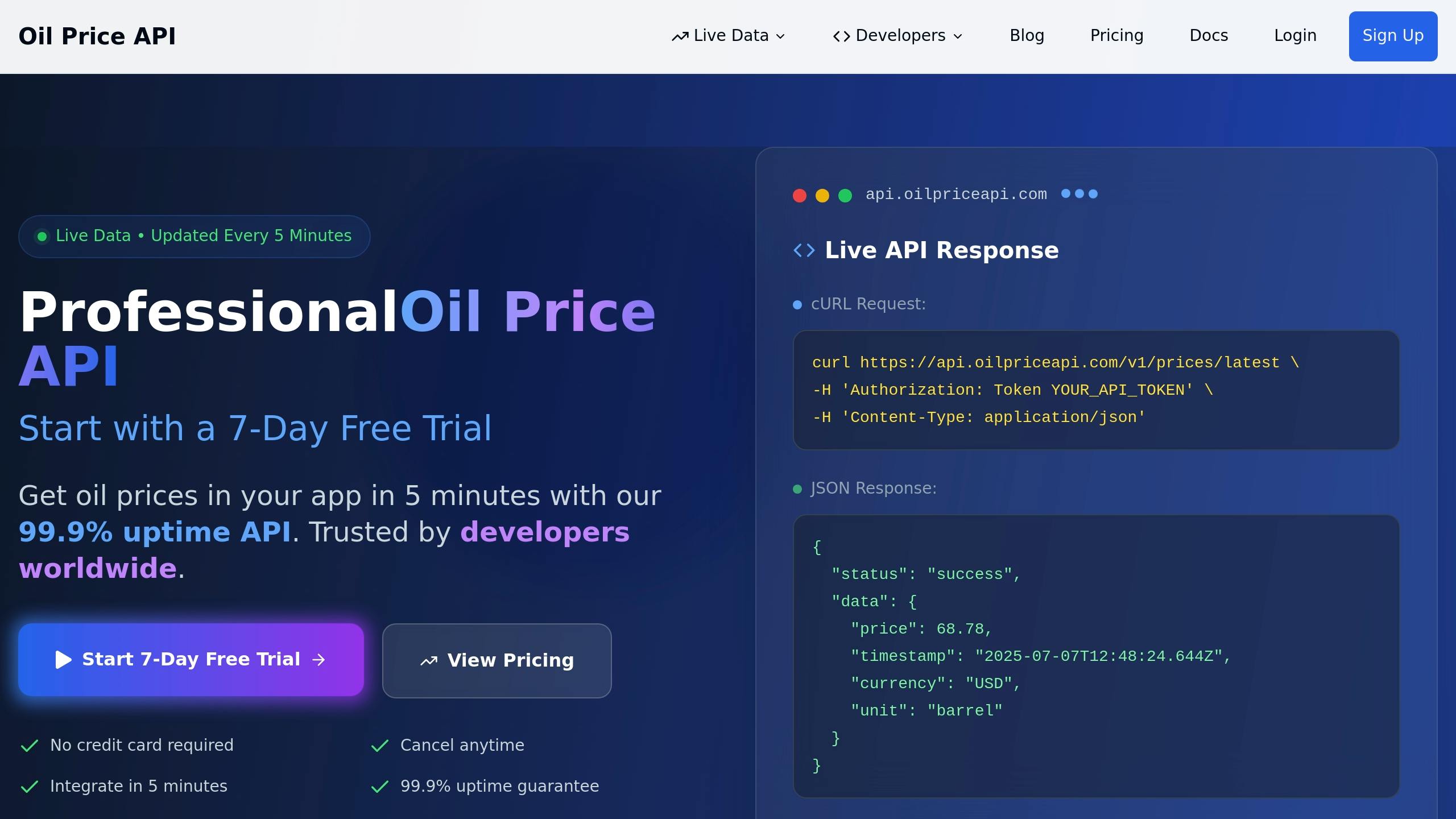
OilpriceAPI offers a RESTful API that delivers Henry Hub pricing data, including both live and historical prices. Refresh timing varies by series, so read the timestamp on each response.
The service supports multiple currencies - such as USD, EUR, and GBP - making it a great fit for energy companies operating globally.
Data is returned in JSON format, which integrates smoothly with modern web applications and trading platforms. Users can access historical data across various timeframes, allowing them to analyze long-term trends alongside real-time updates. For Henry Hub, the API provides spot prices, futures data, and historical pricing, offering a comprehensive toolkit for energy professionals conducting market analysis.
API Integration Steps and Code Examples
To integrate Henry Hub data, developers need to understand the API’s endpoints and implement error-handling measures. The base URL for API calls is https://api.oilpriceapi.com/v1/prices. For the latest Henry Hub price, the /latest endpoint is used, along with the by_code parameter (e.g., by_code=NATURAL_GAS_USD for Henry Hub Natural Gas) to ensure accurate data retrieval.
Other endpoints include past_day, past_week, past_month, and past_year, providing flexibility for different analytical needs. For example, a Flask web application can fetch prices for Brent, WTI, and natural gas, cache the data, and expose API endpoints for easy access. In this setup, the /prices endpoint retrieves Brent prices, while the /health endpoint handles WTI and natural gas.
Best practices for integration include using try/except blocks to gracefully handle network issues or API timeouts. Additionally, implementing retry logic with exponential backoff can help manage temporary interruptions. To optimize performance for high-traffic applications, developers can cache responses for at least 5 minutes, aligning with the API’s update cycle. Asynchronous requests are also recommended for handling multiple API calls efficiently.
Live Pricing Feed Applications
Real-time Henry Hub pricing feeds are essential for energy sector applications. Trading platforms rely on these feeds to display current market conditions, enabling traders to react quickly to price changes. Dashboards and analytical tools use the data to provide management with instant insights into procurement costs, portfolio values, and profit-and-loss positions. These systems often incorporate Henry Hub prices with regional basis differentials to calculate delivered costs for various markets.
Risk management systems use live price feeds to monitor exposure and execute automated hedging strategies. Investment firms tracking natural gas exposure across global markets depend on continuous updates to maintain accurate valuations and meet regulatory requirements.
Financial institutions offering commodity-linked products also use Henry Hub data to price derivatives and structured products. For developers building these applications, balancing real-time updates with system performance is crucial. Because refresh timing varies by series, intelligent caching strategies can help reduce bandwidth usage by updating only when significant price changes occur. This ensures responsiveness without overloading resources.
Henry Hub Pricing Summary
Henry Hub serves as North America's primary benchmark for natural gas pricing. Strategically located at a critical interconnection point, it captures the balance of supply and demand that shapes market prices.
With a trading volume of 400,000 contracts daily and 1.7 million open interest positions, the NYMEX natural gas futures contract - introduced in 1990 - is a vital hedging tool for market participants. Henry Hub ranks among the top three largest physical commodity futures contracts globally.
What sets Henry Hub apart is its ability to directly reflect market conditions. Unlike the fragmented systems seen in other regions, its pricing mirrors the true supply and demand for natural gas. This makes it a trusted benchmark for energy companies, traders, and businesses looking to manage natural gas exposure effectively.
The benchmark's influence extends across various industries. Power generation and petrochemical sectors depend on Henry Hub prices to control energy costs and guide planning. Additionally, most natural gas at U.S. trading hubs is priced in relation to Henry Hub, creating a unified pricing framework across North America. This domestic importance has also laid the groundwork for its growing international role.
As U.S. liquefied natural gas (LNG) exports have surged, Henry Hub has become increasingly relevant for global LNG transactions. Its significance reflects the United States' expanding position as a leading LNG exporter.
For businesses, understanding Henry Hub pricing is crucial for managing risk. Its dependable infrastructure and accurate market representation allow companies to secure future prices and reduce exposure to volatility. This is especially important given the factors that influence natural gas prices, such as weather, storage levels, production changes, and export demand.
As natural gas markets continue to shift, Henry Hub remains the cornerstone of North American energy pricing, offering the transparency and liquidity that the market relies on.
FAQs
How do seasonal patterns affect Henry Hub natural gas prices, and how can businesses manage these fluctuations?
Seasonal trends play a big role in shaping Henry Hub natural gas prices. During winter, prices often climb as heating demand spikes, while summer brings another rise due to increased energy use for cooling. These shifts are influenced by factors such as weather conditions, natural gas storage levels, and production rates.
To handle these price fluctuations, many businesses turn to futures contracts as a way to protect themselves from market volatility. Keeping a close eye on weather forecasts and storage data also allows companies to make smarter decisions and adjust their operations. This proactive approach helps them minimize the risks tied to sudden price swings caused by extreme weather or unexpected supply issues.
How do LNG exports influence Henry Hub natural gas prices and impact global energy markets?
LNG exports play a key role in influencing Henry Hub natural gas prices by increasing demand for U.S. natural gas. As export capacity grows, more gas is sent overseas, which tightens domestic supply and often pushes prices higher. By 2025, LNG export levels are expected to rise significantly, likely intensifying this trend.
The global appetite for U.S. LNG, particularly from Europe and Asia, has a direct impact on Henry Hub pricing. Seasonal consumption trends, production rates, and storage availability also interact with export activity, adding to price volatility. This complex relationship affects domestic markets and reinforces Henry Hub's importance as a benchmark for global natural gas trade.
How can traders and energy companies use Henry Hub pricing data to manage risk and make smarter purchasing decisions?
Traders and energy companies depend on Henry Hub pricing data to navigate market risks and fine-tune their purchasing strategies. By keeping an eye on timestamped natural gas prices and futures contracts, they can better understand market behavior, including shifts in supply, demand, and seasonal patterns. This knowledge helps them predict price movements and adjust their game plan when needed.
Futures contracts on NYMEX offer businesses a way to secure prices and shield themselves from market swings, particularly during peak demand periods or unexpected disruptions. Factors like weather changes, natural gas storage levels, and LNG export activity play a major role in shaping Henry Hub prices. By staying informed about these elements, businesses can make smarter decisions and manage risks more effectively.