Need reliable timber market data? Here are the 7 best sources for 2024:
- Fastmarkets
- TimberMart-South
- Global Wood Markets Info
- FAOSTAT-Forestry Database
- FAO Yearbook of Forest Products
- WoodMarket Prices
- Forest Products Trade Flow Database
Related video from YouTube
Quick Comparison
| Source | Coverage | Updates | Best For |
|---|---|---|---|
| Fastmarkets | Global | Daily | Traders, Investors |
| TimberMart-South | U.S. South | Quarterly | Regional buyers/sellers |
| Global Wood Markets Info | Global | Weekly | International traders |
| FAOSTAT-Forestry Database | Global | Annual | Researchers, Policymakers |
| FAO Yearbook of Forest Products | Global | Annual | Long-term planners |
| WoodMarket Prices | N. America, Europe | Weekly | Mill operators, Wholesalers |
| Forest Products Trade Flow Database | 40+ countries | Semi-annual | Market analysts, NGOs |
Each source has its strengths. Fastmarkets gives you daily global prices. TimberMart-South focuses on the U.S. South. The FAOSTAT database offers big-picture stats.
Mix and match these sources to get both day-to-day insights and long-term trends. With the right data, you'll be ready to tackle the ever-changing timber market in 2024 and beyond.
Fastmarkets: A Top Data Source for Timber Pros
Fastmarkets is the go-to data source for timber market pros in 2024. They offer a bunch of services for the forest products industry, covering lumber, hardwood, and wood products.
Here's what makes Fastmarkets stand out:
- Price assessments for 400+ North American hardwood products
- Market insights on trends and key drivers
- Daily lumber price updates with charts
- Industry-leading forecasts and analysis
They recently bought Hardwood Market Report, a 101-year-old price reporting agency. This move beefs up their coverage of North American and tropical hardwoods.
"I'm thrilled to welcome Hardwood Market Report's customers and team to Fastmarkets. They've built a business on trust and market transparency." - Raju Daswani, Fastmarkets CEO
Check out these lumber price trends:
| Time Period | Lumber Price (per thousand board feet) |
|---|---|
| Pandemic Peak | $1,500 - $1,600 |
| Current (2023) | $400 - $500 |
Dustin Jalbert, Fastmarkets RISI's lumber analyst, says residential construction drives 75-80% of softwood lumber demand. Repair and remodeling make up 40-45% of that.
Fastmarkets helps everyone from timberland owners and investors to equipment suppliers and buyers.
2. TimberMart-South
TimberMart-South (TMS) is the go-to source for timber market data in the southern U.S. They dish out quarterly reports on stumpage and delivered prices across 11 states.
What makes TMS stand out? They cast a wide net, pulling data from buyers, sellers, and everyone in between. This gives you a 360-degree view of the market.
Here's what TMS brings to the table:
| Feature | Details |
|---|---|
| Coverage | 11 southern states |
| Reports | Quarterly |
| Data | Stumpage and delivered prices |
| History | Back to 1976 |
| Custom | Tailored reports available |
TMS doesn't just crunch numbers. They paint a picture of the market. Take Q1 2024:
Southern pine lumber? Up 6-8%. Pulp? Jumped 12-23%. Southern OSB? Skyrocketed 37%.
Why? Blame it on the rain. Wet conditions put a squeeze on supply across the South.
But here's the kicker: TMS doesn't play favorites. They don't set prices or try to sway the market. Instead, they give you the highs, the lows, and let you connect the dots.
Need to go back in time? TMS has you covered with data stretching back to 1976. Perfect for spotting those long-term trends.
If you're in the southern timber game - whether you're buying, selling, or just watching - TMS is your crystal ball. Their laser focus on this market makes them the expert you want in your corner.
3. Global Wood Markets Info
Global Wood Markets Info is a top resource for timber pros who need fresh market data. It's packed with reports and pricing info for key regions and products worldwide.
Here's what you'll get:
| Data Type | Coverage |
|---|---|
| Lumber Prices | U.S. and Canada |
| Market Reports | North American lumber and panel (weekly) |
| Log Prices | New Zealand Pine |
| Sawnwood Prices | UK, Europe, Japan, China |
The site shines with its quick market updates. Recent reports cover:
- EUDR rules hitting EU wood shipments
- Finnish Forest Products Market insights
- North American Softwood Lumber Market Q1 review
But it's not just numbers. They break down market trends too:
"Economic shifts now rule the lumber market, with all eyes on how EUDR rules will shake up EU wood shipments."
This stuff is gold for timber traders.
They don't forget the little guys either. You'll find info on:
- Canadian sawmills
- Russian wood production
- Global wood pellet supply potential
sbb-itb-a92d0a3
4. FAOSTAT-Forestry Database
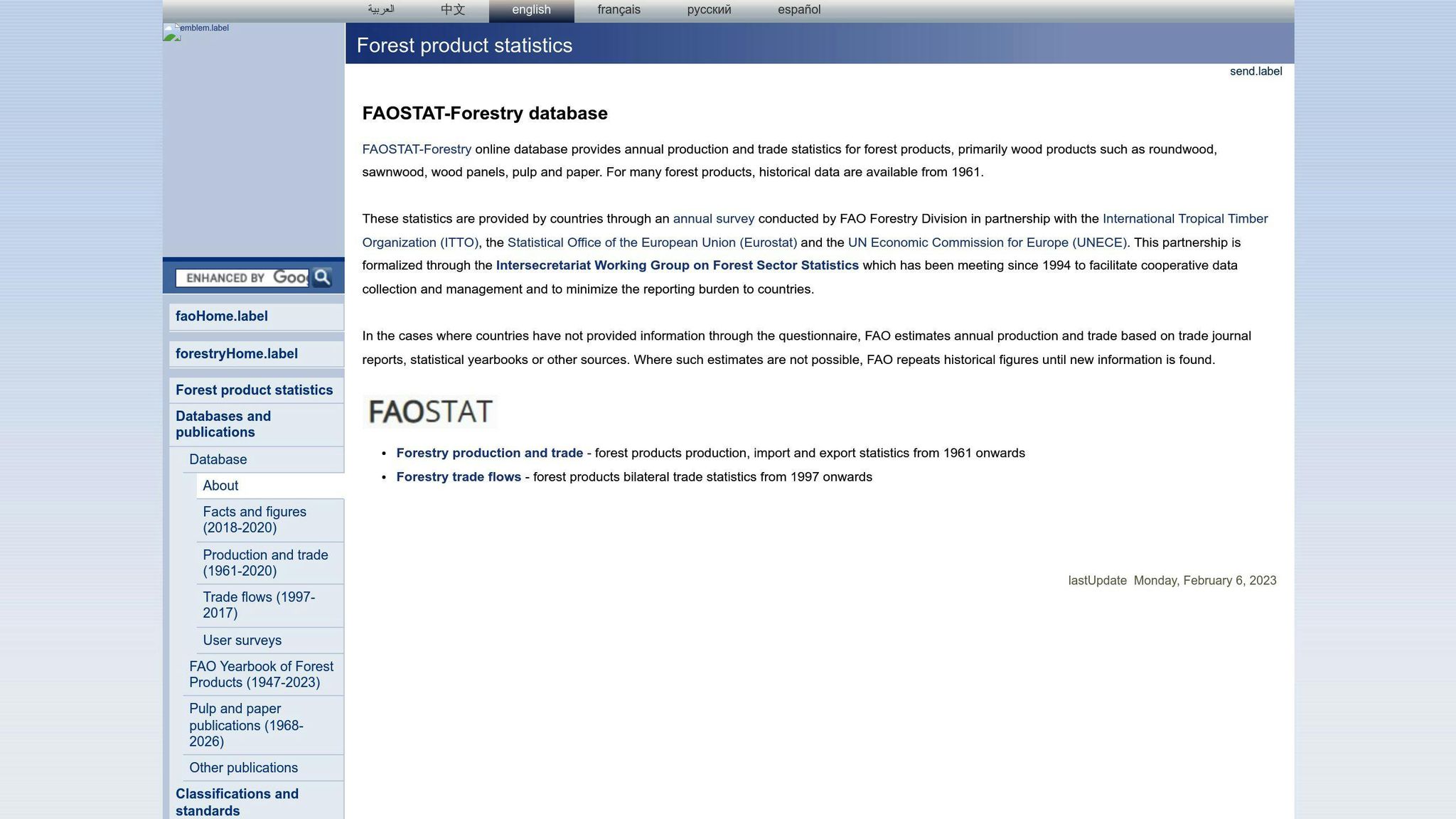
The FAOSTAT-Forestry Database is a treasure trove for timber market pros. It's packed with global forestry stats that'll make any data nerd drool.
What's inside? Here's the scoop:
| Data Type | Coverage | Time Range |
|---|---|---|
| Production | 60+ items (roundwood, sawnwood, panels, pulp, paper) | 1961-present |
| Trade | Volume and value for 40+ countries | 1964-2022 |
| Wood Energy | Fuelwood, charcoal, wood pellets | Varies |
This isn't just a bunch of numbers. The FAOSTAT team gets creative when official data is MIA. They'll dig through trade journals and yearbooks to fill in the blanks.
No annual timber production report? No problem. They might use last year's figure as a placeholder. It's all about keeping the dataset usable.
And get this: the database is a team effort. The FAO has teamed up with heavy hitters like:
- International Tropical Timber Organization (ITTO)
- Eurostat
- UN Economic Commission for Europe (UNECE)
They've been at it since 1994, making sure the data stays rock-solid.
For timber traders, the bilateral trade stats (from 1997 on) are pure gold. Want to know who's buying from whom? It's all there, helping you sniff out new market opportunities.
The best part? It's updated regularly. As of February 2024, you're getting the freshest data around.
5. FAO Yearbook of Forest Products
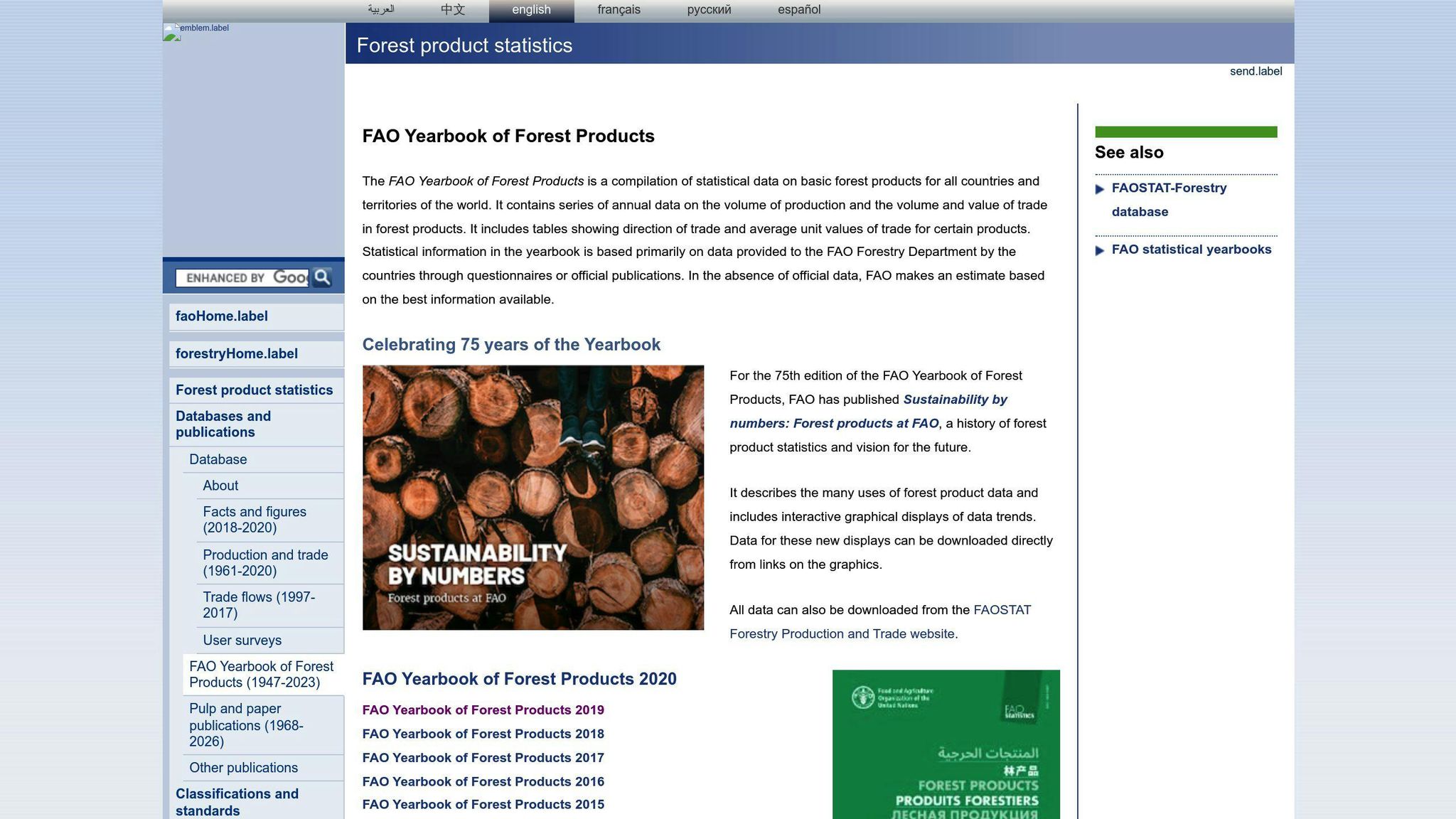
The FAO Yearbook of Forest Products is a must-have for timber market pros. It's crammed with global forest product stats that'll blow your mind.
What's inside?
| Data Type | Coverage | Time Range |
|---|---|---|
| Production | 60+ items (roundwood, sawnwood, panels, pulp, paper) | 1947-present |
| Trade | Volume and value for all countries | 1964-2022 |
| Direction of Trade | Specific products | Varies |
| Average Unit Values | Certain products | Varies |
The FAO team goes all out on data collection. They're sending questionnaires to countries and digging through official publications. When official data's missing? They don't give up. They make estimates based on the best info available.
For timber traders, the direction of trade tables are gold. Want to know who's buying from whom? It's all there, helping you spot new market opportunities.
The best part? It's fresh. As of February 2024, you're getting the latest data.
For the 75th edition, they went big. They published "Sustainability by numbers: Forest Products at FAO", giving you a behind-the-scenes look at forest product stats history and future.
They've also added interactive graphs. You can play with data trends and download raw numbers from the FAOSTAT Forestry Production and Trade website.
Bottom line: If you're in timber, the FAO Yearbook is your new go-to. It's got the numbers you need to make smart market moves.
6. WoodMarket Prices
WoodMarket Prices (WMP) is the digital version of Wood Resources Quarterly. It's used by forest industry analysts in over 30 countries.
Here's what WMP offers:
| Feature | Details |
|---|---|
| Data | Timber, lumber, pellets, pulp markets |
| History | Up to 30 years of quarterly prices |
| Access | 24/7 online platform |
| Custom | User-defined filters and dashboards |
| Visual | Interactive trade flow wheel |
WMP's key strength? Its price indices:
- Global Sawlog Price Index (GSPI): Tracks common log species since 1995.
- European Sawlog Price Index (ESPI): Covers top nine log-consuming countries in Europe since 1999.
- Global Pulpwood Price Indices: Covers 85-90% of global wood-based pulp production since 1988.
These indices are crucial. Why? Sawlog costs make up 65-70% of softwood lumber manufacturing expenses.
With WMP, you can:
- Track global sawlog and pulpwood prices
- Monitor wood chip and pellet trade
- Evaluate sawmill and pulpmill competitiveness
The platform lets you compare current prices to one- and two-year averages. This helps you spot trends and make smart decisions.
"We're giving WRI's customers more value and a better experience with WoodMarket Prices." - Pete Stewart, ResourceWise's CEO
WMP also includes market commentary. This mix of data and analysis makes it a powerful tool for anyone in timber who wants to stay ahead.
7. Forest Products Trade Flow Database
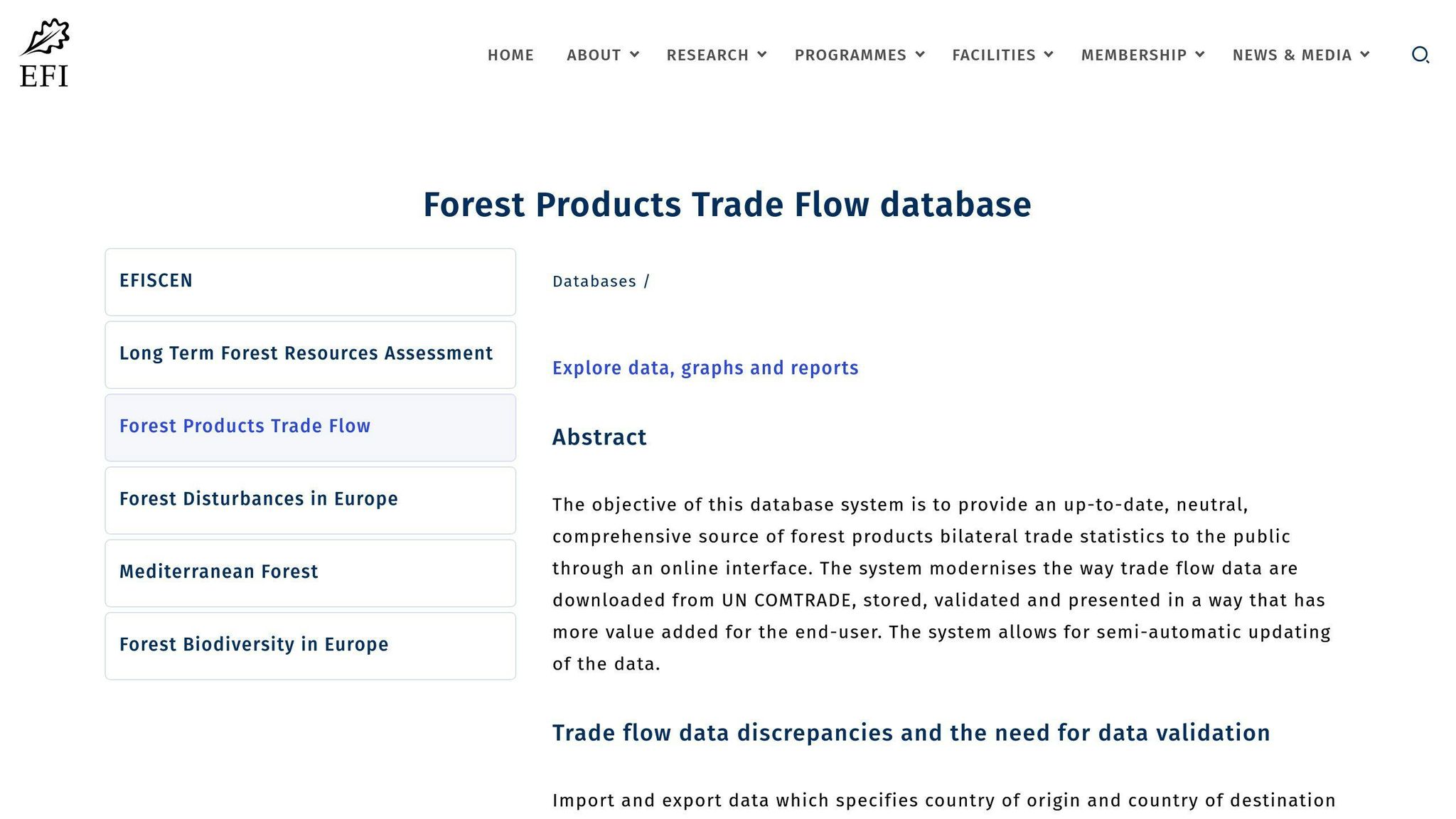
The Forest Products Trade Flow Database is a game-changer for analyzing global timber markets. It covers $520 billion in annual imports across nine product categories.
Here's what makes it special:
| Feature | Description |
|---|---|
| Products | From roundwood to furniture and wood pellets |
| Data Types | Trade flows, production volumes, import/export values |
| Coverage | 40+ countries in Europe, North America, Caucasus, Central Asia |
| Time Range | Yearly data since 1988, with 2023-2024 forecasts |
| Updates | Semi-automatic, latest year: 2021 |
Why it's a big deal:
1. It's HUGE. We're talking production data for 60+ items and trade data in volume and value.
2. It's visual. Explore stats through interactive graphics.
3. It's flexible. Create custom PDF reports.
4. It's historical. Access 80+ price series for various forest products.
Who's it for? Researchers, market specialists, and NGOs tracking forest product flows.
"We're giving users more value by modernizing the way trade flow data are downloaded, stored, validated, and presented", says a database team rep.
Heads up: Early years' data might not tell the whole story due to incomplete reporting. And keep an eye out for trade flow discrepancies – they happen due to mis-reporting or classification differences between countries.
Comparison Table
Here's a quick look at the top 7 timber market data sources:
| Data Source | Coverage | Updates | Key Features | Best For |
|---|---|---|---|---|
| Fastmarkets | Global | Daily | Real-time pricing, Market analysis | Traders, Investors |
| TimberMart-South | U.S. South | Quarterly | Stumpage and delivered prices | Regional buyers, sellers |
| Global Wood Markets Info | Global | Weekly | Market trends, Trade data | International traders |
| FAOSTAT-Forestry Database | Global | Annual | Production, trade statistics | Researchers, Policymakers |
| FAO Yearbook of Forest Products | Global | Annual | Industry overview | Long-term planners |
| WoodMarket Prices | North America, Europe | Weekly | Species-specific pricing | Mill operators, Wholesalers |
| Forest Products Trade Flow Database | 40+ countries | Semi-annual | Trade flows, Production volumes | Market analysts, NGOs |
Each source has its own strengths:
1. Fastmarkets
Up-to-the-minute pricing info. Perfect for daily trading decisions.
2. TimberMart-South
Detailed U.S. South data. A must for local market players.
3. Global Wood Markets Info
Pricing plus market analysis. Keeps international traders in the loop.
4. FAOSTAT-Forestry Database
Big-picture global forestry stats. Great for research and policy work.
5. FAO Yearbook of Forest Products
Yearly industry snapshot. Helps with long-term planning.
6. WoodMarket Prices
Focused on specific wood species in North America and Europe. Useful for mills and wholesalers.
7. Forest Products Trade Flow Database
Deep dive into trade flows. Ideal for tracking global product movements.
Picking the right source? Think about what you need, your budget, and where you operate.
Working in the U.S. South? TimberMart-South might be your go-to. Need a global view with frequent updates? Try Fastmarkets or Global Wood Markets Info.
Want the full picture? Mix and match. Use FAOSTAT for long-term trends and Fastmarkets for daily prices. You'll get both big-picture and day-to-day insights.
Conclusion
Staying on top of timber market shifts is crucial in the forest products industry. Here are seven key data sources to help you make smart moves:
- Fastmarkets
- TimberMart-South
- Global Wood Markets Info
- FAOSTAT-Forestry Database
- FAO Yearbook of Forest Products
- WoodMarket Prices
- Forest Products Trade Flow Database
Each source has its perks. Take TimberMart-South: it's got the scoop on the U.S. South, where softwood lumber capacity hit 28 billion board feet in 2023 - a 34% jump from 2017.
The timber market's future? Looking good. FEA says U.S. housing starts will climb 1.5% to 1.44 million units in 2024, then another 8.5% to 1.56 million in 2025. That's likely to push lumber demand up.
But it's not all smooth sailing. Average stumpage prices for major timber products dipped in 2023, though they're still higher than pre-pandemic levels.
To ride these waves, keep these data sources in your toolkit. They'll help you spot trends, track prices, and make smart calls in this ever-changing market.