If you need diesel price data, the choice is simple: use a commercial API for app data, use EIA for weekly benchmark pricing, and treat scraping as a last resort.
I’d break it down like this:
- Commercial APIs fit tools that need JSON, station-level data, and faster updates
- EIA feeds fit teams that need free weekly U.S. diesel benchmarks for billing and surcharge work
- Scraping can pull site-specific station prices, but it often fails and can create legal trouble
Two questions decide almost everything:
- How often do you need updates?
- How local does the price data need to be?
A few facts stand out right away:
- EIA diesel data is usually posted weekly on Monday around 5:00 p.m. ET
- EIA history goes back to March 1994
- EIA covers the U.S. average, 5 PADD regions, 3 subregions, and California
- Commercial API feeds may offer weekly averages and daily station-level data
Quick Comparison
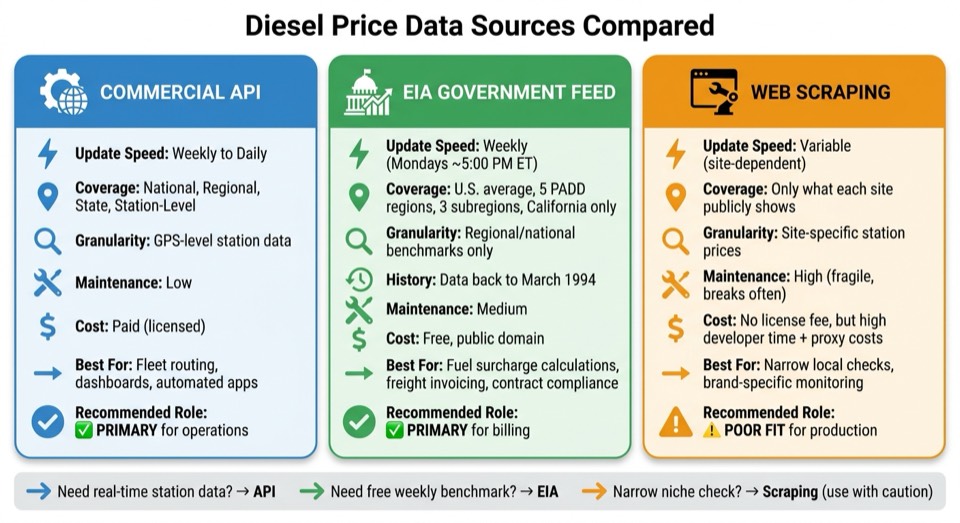
Diesel Price Data Sources Compared: API vs EIA vs Scraping
| Source | Update speed | Coverage | Work to maintain | Cost / access |
|---|---|---|---|---|
| Commercial API | Weekly to daily | U.S., regional, state, station-level | Low | Paid, with set terms |
| EIA feed | Weekly | U.S. average, regions, subregions, California | Medium | Free, public domain |
| Scraping | Depends on site | Only what each site shows | High | No direct license fee, but high time cost |
Bottom line: if you run routing, dashboard, or alert systems, I’d start with an API. If you only need a weekly U.S. benchmark, I’d start with EIA. If you’re thinking about scraping, I’d only use it for narrow checks where breakage is acceptable.
Below, I’ll walk through the tradeoffs in plain terms so you can pick the right source with less guesswork.
sbb-itb-a92d0a3
1. Commercial Diesel Price APIs
Commercial APIs are a good fit for production systems that need structured, authenticated diesel price data. You make an authenticated HTTP request to a REST endpoint and get structured JSON back. No manual file downloads. No scraping HTML. No duct-tape parsing jobs.
The tradeoff is pretty simple: you pay for speed, support, and cleaner access instead of relying on slower, broader, or free sources.
With OilPriceAPI, the request looks like this:
GET https://api.oilpriceapi.com/v1/prices/latest
Authorization: Token YOUR_API_KEY
The response is structured and ready to parse. Full endpoint details are in the API documentation.
Refresh Rate
Commercial APIs usually offer two update cadences:
- Weekly updates for state and regional averages within the global oil market
- Daily refreshes for station-level pricing
Weekly updates line up with EIA releases. Daily station feeds make more sense for tools that need current pump prices.
Coverage and Granularity
Coverage includes U.S. national, regional, state, and station-level data. Station feeds also include broad station-level coverage with GPS coordinates. That gives you enough detail for a statewide benchmark, a route-planning tool, or a local fuel-stop lookup.
Overhead
Integration overhead is low. OilPriceAPI offers tutorials for Python and Node.js. It also has guides for pulling prices into Excel and Google Sheets.
The main point: the data arrives in a structured format that’s ready for app logic.
Legal and Cost Profile
Commercial APIs come with explicit terms and licensing. OilPriceAPI lists clear pricing tiers, so you can see cost and access rules before you start building. If weekly U.S. averages are enough, the government feed is the next baseline to compare.
2. U.S. Government Diesel Feeds (EIA)
The U.S. Energy Information Administration (EIA) publishes the Gasoline and Diesel Fuel Update, a free weekly report on U.S. retail on-highway diesel prices, including taxes. People often use it for fuel surcharge calculations and benchmarking. For developers, EIA is a good fit when benchmark accuracy matters more than local station coverage.
Refresh Rate
EIA updates the report weekly, usually on Monday at about 5:00 p.m. ET, after sampling truck stops and service stations that morning. That weekly delay makes it less useful if you need current pump prices.
Coverage and Granularity
This feed is broad, but it's also coarse by design. Coverage includes:
- The U.S. average
- Five PADD regions
- Three subregions
- California as the only state-level series
Historical on-highway diesel data goes back to March 1994, which makes the feed useful for trend analysis and forecasting. You can also use AI for price insights to interpret these trends. But it isn't meant for station-level routing or local fuel-stop selection.
Overhead
Raw access usually comes through XLS downloads or RSS feeds, so you'll need a parser or wrapper to turn the data into JSON.
Legal and Cost Profile
EIA data is public domain, free to access, with no licensing restrictions for internal use or redistribution. That makes EIA a solid benchmark source when weekly U.S. averages are enough. If you need more granular or more frequent pricing, the next source type is web scraping.
3. Web Scraping of Fuel Websites
When weekly EIA data is too broad, scraping can be the most flexible path to station-level diesel prices. But it also breaks the easiest.
Here’s the tradeoff: a government feed or paid API usually gives you a set structure. A scraper doesn’t. It has to deal with whatever HTML or JavaScript the site serves at that moment. One layout tweak, and your parser can go sideways.
Refresh Rate
A scraper can run as often as you want, but only up to the site’s own update rhythm and bot limits. Push too hard, and you may hit rate limits or get your IP blocked.
Coverage and Granularity
If a fuel site shows station-level prices on public pages, a scraper can pull them. That said, coverage depends fully on what each site makes public. So if you want multi-state coverage, you usually need a separate parser for each source.
Overhead
Most scraper failures come from page layout changes, JavaScript-heavy pages, and anti-bot controls like CAPTCHAs, header checks, and IP blocking. In production, scrapers need:
- Fallback selectors
- Failure alerts
- Checks against weekly EIA data
Without those safeguards, small site changes can quietly corrupt your data.
Legal and Cost Profile
Scraping commercial fuel websites sits in a gray area. Many sites ban automated access in their Terms of Service, which can lead to IP blacklisting or legal notices. The main cost isn’t licensing. It’s developer time, proxy services, and CAPTCHA handling.
The summary below turns those tradeoffs into a side-by-side comparison.
Pros and Cons by Source Type
Each source solves a different logistics problem. The right pick comes down to three things: how often the data updates, how much ground it covers, and what it costs to keep running.
The table below gives you the tradeoffs at a glance.
| Source Type | Best For | Main Advantages | Main Limitations | Recommended Role |
|---|---|---|---|---|
| Commercial API | Fleet routing, real-time dashboards, automated apps | Station-level U.S. pricing with API access and structured responses | Per-query costs for high-volume station data | Primary for operations |
| Government Feed (EIA) | Fuel surcharge calculations, freight invoicing, contract compliance | Official benchmark, free, public domain | Weekly cadence only; no station-level granularity | Primary for billing; Supplementary for analytics |
| Web Scraping | Niche local data, specific brand monitoring | Access to public pages without an official feed | Fragile and legally risky | Poor fit for production logistics |
Use EIA as the benchmark for surcharge calculations. It’s the best fit for billing workflows tied to freight invoicing and contract compliance.
For tools that depend on station-level data or near-real-time updates, a commercial API covers what EIA does not. (See our API integration FAQ for setup details.) That makes it the better choice for routing systems, live dashboards, and other app-driven workflows.
Web scraping can help with narrow local checks or brand-specific monitoring, but it’s a shaky option for production logistics. If uptime, compliance, and steady maintenance matter, it usually creates more trouble than it saves.
Conclusion
Pick the option that matches your refresh rate needs, geographic scope, and how much upkeep you're willing to take on.
For production workflows like routing, dashboards, and alerts, a commercial API is the simplest fit. You get structured JSON, frequent updates, and station-level coverage without having to maintain a parser. OilPriceAPI provides that through a single authenticated endpoint. For setup details, start with the API documentation.
If your use case is U.S.-only and weekly updates are enough, the EIA feed is a solid free option. Just keep in mind the weekly cadence and broader coverage.
Scraping can work for narrow, site-specific needs, but it's fragile and comes with legal risk.
Get a free API key at oilpriceapi.com and review the API documentation before you build.
FAQs
How fresh does my diesel price data need to be?
It depends on your use case.
For high-level analytics, long-term trend reports, or executive dashboards, weekly updates are usually enough. Government sources like the EIA publish retail diesel prices every Monday, and that cadence works well as a standard benchmark.
If your tool supports logistics or day-to-day decisions, you'll need data more often. Either way, check the response metadata before you use anything - especially timestamps and source attribution.
When is EIA enough instead of an API?
EIA is enough if your diesel price data lines up with its publishing schedule and geographic coverage. It publishes weekly U.S. retail diesel data for states and national averages every Monday.
That makes it a good fit for long-term trend analysis, reporting, or systems that don't need daily updates. If you're only looking for historical U.S. fuel trends or broad regional averages, EIA is a reliable and free source with strong authority.
How risky is scraping for production use?
Scraping is usually a risky choice for production use. It can be unreliable by nature, and it may also break a site’s terms of service.
It’s fragile too. A small change in a website’s layout or page structure can knock out your data pipeline, which means downtime and more upkeep. For logistics or fuel-cost tools, professional APIs are a steadier, supported way to get consistent data.