Oil prices can move almost all day on weekdays, but most apps do not need constant updates. If I’m building a dashboard, report, or ERP workflow, I’d usually pull oil prices once per day. If I’m tracking intraday risk or alerts, I’d look at every 5 to 15 minutes. And if I’m trading, I’d need per-minute or streaming data.
Here’s the short version:
- Spot prices change during market hours
- Futures like WTI and Brent trade nearly 24 hours a day, 5 days a week
- Settlement prices update once per trading day
- The biggest gap is the weekend: trading stops Friday and resumes Sunday evening ET
- For many business tools, 1 API call per day is enough
- Polling more often adds cost, cache work, retries, and rate-limit pressure
If you only need one trusted daily number for pricing, reporting, or contract math, use the daily settlement or a daily snapshot. If stale intraday data can cost you money, poll more often.
| Price type | How often it changes | Best use |
|---|---|---|
| Spot | During market hours | Live monitoring |
| Futures | Nearly 24x5 | Trading and hedging |
| Settlement | Once per trading day | Accounting and contracts |
My takeaway: match the pull rate to the job, not to the fastest move in the market.
How often oil prices actually change
Oil prices don't all update on the same clock. Live spot and futures quotes move during market hours, while settlement prices update once per trading day. So for most apps, the main question is simple: Do you need a live quote or just a daily snapshot?
Spot prices: continuously quoted during market hours
Spot quotes move throughout the trading session. In practice, many dashboards and APIs refresh every 5 minutes to cut down on noise and cost.
Futures prices: nearly 24x5, not 24x7
Most live oil feeds rely on the front-month futures contract. For most systems, the bigger issue isn't the contract itself. It's whether the feed is current enough for the job you're trying to do.
Settlement prices and weekend gaps
Weekend gaps matter because global oil markets reopen after two days of news and price movement. For dashboards, stale weekend data is normal and usually fine. But for settlement-based use cases like accounting or contracts, it's better to wait for the official daily close before pulling a new value.
Automated systems should treat Friday close and Sunday open as separate states. That one detail can shape how your app handles updates, whether that means polling intraday or calling the API once per day.
sbb-itb-a92d0a3
How often your application should pull oil prices
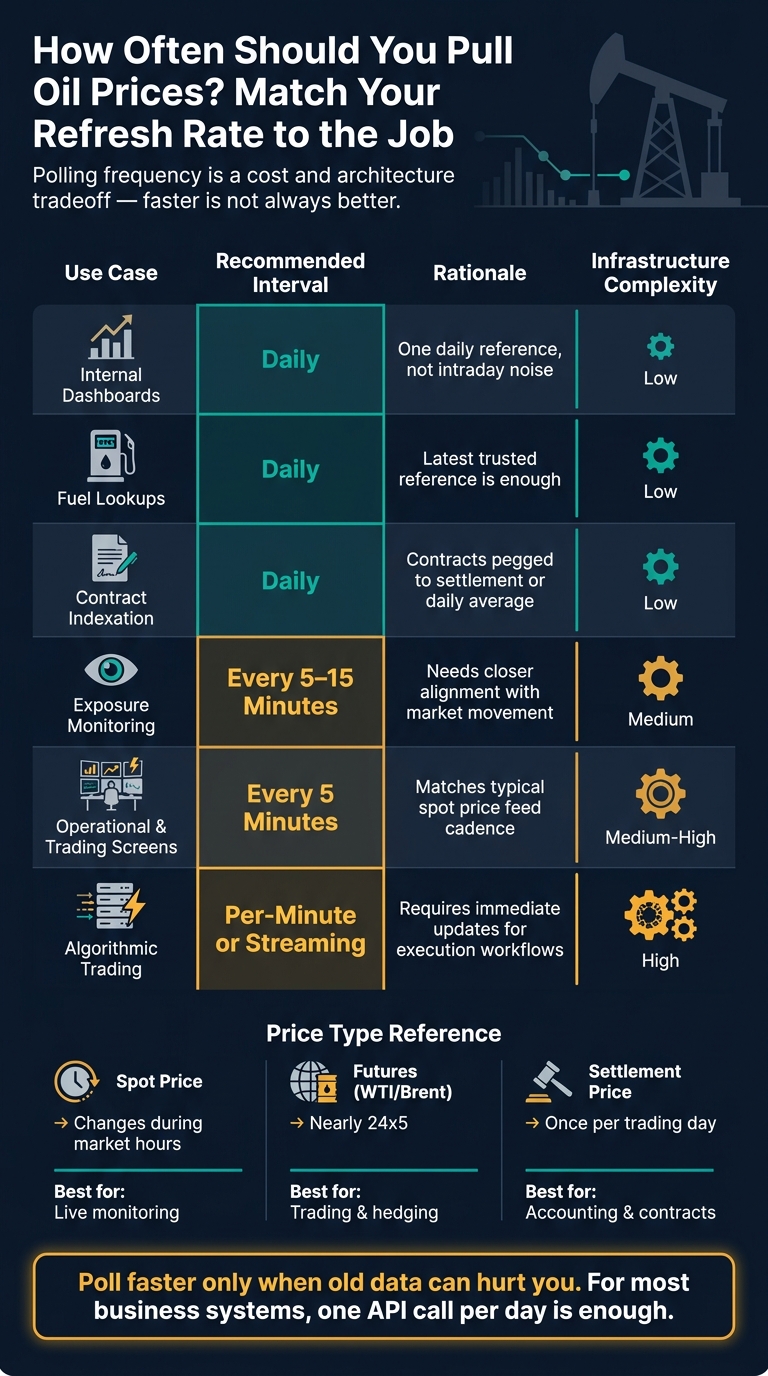
Oil Price API Refresh Rate Guide: Match Your Update Frequency to Your Use Case
Getting the timing right matters. But the bigger call is simpler: how often should your app ask for a new price? That depends on what the price is doing in your system, not on how fast the market can move.
Daily updates are enough for most business systems
For most business systems, one API call per day is enough. Dashboards, reports, fuel lookups, and contract indexation usually need one trusted daily number, not a stream of intraday moves.
Contract indexation shows this well. Most supply agreements are tied to a daily settlement price or a monthly average, not to an intraday quote.
When hourly or per-minute polling makes sense
Use faster polling only when stale prices create immediate business risk. Intraday dashboards and exposure monitoring can work well with hourly or 15-minute refreshes. If you're dealing with active hedging, spread trading, or algorithmic trading, 5-minute polling or streaming is a better match.
The rule is pretty simple: poll faster only when old data can hurt you. If your feed can't support that speed, polling more often just burns through quota.
Polling frequency is a cost and architecture tradeoff
More frequent API calls don't just mean more data. They also mean more backend work: scheduling workers, running a cache, handling retries, and watching rate limits. A daily snapshot is a cron job. Intraday polling needs a worker, retries, cache control, and rate-limit monitoring.
Here’s a simple rule of thumb for matching refresh rate to the job:
| Use Case | Recommended Interval | Rationale |
|---|---|---|
| Internal dashboards | Daily | One daily reference, not intraday noise. |
| Fuel lookups | Daily | Latest trusted reference is enough. |
| Contract indexation | Daily | Contracts are pegged to settlement or daily average prices. |
| Exposure monitoring | 5–15 minutes | Needs closer alignment with market movement. |
| Operational and trading screens | 5 minutes | Matches typical spot price feed cadence. |
| Algorithmic trading | Per-minute or streaming | Requires immediate updates for execution workflows. |
A practical middle ground for most teams is to cache the last known price in memory or Redis with a TTL that matches your polling interval. That way, multiple internal services can read the same price without each one firing off a separate API call. You can also use the updated_at and data_age_warning fields in the response to decide whether the cache even needs a refresh.
Next, map that refresh rate to your API and caching setup.
How to implement refresh strategies with OilPriceAPI
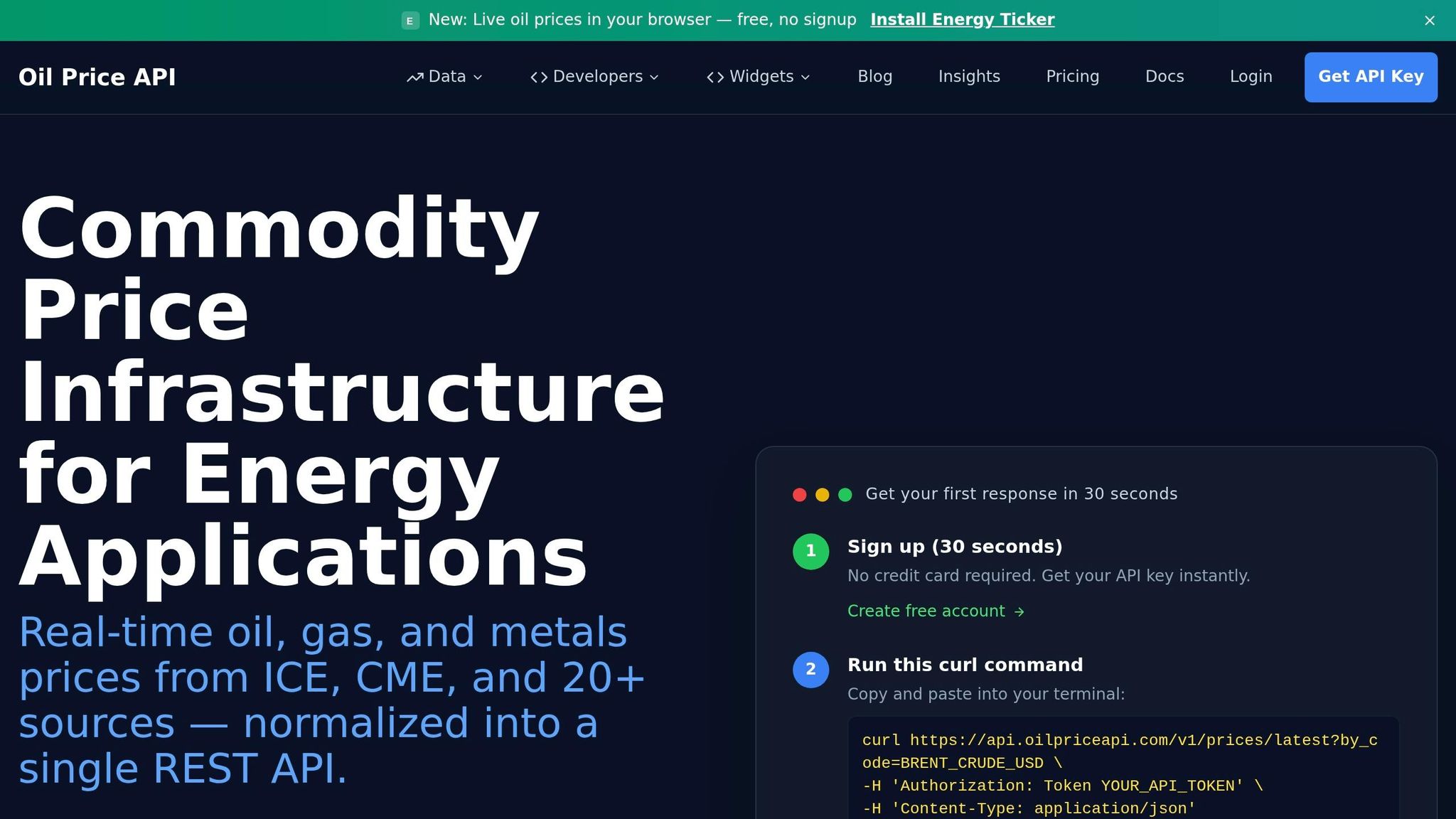
Once you know your refresh interval, plug it into one API request, one cache, and one scheduler.
The latest price request and authentication header
Use the same request no matter which refresh plan you pick. Send a GET request to https://api.oilpriceapi.com/v1/prices/latest and pass your API key in the Authorization header:
Authorization: Token YOUR_API_KEY
The API returns JSON with the price, currency, unit, and timestamp. Use that timestamp to check how fresh the data is. This same endpoint works for both daily snapshots and intraday polling. The request doesn't change, only the way you schedule it does.
For the full schema and sample responses, see the official API documentation.
Daily snapshot job vs. intraday polling worker
The setup depends on whether you need one price per day or a live feed.
Use a daily cron job for reports, accounting, and indexation. Use a 5-minute worker for live dashboards and alerts. If you're running an intraday worker, store the latest response in memory and let downstream services read from that cache instead of hitting the API on every request. Before you replace stored data, check the response timestamp.
| Pattern | Frequency | Best For |
|---|---|---|
| Daily snapshot | Once/day | Reports, contract indexation, accounting |
| Intraday worker | Every 5 min | Live dashboards, price alerts |
Excel, Google Sheets, Python, and Node.js integration guides
The API call stays the same across tools. What changes is the scheduler and the way each stack handles the response.
- Excel: How to get oil prices in Excel
- Google Sheets: How to get oil prices in Google Sheets
- Python: Python oil price API tutorial
- Node.js: Node.js oil price API tutorial
Pick the guide that fits your stack, then apply the refresh interval you chose above.
Conclusion: Match your refresh rate to the business need
Spot prices move during market hours. Futures trade close to 24x5. Settlement prices give you the official daily benchmark. That rhythm should drive your refresh rate.
In plain English: pick the refresh schedule that fits the job, not the fastest move the market can make.
For most business systems - reporting tools, ERPs, procurement dashboards, and accounting platforms - one API call per day is enough. Use the daily settlement price for reporting and accounting. If you're running live dashboards and alerts, 5-minute polling is usually the right fit. Save per-minute polling for trading and other high-frequency workflows.
Once you settle on a refresh rate, build the polling job around it. Polling frequency is both a cost and architecture tradeoff: higher refresh rates use more requests and more infrastructure. Match the refresh rate to the business need.
Get a free API key at OilPriceAPI and get started in minutes.
FAQs
Should I use spot, futures, or settlement prices?
It depends on your use case. Spot prices show the current market for immediate delivery. Futures prices apply to contracts that expire at a later date. And settlement prices are the official closing values used for daily reconciliation.
For most business systems, one daily price is enough. If you need live data, check the contract metadata and freshness fields. That helps you compare the right instrument and confirm how current the data is.
What should my app do over the weekend gap?
Oil and futures markets don’t trade 24/7. That means weekend and holiday gaps are normal, not a data problem.
When the market is closed, use the last settlement price from the final trading session as the current market state until new pricing is published.
Also, check the API response timestamp instead of guessing that the data is old based on the clock alone. In most business systems, one update per day is enough, and you usually don’t need to poll while the market is closed.
How do I pick the right API refresh rate?
Choose the refresh rate based on what your business needs, your API limits, and your budget. Most business systems - like internal dashboards or reporting portals - do just fine with daily updates. But if you're dealing with trading or live monitoring, the 5-minute update interval may make more sense.
To keep costs down and cut latency, use caching or local storage. If you're handling a lot of requests, keep an eye on your rate-limit headers too.