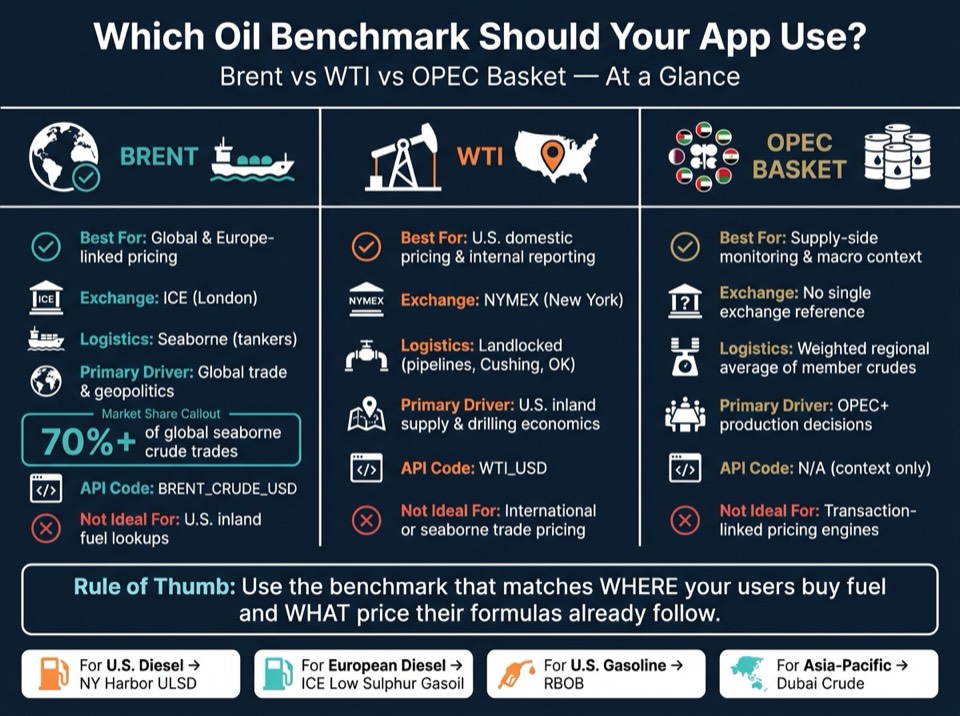
If I had to give one short answer, it would be this: use Brent for global and Europe-linked pricing, WTI for U.S. pricing, and the OPEC Basket for market context, not direct transaction pricing.
That one choice can change how your app handles alerts, fuel surcharges, cost tracking, and historical comparisons. The article’s main point is simple: the right benchmark is the one that matches where your users buy fuel and what price their formulas already follow.
Here’s the whole article in plain English:
- Brent is the main fit for international and seaborne pricing
- WTI is the main fit for U.S. inland and domestic pricing
- OPEC Basket is better for supply-side tracking than day-to-day pricing logic
- For diesel or gasoline workflows, refined product benchmarks can fit better than crude
- OilPriceAPI lets you pull benchmark prices with codes like
BRENT_CRUDE_USDandWTI_USD - Brent is used in 70%+ of global seaborne crude trades, which is why it often becomes the default outside the U.S.
Brent vs WTI vs OPEC Basket: Oil Benchmark Comparison Guide
Why Is Brent Crude Usually More Expensive Than WTI? (Part 1)
sbb-itb-a92d0a3
Quick Comparison
| Benchmark | Best use | What drives it most | Main limitation |
|---|---|---|---|
| Brent | Global, Europe-linked, cross-border pricing | Seaborne trade and geopolitics | Less direct for U.S. inland fuel lookups |
| WTI | U.S. domestic pricing and internal cost tools | U.S. pipeline flows and shale output | Less tied to global shipping shocks |
| OPEC Basket | OPEC+ supply tracking and market context | Member crude averages and production policy | Weak fit for transaction-linked pricing |
I’d sum up the article this way: don’t pick a benchmark because it is famous - pick it because it matches your pricing logic. And if your app is built around diesel or gasoline, I’d check whether ULSD, gasoil, or RBOB tracks your costs better than crude.
Brent, WTI, and OPEC Basket: what each benchmark is built for

Brent: the default for global and Europe-linked pricing
Brent is the North Sea benchmark that most global pricing systems lean on. In plain terms, it’s the standard reference for international pricing.
In pricing engines, Brent makes sense as the base reference because many international producers price their crude grades at a premium or discount to Brent. That’s why it fits European, Asian, and other cross-border pricing flows so well. It also tends to move more sharply than WTI when geopolitics start shaking the market, including Middle East tensions and shipping disruptions in the Strait of Hormuz. If your app needs to reflect global supply risk, Brent is often the signal to watch.
If Brent is the global default, WTI fills that role inside the U.S.
WTI: the best fit for U.S. operations and domestic pricing
WTI is a U.S. inland benchmark centered on Cushing, OK, and it trades on NYMEX in New York. Because it’s built around a landlocked delivery system, it’s usually the better fit for domestic U.S. pricing.
For U.S.-based pricing systems, domestic refinery procurement tools, or internal cost dashboards tied to American shale output, WTI is often the right input. It also lines up well with many U.S. refinery setups.
The OPEC Basket plays a different role. It’s better for market context than direct pricing.
OPEC Basket: useful for supply-side context, not ideal as a core benchmark
The OPEC Reference Basket is a weighted average of crude streams produced by OPEC member countries. That makes it a macro market signal, not a transaction anchor.
Use the OPEC Basket when your app needs to track broader OPEC+ production decisions or give analysts supply-side context. But it’s not the best anchor for transaction-linked pricing engines. In that case, you usually want a single-stream price reference that maps more directly to the fuel your users are buying.
| Feature | Brent | WTI | OPEC Basket |
|---|---|---|---|
| Composition | Blend of North Sea crudes | Single stream (U.S. light sweet) | Weighted average of member crudes |
| Exchange | ICE (London) | NYMEX (New York) | No single exchange reference |
| Logistics | Seaborne (tankers) | Landlocked (pipelines, Cushing, OK) | Weighted regional average |
| Best for | Global and Europe-linked pricing engines | U.S. domestic pricing and internal reporting | Supply-side monitoring and macro context |
| Not ideal for | U.S. inland fuel lookups | International or seaborne trade pricing | Transaction-linked pricing engines |
| Primary driver | Global trade and geopolitics | U.S. inland supply and drilling economics | OPEC+ production decisions |
Once you know which benchmark your logic follows, the next step is pulling that price into your app. For technical implementation details, check our API integration FAQ. For the market background behind these differences, see our Brent vs. WTI guide.
How to pick the right benchmark for fuel, surcharge, and pricing systems
Match benchmark to geography and customer exposure
Pick the benchmark based on where the charge happens and how fuel is priced in that market. Once you’ve pinned down that exposure, line it up with the fuel your system is pricing.
For U.S. domestic pricing and surcharges, WTI is the natural anchor. For international trade or Europe-facing pricing, Brent is the better fit. Use the OPEC Basket for supply-side monitoring, not for pricing.
Match benchmark to downstream fuels and surcharge formulas
If your workflow is diesel-specific, use refined benchmarks instead of raw crude. In the U.S., that means NY Harbor ULSD. In Europe, use ICE Low Sulphur Gasoil. For U.S. gasoline, the relevant refined benchmark is RBOB, while natural gas systems typically rely on Henry Hub pricing.
If crude is only acting as a proxy for the fuel you care about, check it against your own historical data. Crude and refined products don’t move in the same way, so your input should track the exposure your formula is built to follow.
Put simply: the right benchmark is the one your pricing rules already depend on.
Comparison table: benchmark fit by region, pricing context, and fuel relevance
| Use Case | Primary reference | Notes |
|---|---|---|
| U.S. domestic fuel surcharges | WTI or NY Harbor ULSD for diesel | WTI fits U.S. domestic pricing; NY Harbor ULSD is better for diesel-specific workflows |
| International freight and trade pricing | Brent | Standard for global trade and international pricing |
| European diesel cost modeling | ICE Low Sulphur Gasoil | Better match for downstream diesel pricing |
| U.S. gasoline pricing | RBOB | More directly aligned with gasoline exposure |
| OPEC supply monitoring | OPEC Basket | Broad supply-side context; not suited for transaction pricing |
| Asia-Pacific regional pricing | Dubai Crude | Often used alongside Brent in Asia-Pacific pricing |
After you choose the reference, pull the latest price into your app and apply that same logic in your calculation layer.
How to pull benchmark data using OilPriceAPI
Start with the documented latest-price request
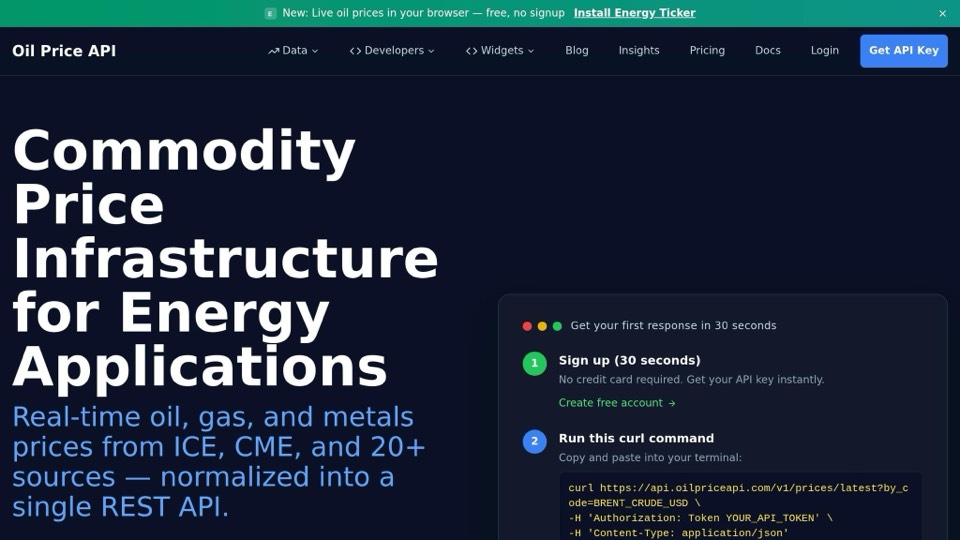
Send a GET request to https://api.oilpriceapi.com/v1/prices/latest with this header:
Authorization: Token YOUR_API_KEY
If you want a specific benchmark, add by_code to the request. For example:
?by_code=BRENT_CRUDE_USDfor Brent?by_code=WTI_USDfor WTI
You can find the full list of supported codes and JSON response details in the API documentation. One small thing matters a lot here: use the same code everywhere you read the price. If your spreadsheet uses Brent, your app should use Brent too.
| Benchmark | by_code Value |
Region |
|---|---|---|
| Brent Crude | BRENT_CRUDE_USD |
Global / Europe |
| West Texas Intermediate | WTI_USD |
North America |
Apply the same benchmark logic in spreadsheets and code
Use the same benchmark code in every spreadsheet, dashboard, and service that reads the price.
That keeps your numbers lined up across analysis and production. If one tool pulls WTI_USD and another pulls BRENT_CRUDE_USD, you'll end up comparing apples to oranges.
OilPriceAPI provides step-by-step integration guides for Excel, Google Sheets, Python, and Node.js. Use those guides when you want your pricing rule to move cleanly from analysis into application code.
Go deeper on benchmark behavior when your app needs it
If your team needs market context, check the WTI vs. Brent crude oil guide. It covers spread behavior and benchmark divergence, which can help when price gaps start to show up and you need to explain why.
Conclusion: use the benchmark your users actually operate against
After you match the benchmark to geography and fuel exposure, the rule gets pretty simple: use Brent for global and Europe-linked pricing, WTI for U.S.-centered apps, and the OPEC Basket for supply-side context.
That match is what keeps your pricing logic consistent. If the benchmark is off, pricing trust starts to slip. It can also skew dashboards, alerts, and surcharge outputs.
Once you've chosen the benchmark, plug it into your app. You can even use AI for oil price analysis to interpret these trends. Get a free API key at OilPriceAPI and pull live benchmark data through the documented endpoint.
FAQs
How do I choose between crude and refined benchmarks?
Choose the benchmark that fits your app’s market and use case. WTI usually works best for U.S. domestic supply, drilling economics, and regional fuel surcharges. Brent is often the better choice for global trade, international market analysis, and shipping logistics.
WTI is landlocked, while Brent is seaborne. That means their prices don’t always move in sync. For Asian markets, Dubai Crude may be a better match.
What if my users buy fuel in multiple regions?
Track both Brent and WTI. WTI is the main benchmark in North America. Brent is the main reference point across much of Europe, Africa, and Asia.
Watching both gives your application a clearer view of regional price gaps. That matters when you calculate fuel surcharges and build pricing systems that need to stay accurate.
When should I use the OPEC Basket in an app?
Use the OPEC Reference Basket when your app needs to track the combined price of crude exported by OPEC member countries or study trends linked to OPEC production decisions.
Unlike WTI or Brent, it reflects a mix of crude grades. For most general pricing or fuel surcharge systems, WTI and Brent are still the standard benchmarks.