If I had to sum it up in one line: H2S is usually the ppm problem, CO2 is usually the energy problem.
When I look at amine treating, I don’t start with the inlet gas alone. I start with the outlet spec. That tells me whether the unit should favor deep CO2 removal, very low H2S removal, or a balance of both. In most U.S. gas service, H2S has to drop to low-ppm levels, while CO2 limits are often much higher, such as about 2–3 mol%. That gap changes the solvent, the absorber setup, and the reboiler duty.
Here’s the short version:
- H2S reacts faster with amines, so it is usually removed first.
- CO2 is harder to remove deeply, so it often needs more contact time, more circulation, or a more reactive solvent.
- MDEA is often used when I want H2S selectivity and can allow CO2 slip.
- MEA or DEA make more sense when I need lower CO2 in treated gas.
- In mixed gas service, trying to remove too much CO2 can add steam cost without helping the main spec.
- For LNG feed or tight CO2 limits, the absorber often needs more stages or deeper packing, and duty climbs fast.
- For H2S-selective service, plants may allow 60–80% CO2 slip, and some selective designs can slip 70–88% of inlet CO2.
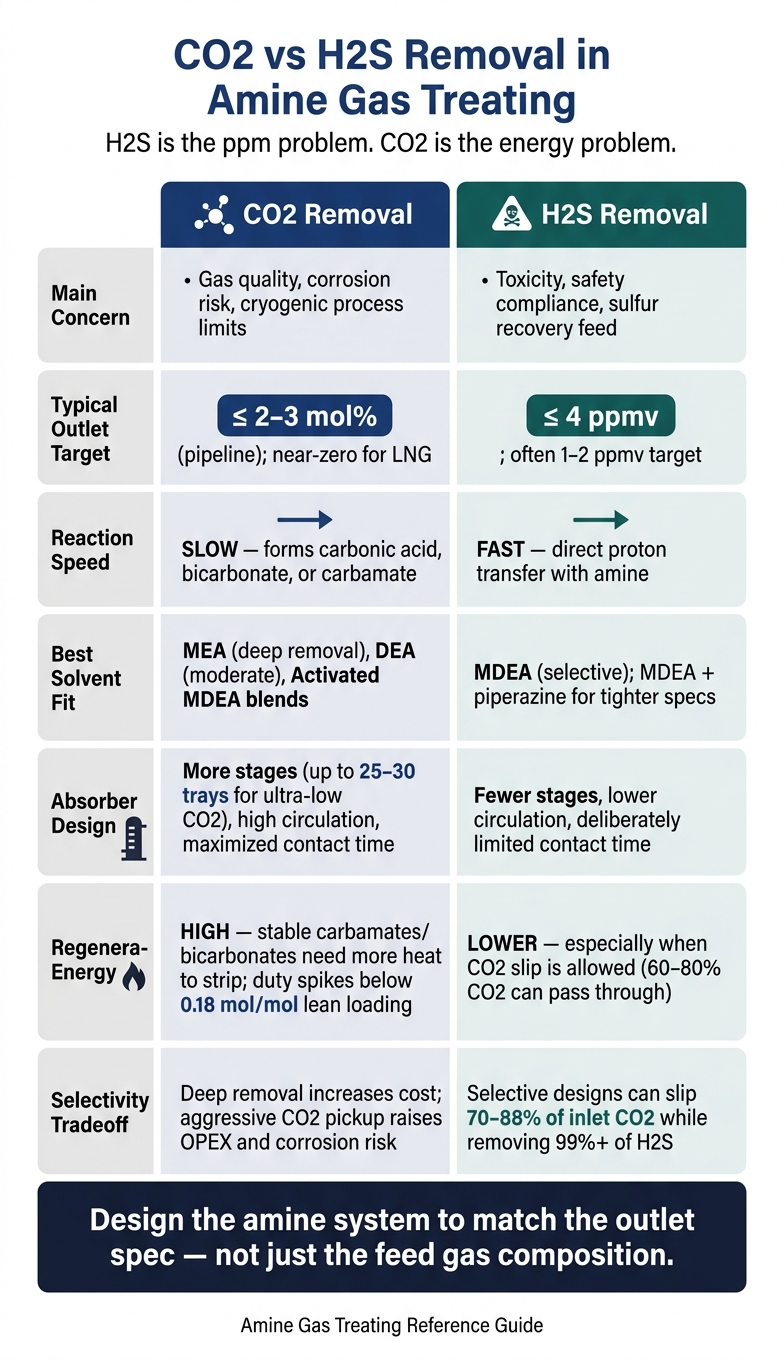
CO2 vs H2S Removal in Amine Gas Treating: Key Differences at a Glance
Process Design tips in Amine Gas Sweetening Units
sbb-itb-a92d0a3
Quick Comparison
| Topic | CO2 Removal | H2S Removal |
|---|---|---|
| Main concern | Gas quality, corrosion, cryogenic limits | Toxicity, safety, sulfur compliance |
| Typical target | ≤2–3 mol% in many gas specs | ≤4 ppmv, often 1–2 ppmv target |
| Reaction in amine | Slower | Faster |
| Best solvent fit | MEA, DEA, activated MDEA | MDEA |
| Absorber design | More stages, more contact time | Less contact time to limit CO2 pickup |
| Energy use | Higher when deep removal is needed | Lower when CO2 slip is allowed |
My takeaway is simple: if the plant is built for the wrong target, you can end up with more column, more steam, and still miss the spec that matters most. The smart move is to match the amine system to the sales gas or downstream requirement first, then size the process around that.
CO2 vs H2S Removal: Reaction Behavior and Selectivity
H2S reacts almost right away with aqueous amines, while CO2 moves more slowly through carbonic acid, bicarbonate, or carbamate formation. At equilibrium, amine chemistry may lean toward CO2 in some cases, but inside the absorber, H2S gets picked up faster. Under common absorber conditions, H2S is usually removed first, while some CO2 slips through unless the unit is set up for deep CO2 removal. That difference in reaction speed is the main reason plants can target H2S first.
Selective systems take advantage of short contact time. The idea is simple: give the solvent enough time to grab H2S, but not much time to load up on CO2. Once contact time gets longer, CO2 loading keeps rising, while H2S is already near equilibrium even at short residence times.
| Property | H2S | CO2 |
|---|---|---|
| Reaction mechanism | Direct proton transfer with amine | Slower reactions that form carbonic acid first, then bicarbonate or carbamate |
| Reaction speed | Very fast | Slow, kinetically limited |
| Removal difficulty | Easier to reach very low ppm levels | Harder to remove deeply without more reactive solvents or more contact time |
| Typical treating objective | Near-complete removal, often to about 4 ppmv | Controlled slip or deep removal depending on spec |
Why H2S Is Typically Absorbed First
H2S is usually absorbed first because it reacts so fast. In the column, it gets into the solvent before CO2 has much chance to compete. With less contact time and shallower contacting, H2S removal stays high while CO2 removal trails behind. That gap is the kinetic window selective amine systems use.
MDEA is a good example. Under common absorber conditions, H2S/CO2 selectivity ratios can be above 10:1, which lets H2S drop to about 4 ppmv while much of the CO2 passes through. MDEA also does not form carbamates with CO2, so CO2 absorption depends mostly on the slower bicarbonate route. That helps preserve the selectivity edge.
Why Deep CO2 Removal Takes More Effort
Once the goal changes from H2S pickup to deep CO2 removal, the speed advantage alone won't carry the process. Deep CO2 removal needs more contact time, more circulation, or a solvent that reacts faster with CO2. Primary amines like MEA react faster with CO2 and can push removal much lower, but there's a tradeoff: they also absorb CO2 more aggressively, which increases regeneration energy and corrosion risk. Tertiary amines like MDEA work well when H2S selectivity is the priority, but they often need blended promoters such as piperazine, or a lot more contact stages, to meet tight pipeline or LNG feed specs.
In practice, stronger CO2 removal usually means more solvent flow, more trays, or deeper packing. Each of those moves can help, but each also pushes reboiler duty higher. That's what shapes the next step in design: choosing the solvent and the contactor setup, not just looking at the raw gas composition.
Solvent Choice: Matching the Amine to the Removal Target
Because H2S reacts faster than CO2, the solvent you choose decides whether the unit leans toward selectivity or deep removal. In plain terms, you pick the amine based on the outlet spec. MEA, DEA, and MDEA each fit a different job, so this one decision shapes both treating performance and energy use. It also affects absorber contact time and the load on regeneration.
The solvent window is tighter than the gas analysis may first suggest.
| Solvent | Type | Selectivity | Regeneration Duty | Best Use |
|---|---|---|---|---|
| MEA | Primary | Non-selective | High | Deep CO2 removal, legacy units |
| DEA | Secondary | Non-selective | Medium | General sour gas treating, moderate CO2 removal |
| MDEA | Tertiary | H2S-selective | Low when CO2 slip is allowed | Selective H2S removal, sulfur recovery feed prep |
| MDEA + activator (e.g., piperazine or MEA) | Blended | Moderate to high | Medium | Mixed acid gas, tighter CO2 specs with H2S selectivity |
When Deep CO2 Removal Calls for More Reactive Amines
If the plant has to push CO2 much lower - for example, pipeline specs below about 2–3 mol% CO2 or LNG feed gas service - primary and secondary amines are usually the right fit. MEA is still the standard when the target is very deep CO2 removal. DEA sits in the middle: it removes CO2 well, but with lower reboiler duty than MEA, which makes it a better fit for moderate CO2 specs.
That said, MEA comes with a clear price. It needs more reboiler duty, brings more corrosion risk, and tends to degrade faster. Those issues add to OPEX and often push plants toward heavier-duty metallurgy and solvent reclaiming systems. In practice, that tradeoff also affects absorber size and reboiler duty.
When Selective H2S Removal Calls for Tertiary or Blended Solvents
When H2S removal comes first - especially when SRU feed quality and H2S slip control matter most - MDEA is usually the default. It removes H2S well while allowing more CO2 to slip through. That is exactly what many plants want: less wasted energy on CO2 removal and a richer acid gas stream going to sulfur recovery.
A well-designed MDEA unit can remove H2S to below 4 ppmv while allowing 60–80% of the CO2 to pass through. That helps keep the acid gas stream H2S-rich for the Claus unit without loading the regenerator with extra CO2.
If the CO2 spec gets tighter, but full non-selective removal is not needed, activated MDEA blends help bridge that gap. Adding piperazine or MEA speeds up CO2 reaction rates while MDEA still supports H2S selectivity. In other words, these blends give plants a way to meet tighter outlet specs without taking on the full energy hit of MEA by itself. That's why they are showing up more often in mixed acid gas service.
That solvent choice also decides whether the unit is built for bulk CO2 removal or for H2S-selective treating.
Equipment and Energy: Absorber Setup and Regeneration Duty
Solvent choice decides the chemistry. Absorber design decides how much of that selectivity you keep inside the column. In practice, that shows up in the internals and the circulation rate.
Absorber Design for CO2-Heavy Service vs H2S-Selective Service
Deep CO2 removal needs a lot of mass-transfer area. If you need to push CO2 down to pipeline spec - or even lower for LNG feed gas - you usually need more theoretical stages or deeper packing beds. Ultra-low CO2 service can need 25–30 trays in the amine absorber, plus high-efficiency internals, tight liquid distribution, and higher circulation rates. The aim is simple: load the solvent as much as the CO2 spec will allow.
H2S-selective service flips that logic. Here, the absorber is set up to limit CO2 mass transfer. Fewer stages, shorter packed sections, and lower circulation rates let more CO2 pass through while H2S is still removed well. Even without changing solvent chemistry, tray and spray internals can be adjusted to favor H2S pickup and hold back CO2 absorption.
| Aspect | Deep CO2 Removal | Selective H2S Removal |
|---|---|---|
| Stages / Packing | High (up to 25–30 trays for ultra-low CO2) | Lower; fewer stages to limit CO2 contact |
| Circulation Rate | High | Reduced |
| Contact Time | Maximized | Deliberately limited |
| Reboiler Duty | High | Lower |
| Control Focus | Maximize CO2 pickup | Limit CO2 contact |
There’s the catch: the same setup that cuts CO2 slip also pushes regeneration energy higher.
Why CO2 Pickup Raises Reboiler Duty
CO2 is harder to strip than H2S. With primary and secondary amines, CO2 forms stable carbamate species, and those take more heat to break apart. With MDEA, CO2 reacts through bicarbonate formation instead, but the pattern stays the same: higher CO2 loading means more acid gas to strip for each unit of solvent, which pushes up steam demand in the reboiler.
Once lean CO2 loading drops below 0.18 mol/mol, reboiler duty rises sharply. That extra duty comes straight from plant fuel gas. So when gas prices climb, CO2-heavy service gets more expensive too.
Mixed Acid Gas Streams: How CO2 and H2S Together Change the Process Target
When both gases show up in the same stream, the design starts with the product spec, not just the feed composition. In mixed service, CO2 and H2S turn amine treating into a target-setting job. The key question isn't simply what's in the gas? It's what does the treated gas need to look like?
In most cases, mixed service falls into three process targets:
- Remove both gases to meet a combined pipeline limit
- Remove H2S to spec while letting some CO2 pass through
- Drive CO2 to a very low level while still meeting a tight H2S requirement
That decision shapes the solvent choice, absorber setup, and regeneration duty.
| Aspect | Bulk Removal | Selective H2S Removal | Deep CO2 Cleanup |
|---|---|---|---|
| Primary objective | Meet combined pipeline limits for both CO2 and H2S | Pull H2S to spec while allowing CO2 slip | Meet LNG-grade or tight CO2 spec alongside H2S target |
| Typical solvent | MDEA or activated MDEA blends | MDEA, often 40–50 wt% | Activated MDEA blends or primary/secondary amines |
| Absorber focus | Balance CO2 and H2S contact | Limit CO2 contact; favor H2S pickup | Maximize CO2 mass transfer |
| Intentional CO2 slip | Low | High; selective designs can slip 70–88% of inlet CO2 | Minimized |
| Regeneration burden | Moderate to high | Lower; driven by H2S loading | High |
| Sulfur recovery impact | Moderate CO2 dilution | H2S-rich acid gas benefits Claus performance | CO2 dilution risk if CO2 removal is incomplete |
Bulk Removal vs Preferential Removal: How to Choose
Feed composition is the first screen. A gas stream at 15 mol% H2S and 5 mol% CO2, or a 3:1 ratio, strongly points toward selective H2S removal. In that case, chasing deep CO2 removal can drive up reboiler duty without much payoff, especially when the sales gas contract already allows CO2 up to about 2 mol% and holds H2S to ≤4 ppmv.
The downstream unit also matters. If the treated gas ties into a Claus unit, an H2S-rich acid gas stream is usually the better fit. If the gas goes to LNG service or another CO2-sensitive process, deeper CO2 removal moves much higher on the priority list.
In practice, selective service can be pushed pretty far. One study using 32 wt% MDEA removed 99.95% of H2S but only 68.85% of total acid gas. Put simply, the system stripped out almost all of the H2S while leaving most of the CO2 behind in the treated gas.
Conclusion: The Right Amine System Depends on the Spec, Not the Gas Alone
H2S is easier to remove from a kinetics standpoint. CO2 is tougher. It needs more contact time, a more reactive solvent, and more regeneration energy when deep cleanup is the goal. In mixed service, those two facts pull the design in opposite directions.
That's why solvent selection, absorber staging, lean loading, and reboiler operation have to be set against the actual treating target, not feed analysis alone. A plant built to hit a tight H2S spec with a loose CO2 limit should not look like a plant designed for LNG-grade CO2 cleanup. If that alignment is off, the result is easy to guess: more equipment than needed, higher energy use, and weaker performance on the spec that matters most.
FAQs
Why is H2S usually removed before CO2?
The material you shared doesn't address why H2S is removed before CO2 in amine gas treating.
Instead, it focuses on:
- natural gas pricing benchmarks
- market analysis
- OilpriceAPI technical details
So if you're looking for the technical basis for H2S-first removal, that information isn't in the source material provided.
When should I choose MDEA instead of MEA or DEA?
Choose MDEA over MEA or DEA when your main goal is selective H2S removal from gas streams that also contain CO2. In plain terms, MDEA can pull out H2S while letting some CO2 stay in the gas stream.
It’s also usually easier to regenerate than primary and secondary amines. That can lower energy use and help the process run more efficiently.
How do mixed acid gases change the treating target?
When both CO2 and H2S show up in the same gas stream, the treating job gets more complicated. These gases don’t behave the same way with every amine, so operators have to choose the solvent with care and manage selectivity closely. The goal is simple on paper but harder in practice: remove H2S to meet pipeline specs while also controlling CO2 for heating value or corrosion concerns.
Mixed gas streams can also change the math inside the unit. In many cases, operators need to recalculate regeneration duty and fine-tune the absorber setup, because the two gases compete during absorption. That back-and-forth can make performance less straightforward than it looks.