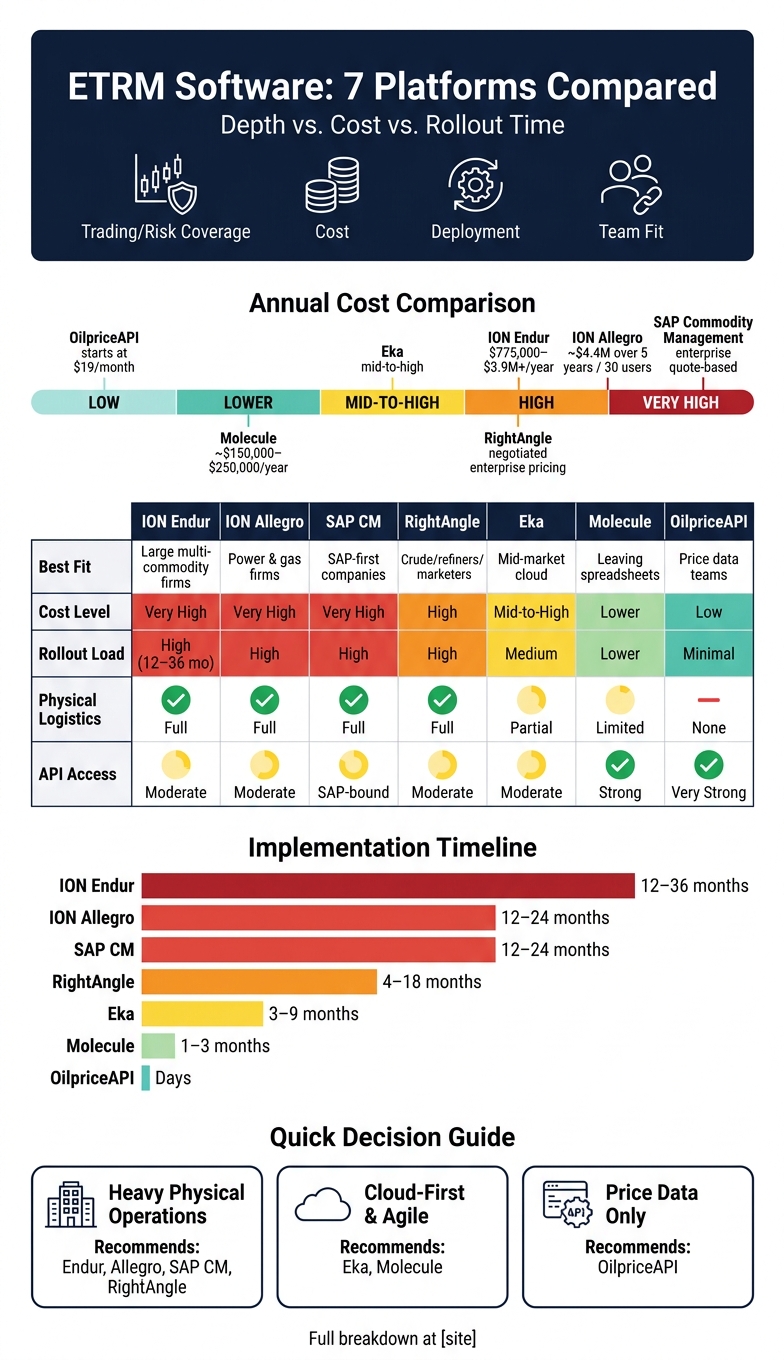
If you trade energy in the U.S., your software choice usually comes down to one simple trade-off: depth vs. cost vs. rollout time. In this article, I compare 7 options - ION Endur, ION Allegro, SAP Commodity Management, RightAngle, Eka, Molecule, and OilpriceAPI - using 4 checks: trading/risk coverage, cost, deployment/integration, and team fit.
Here’s the short version:
- Endur and Allegro fit large desks with power, gas, crude, and back-office needs.
- SAP Commodity Management fits firms already deep in SAP S/4HANA.
- RightAngle is aimed at crude, refined products, logistics, and downstream accounting.
- Eka and Molecule suit firms that want a cloud setup and a lighter rollout.
- OilpriceAPI is not an ETRM. It’s a price data layer for Brent, WTI, natural gas, and gold.
A few numbers stand out:
- Endur can run from $775,000 to $3.9 million+ per year with 12–36 month rollouts.
- Allegro was estimated at about $4.4 million over five years for 30 users.
- Molecule is often cited around $150,000–$250,000 per year.
- OilpriceAPI starts at $19/month.
If I were shortlisting tools, I’d look at these first:
- Do I need trade capture, scheduling, settlement, and risk in one system?
- Do I need power/gas workflow depth or just cleaner market data?
- Can my team handle a 12+ month implementation?
- What does 3–7 year total cost look like, not just year 1?
Quick Comparison
| Product | Best fit | Cost level | Rollout load | Main point |
|---|---|---|---|---|
| ION Endur | Large multi-commodity energy firms | Very high | High | Deep front-to-back ETRM |
| ION Allegro | Power and gas-heavy firms | Very high | High | Strong scheduling and risk |
| SAP Commodity Management | SAP-first companies | Very high | High | ERP-linked trading and finance |
| RightAngle | Crude, fuels, refiners, marketers | High | High | Physical logistics plus accounting |
| Eka | Mid-market multi-commodity firms | Mid-to-high | Medium | Cloud CTRM/ETRM with broad coverage |
| Molecule | Firms leaving spreadsheets or old systems | Lower | Lower | SaaS-first with API access |
| OilpriceAPI | Teams that need benchmark price data | Low | Low | Price feed, not trade processing |
My takeaway: if you run heavy physical energy workflows, you’re likely looking at Endur, Allegro, SAP, or RightAngle. If you want a lighter cloud setup, Eka or Molecule may fit better. If your stack is already in place and you mainly need price inputs for valuation, dashboards, or risk models, OilpriceAPI sits in that lane.
Below, I break the options down without repeating every product detail line by line.
ETRM Software Comparison: Cost, Deployment & Best Fit 2024
Simulator Demo - What do ETRM applications look like?
sbb-itb-a92d0a3
1. ION Openlink Endur
Endur is the enterprise yardstick in this comparison: broad asset coverage, deep setup options, and a heavy lift to put in place. In crude trading, people often say "Openlink" when they mean Endur. It’s ION’s main ETRM platform for large energy desks, and big trading houses and integrated energy companies use it. Endur supports power, gas, crude, refined products, LNG, emissions, and freight. It helps firms move away from scattered spreadsheets and one-off tools across desks. Its core strength is depth across trading, risk, and back-office work.
Trading and risk coverage
Endur packs risk and trading tools into the trade-capture system itself. That includes VaR, scenarios, stress tests, curve and volatility models, exposure analysis, and limits monitoring. Traders also get real-time P&L, position views, configurable desktops, plus exchange and broker connectivity for straight-through processing. On the crude and refined products side, it covers dated Brent pricing, assay libraries, crack spreads, and tanker logistics.
Pricing and total cost of ownership
That depth comes with a price: more time to deploy and a higher total cost. Pricing is quote-based and depends on user count, modules, and support. Large deployments often land in the £600,000 to £3 million+ per year range, with implementation timelines of 12 to 36 months. And the license is only part of the bill. License fees usually make up 30% to 40% of five-year TCO, while implementation, integration, customization, support, and upgrades make up the rest. If you're sizing this platform, model five-year TCO upfront and ask for year-3 and year-5 pricing.
Deployment and integration
This is where Endur can feel less like a software buy and more like a long-term IT program. It runs on-premises or in Endur Cloud. More recent deployments use Docker/Kubernetes, Kafka, and CI/CD to cut upgrade friction. Integration options include REST/SOAP APIs, SAP and Oracle connectors, bank connectivity, and market-data adapters.
Role-specific fit
| Team | Primary use |
|---|---|
| Front office | Trade capture, real-time P&L, exchange connectivity, hedging workflows |
| Risk | VaR, stress testing, credit exposure, collateral management, limits monitoring |
| Finance and back office | Settlements, invoicing, ERP/GL integration, multi-currency books, audit trails |
| IT and developers | API integrations, ERP connectors, Kafka streaming, containerized environments |
Endur shows up in 181 ETRM-related job listings, about 29% of the market, which also hints at how specialized the support talent is around the platform.
2. ION Allegro
ION Allegro runs on the Horizon architecture, which lets firms roll it out desk by desk instead of flipping the switch all at once. It’s a front-to-back ETRM platform built for utilities, power generators, gas and liquids traders, and multi-commodity firms. Its strongest area is power and natural gas, with added support for refined products, emissions, renewables, and other commodities.
That product mix matters. If a team lives in power and gas every day, Allegro often feels like the tighter fit. It’s built for desks that need strong scheduling, nominations, and region-level risk control. If Endur is the broad enterprise choice, Allegro is usually the sharper match for power- and gas-heavy operations.
Trading and risk coverage
Allegro covers trade capture, position management, scheduling and nominations, settlement, and regulatory reporting. Traders get real-time position and P&L views. Risk teams can run VaR, earnings-at-risk, stress tests, and scenario analysis across market, credit, and liquidity risk. The Trade Strategy module adds another layer by comparing live portfolios with simulated positions and stress tests through dashboards.
On the power side, Allegro supports five-minute intervals and instruments like weekly and average rate futures used in Nordic and Baltic markets. On the gas side, it handles pipeline scheduling and nominations. Allegro ↔ NatGasHub Connect can also sync scheduled quantities across 300+ North American pipelines in real time.
Pricing and total cost of ownership
Allegro sits firmly in the high-cost enterprise tier. For a 30-user deployment, one independent analysis puts five-year TCO at about £3.41 million. That works out to roughly £113,000 per user per year all-in, including licenses, implementation, internal IT, upgrades, consulting, and integration maintenance.
In that same estimate, annual license fees are about £280,000, while first-year implementation comes in around £650,000. Consulting and customization often add another 20% to 40% on top of implementation costs.
That’s why buyers should push for a five-year TCO model that breaks out:
- Software
- Implementation
- Internal staffing
- Upgrades
- Integration maintenance
- Add-on modules
Without that breakdown, the price can look cleaner than it is.
Deployment and integration
For many buyers, the main issue isn’t feature depth. It’s integration scope. Horizon was redesigned so firms can deploy Allegro desk by desk, such as upgrading gas without disrupting power or emissions desks. That can make change management a lot less painful.
Deployment choices include on-premises, private cloud, and cloud-native options through ION Cloud. Over a five-year period, cloud and private-cloud setups usually cut infrastructure and upgrade costs.
Integration often reaches into SAP, market data feeds, logistics systems, and analytics tools through APIs or message buses. And in practice, firms need to move a lot more than trade data. Positions, exposures, credit data, valuations, curves, and scenario outputs often need to flow into downstream reporting and analytics systems.
For Brent, WTI, or gas-indexed portfolios, OilpriceAPI can supply real-time and historical benchmark data for valuation and scenario models.
Role-specific fit
| Team | Primary use |
|---|---|
| Traders | Deal capture, real-time P&L, granular power reporting, and support for modern derivative instruments |
| Risk analysts | VaR, earnings-at-risk, stress testing, scenario analysis, and counterparty credit exposure monitoring |
| Finance and back office | Deal-to-cash workflows, settlement automation, ERP integration, hedge accounting support |
| IT and developers | API and message-bus integrations, desk-by-desk rollout, ERP connectors, and market data feeds |
3. SAP Commodity Management / CTRM
For companies already running on SAP, the main issue isn’t feature count. It’s how well the CTRM layer fits the ERP stack. SAP Commodity Management sits inside SAP S/4HANA as an ERP-embedded CTRM layer. That makes it a strong match for firms that want trading, risk, finance, logistics, and procurement working in the same system.
Trading and risk coverage
SAP CM supports both physical and financial trades, including forwards, futures, swaps, options, and Asian options with average pricing periods. It also ties those trades back to the physical positions underneath them.
On the pricing side, CPE handles indexed pricing, tiered pricing, quality differentials, provisional invoices, and final true-ups linked to market quotes. For risk teams, Market Risk Analyzer covers mark-to-market valuation, VaR, sensitivity analysis, and option greeks such as delta. Position reporting pulls exposures from derivatives, logistics documents, and material stock into a single exposure view.
Commodity Hedge Cockpit and hedge accounting tools also support ASC 815 and IFRS 9 compliance. They do this by splitting hedge programs into separate hedge books and hedging areas.
Pricing and total cost of ownership
SAP CM is sold as SAP modules, usually through perpetual or subscription pricing with annual maintenance. Total cost goes beyond the license. It also includes implementation, infrastructure, upgrades, and team training.
If your desk tracks WTI, Brent, or Henry Hub exposure, REST-based benchmark feeds such as OilpriceAPI can help cut market-data costs inside SAP risk workflows.
Deployment and integration
SAP CM can run on-premises or in SAP HANA Enterprise Cloud. It connects natively with MM, SD, FI/CO, and TRM. It can also link with IS-OIL, Global Trade Management, and Transportation/Scheduler's Workbench for oil and gas logistics. For outside data, SAP uses CDS views and APIs to pull in market data, trade confirmations, and regulatory data.
The tradeoff is pretty plain. Deep ERP integration can cut reconciliation work, which is a big deal. But it also adds more moving parts across dev, test, and prod, plus upgrades and outside analytics tools.
The next platform shifts back to a purpose-built ETRM setup, with a different integration load.
Role-specific fit
| Team | Primary use |
|---|---|
| Traders | Formula-based pricing, physical and financial deal capture |
| Risk analysts | VaR, MtM, sensitivity analyses, hedge effectiveness testing |
| Finance and back office | Hedge accounting, automated valuation postings, SOX-compliant audit trails |
| IT and developers | ABAP and CDS extensions, REST API integrations for market data, custom Fiori dashboards |
4. RightAngle
RightAngle, also from ION Group, is a CTRM built for crude producers, refiners, marketers, and large fuel consumers. It tends to fit companies that want hydrocarbon workflows, credit control, and downstream accounting in the same system. In practice, the big decision points are workflow depth, integration work, and total cost.
Trading and risk coverage
RightAngle covers the full transaction lifecycle: trade capture, scheduling, inventory, ticketing, settlement, tax, and financial reporting. Its Credit Center connects trading, invoicing, and payment data so teams can track credit exposure in real time.
On the risk side, it supports Value-at-Risk through Monte Carlo simulation, stress testing, and counterparty credit exposure analysis. It also supports RINs, carbon offsets, and renewable energy credits. So if your desk deals with both physical barrels and the paperwork that follows them, RightAngle is built to handle that whole chain.
Pricing and TCO
RightAngle does not publish list prices. Pricing is negotiated based on scope, user count, and deployment model, along with implementation and support.
The main cost driver is usually implementation scope, not just the license. That means teams should budget for process redesign, custom deal templates, auto-matching rules, invoice templates, reporting, upgrades, regulatory changes, and training. This is where costs can creep up fast if the rollout gets broad.
Deployment and integration
RightAngle supports both on-premises and cloud deployment, and recent releases have put more focus on Azure, OpenID Connect SSO, and MFA. RightAngle Xpress bundles core functions for smaller firms; one cloud implementation took about four months.
Integration work usually includes ERP posting, market data feeds, and cash and credit systems. Finance needs ERP posting. Risk needs market-data feeds. IT needs SSO and API integration. That mix matters most when finance, logistics, and IT all expect the same system to stay in sync.
Role-specific fit
| Team | Primary use |
|---|---|
| Traders | Trade capture and crude/products scheduling |
| Risk analysts | VaR, stress testing, credit exposure |
| Schedulers and logistics | Inventory, ticketing, logistics coordination |
| Finance and back office | Settlement, invoicing, tax, GL posting |
| IT and developers | ERP, market data, SSO/MFA integration |
5. Eka
Eka is a cloud-first CTRM/ETRM platform built for multi-commodity firms that want trade capture, risk, logistics, and finance in one place. It covers energy, agriculture, metals, and manufacturing inputs.
Trading and risk coverage
Eka covers the full trade lifecycle, from pre-trade analysis through settlement. That means teams can track physical, derivatives, and FX positions in the same system, while real-time P&L and exposure update across books and portfolios as market prices change.
On the risk side, Eka includes:
- VaR
- Scenario analysis
- Limit monitoring
- Breach alerts
Eka.Risk pulls risk data from multiple trade capture systems, ERPs, and spreadsheets into a single view. For risk teams, that matters. Instead of stitching together reports by hand, they can work from one shared picture of exposure.
Pricing and TCO
Eka uses annual, user-based subscription pricing with basic, professional, and enterprise tiers. Larger deployments may use custom pricing, especially when they need more setup work or deeper integrations.
Total cost of ownership includes more than the subscription fee. Teams also need to account for implementation, support, and internal IT costs. Eka does help trim some build work because it comes with prebuilt risk engines and connectors.
Deployment and integration
For IT and finance teams, the big issue is fit. How easily does Eka plug into the systems already in place?
Eka supports both cloud and on-premises deployment, with multi-tenant and single-tenant options. Its integration layer includes web services, a common data model, 20+ connectors, and ETL tools for ERPs, data warehouses, and market data APIs.
Eka's VaR and risk apps can pull market prices from third-party data providers alongside internal trade and position data. That helps keep forward curves, settlement prices, and FX rates current for risk calculations. IT teams should still plan for API mapping, scheduled feeds, and role-based access controls.
Role-specific fit
| Team | Primary use |
|---|---|
| Traders | Trade capture, scheduling, and real-time P&L and risk |
| Risk analysts | VaR, limit monitoring, scenario analysis, and enterprise risk consolidation |
| Finance and back office | Hedge accounting, financial close, P&L reporting, and ERP integration |
| IT and developers | API-driven integration, data modeling, and cloud deployment configuration |
For teams that mainly need commodity data APIs instead of a full operating platform, the next section moves to that layer.
6. Molecule
Molecule is a cloud-native ETRM/CTRM built for firms moving off spreadsheets and older on-prem systems. If you're comparing options, the big things to look at are trading coverage, how fast you can get live, and how much integration work your team will need to carry. Molecule fits teams that want solid ETRM depth without getting stuck in a rollout that drags on for years. It supports 50+ commodities across both physical and financial products.
Trading and risk coverage
Molecule covers the core workflows most trading teams care about: deal capture, automated position tracking, near-real-time P&L, and risk processes like VaR and FCM (futures commission merchant) reconciliation.
It also supports physical and financial instruments such as:
- Futures
- Options
- Swaps
- Physical deliveries
The product covers 25,000+ products representing nearly $100 billion in value.
If your desk works in power, the add-on modules matter. Molecule extends into power markets and ISO data, and it also offers extra modules for renewable energy certificates and other asset classes.
Pricing and TCO
Molecule’s lighter SaaS setup shows up in the cost model too. Pricing is quote-based and usually runs on 1- to 2-year contracts, with Fund, Core, and Enterprise packages based on the number of desks and the integrations you need.
There’s no public price sheet, but market commentary puts annual cost at about $150,000 to $250,000, depending on portfolio complexity. Implementation is included in the Fund package. For Core and Enterprise, implementation is priced upfront based on book complexity, which can make spending easier to plan as an operating expense.
Buyers should also watch for extra charges tied to new users, custom reports, or reconfiguration.
Deployment and integration
Molecule is easier to roll out than a big enterprise suite, but that doesn’t mean setup is automatic. It’s cloud-based, and continuous updates are included in the subscription. Even so, teams should plan for an early configuration phase around instruments, curves, counterparties, and reference data.
On the integration side, Molecule includes 30+ connectors for exchanges, ISOs, FCMs, market data sources, and GL systems. Trades from venues like ICE, CME/NYMEX, Nodal, and Trayport can flow in through built-in connectors, which helps cut manual entry.
For teams that want to move data into their own stack, developers can pull trade, position, and risk data through a JSON/CSV REST API. That data can feed into Excel, Power BI, or internal data warehouses through the Bigbang module.
Role-specific fit
| Team | Primary use |
|---|---|
| Traders | Automated deal capture, near-real-time P&L, and multi-commodity position tracking |
| Risk analysts | VaR, exposure profiles, mark-to-market valuations, and compliance-oriented monitoring |
| Finance and back office | FCM reconciliation, GL integration, and automated P&L reporting |
| IT and developers | REST API, data-lake outputs, and 30+ standard connectors for custom workflows |
7. OilpriceAPI
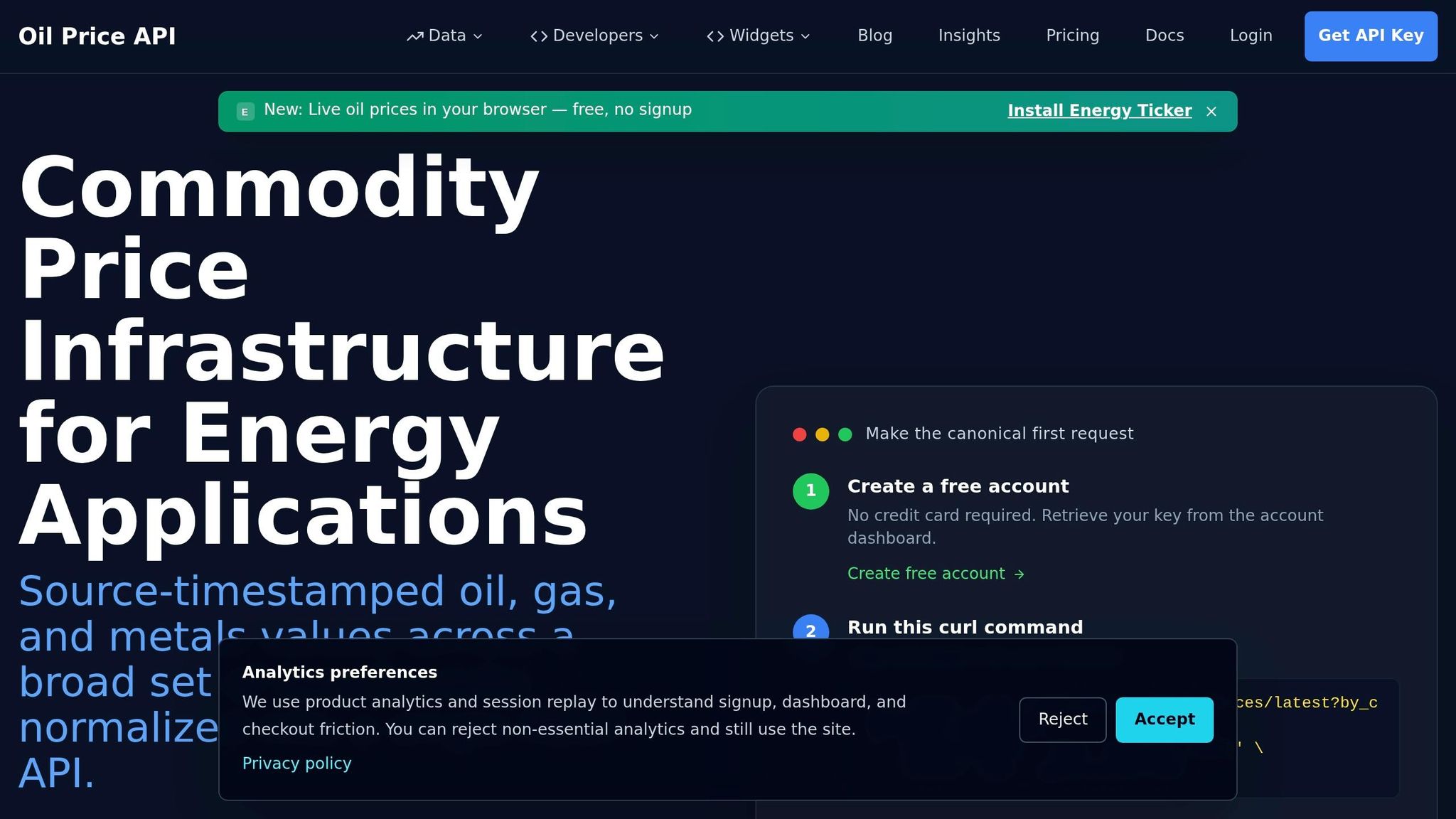
OilpriceAPI is a commodity price API, not an ETRM suite. It plugs Brent, WTI, natural gas, and gold prices into your current stack. So if your valuation, forecasting, or reporting depends on live benchmark prices, this tool can fill that gap. It supports valuation, forecasting, and reporting with current price data.
Pricing and TCO
Pricing uses a subscription model with tiers based on monthly request volume:
| Plan | Monthly Cost | Requests/Month | Key Inclusions |
|---|---|---|---|
| Developer | $19.00 | 10,000 | Core benchmarks, REST API |
| Starter | $49.00 | 50,000 | Price alerts and futures curves |
| Professional | $99.00 | 100,000 | 5+ years of historical data, all energy benchmarks |
| Enterprise | Custom | 200,000+ | SLAs, dedicated support |
Total cost of ownership stays fairly narrow. Beyond the subscription, the main spend usually comes from developer time for integration and upkeep, plus any in-house setup for caching, storage, monitoring, and data validation.
Deployment and integration
OilpriceAPI is cloud-based and accessed over HTTPS. Its REST endpoints update every five minutes for most commodities, and premium plans also include WebSocket streaming for near-real-time use cases.
The service also offers official Python and Node.js SDKs. Since the API returns normalized JSON, teams can map instrument codes to internal product IDs without building custom parsers from scratch. That cuts down setup work.
In many ETRM environments, integration follows a simple scheduled-job pattern. An adapter calls the API at set times, such as before the market opens or at end of day, then loads those prices into internal curves. Those curves then feed valuation and risk calculations.
Each price point includes a source timestamp. That matters for audit trails, especially when finance teams need to trace mark-to-market values back to a specific data point for auditors.
Role-specific fit
These workflows show where OilpriceAPI tends to fit across finance, risk, and developer teams:
| Team | Primary use |
|---|---|
| Traders | Real-time Brent and WTI dashboards, intraday P&L reference, price alerts |
| Risk analysts | Historical series for VaR, stress testing, and hedge effectiveness |
| Finance and accounting | Auditable end-of-day price snapshots for mark-to-market and fair value reporting |
| IT and developers | REST API, Python/Node.js SDKs, and Excel add-in support for integration workflows |
Features, Costs, and Use Cases Side by Side
The tables below compare functional depth, cost, deployment, and buyer fit.
Trading and risk coverage
The big split here comes down to depth. Enterprise suites handle end-to-end trading workflows, while lighter tools focus on a smaller slice of the job.
ION Endur, ION Allegro, SAP Commodity Management, and RightAngle support multi-commodity portfolios and a broad set of instruments, from physical forwards to options and swaps. They also cover position management, mark-to-market, VaR, stress testing, credit controls, and physical logistics workflows like scheduling and nominations. Eka and Molecule handle core trading and risk reporting well, though logistics coverage changes by commodity. OilpriceAPI plays a different role: it provides market data inputs, not trade capture, settlement, or scheduling.
| Capability | ION Endur | ION Allegro | SAP CM | RightAngle | Eka | Molecule | OilpriceAPI |
|---|---|---|---|---|---|---|---|
| Multi-commodity coverage | ✓ | ✓ | ✓ | ✓ | ✓ | ✓ | Brent, WTI, natural gas, Gold |
| Forwards, futures, options, swaps | ✓ | ✓ | ✓ | ✓ | ✓ | ✓ | Price data only |
| Position management | ✓ | ✓ | ✓ | ✓ | ✓ | ✓ | - |
| Mark-to-market / P&L | ✓ | ✓ | ✓ | ✓ | ✓ | ✓ | Price inputs |
| VaR and stress testing | ✓ | ✓ | ✓ | ✓ | ✓ | ✓ | Historical price data |
| Credit controls | ✓ | ✓ | ✓ | ✓ | Partial | Partial | - |
| Scheduling and nominations support | Full | Full | Full | Full | Partial | Limited | - |
OilpriceAPI supplies benchmark prices for valuation and risk models. It does not handle trade capture, scheduling, or settlement.
Cost and deployment often decide whether that level of depth makes sense in practice.
Pricing and total cost of ownership
Feature breadth only matters if the budget and staffing model can carry it. Cost usually comes from four places: licensing, implementation, staffing, and integration. Cloud-native tools like Eka and Molecule cut infrastructure overhead, but they still need support and integration work.
| Product | Pricing model | Implementation effort | Infrastructure / hosting | Typical cost profile |
|---|---|---|---|---|
| ION Endur | Enterprise quote-based | High | On-premises, private cloud, or hosted | Very high |
| ION Allegro | Enterprise subscription / quote-based | High | Cloud-hosted | Very high |
| SAP CM | Enterprise quote-based | High | SAP ecosystem | Very high |
| RightAngle | Enterprise quote-based | High | Azure-based cloud | High |
| Eka | Subscription-based | Moderate | SaaS / cloud or on-prem | Mid-to-high |
| Molecule | Subscription-based | Lower | Multi-tenant SaaS | Lower |
| OilpriceAPI | Tiered subscription starting at $19/month, with higher tiers at $49/month and $99/month; custom enterprise pricing | Minimal | SaaS | Low |
OilpriceAPI keeps total cost of ownership narrow on purpose. Beyond the subscription, the main spend is usually developer time for integration, plus any internal setup for caching or monitoring.
Deployment and integration requirements
Integration work can matter just as much as feature depth. A tool may look strong on paper, but if it takes forever to connect to the rest of your stack, that changes the picture fast.
Deployment models vary a lot across this group. Endur and Allegro are often deployed on-premises, in privately hosted setups, or in cloud-hosted environments. SAP Commodity Management fits most naturally in organizations already running SAP S/4HANA. RightAngle runs on Azure infrastructure. Eka and Molecule are SaaS-first, with vendor-managed upgrades.
| Dimension | ION Endur | ION Allegro | SAP CM | RightAngle | Eka | Molecule | OilpriceAPI |
|---|---|---|---|---|---|---|---|
| Deployment model | On-premises, private cloud, or hosted | Cloud-hosted | On-prem or cloud depending on SAP strategy | Azure-based cloud | SaaS or on-prem | Multi-tenant SaaS | SaaS (cloud-native) |
| Upgrade responsibility | Customer-managed or vendor-assisted | Vendor-managed | Customer or SAP depending on environment | Vendor-managed | Vendor-managed | Vendor-managed | Vendor-managed |
| API maturity | Mature | Mature | SAP-native | Mature | REST/JSON | REST/JSON | High (REST/JSON) |
| ERP / GL integration | Strong | Strong | Native in SAP environments | Strong | Strong | Moderate | Direct JSON feed |
| API access and customization | High, but complex | Moderate | SAP tools | Moderate | Moderate | Moderate | High |
OilpriceAPI is simple to ingest into internal systems. It runs over HTTPS, returns normalized JSON, and is built for lightweight integration into ETRM environments, data warehouses, and custom risk models.
Best fit by team and operating model
Once product fit is narrowed down, team workflow usually becomes the next filter. Finance teams care about auditability and close-cycle reliability. Risk analysts need intraday recalculation and enough historical depth to test models with confidence. Developers tend to look for clean APIs and room to extend the system without fighting it.
| Role / Need | ION Endur | ION Allegro | SAP CM | RightAngle | Eka | Molecule | OilpriceAPI |
|---|---|---|---|---|---|---|---|
| Finance: valuation control | Strong | Strong | Strong | Strong | Strong | Moderate | Price inputs only |
| Finance: close and reconciliation | Strong | Strong | Strong | Strong | Strong | Moderate | Auditable price inputs |
| Risk: intraday recalculation | Strong | Strong | Moderate | Strong | Moderate | Strong | Real-time price inputs |
| Risk: historical depth | Strong | Strong | Strong | Strong | Strong | Strong | Historical price inputs |
| Developer: custom analytics | Moderate | Moderate | SAP-bound | Moderate | Moderate | Strong | Strong |
| Developer: API and SDK access | Moderate | Moderate | Limited | Moderate | Moderate | Strong | Strong |
OilpriceAPI fits the data layer, not the transactional core.
Pros and Cons
Full ETRM suites vs. specialist data APIs
Full ETRM suites handle the trade lifecycle end to end. Specialist data APIs provide the price data that feeds the system running trading and operations. They can work side by side, but one does not replace the other.
Pros and cons for each product
The summary below strips the choice down to the buyer trade-offs that matter most.
| Product | Pros | Cons | Best For |
|---|---|---|---|
| ION Openlink Endur | Mature implementation ecosystem; strong credit and compliance controls | Long timelines; high total cost; customization complicates upgrades | Large utilities and integrated energy traders needing enterprise-grade controls |
| ION Allegro | Centralized credit information; broad commodity workflow support | Interface complexity; enterprise deployment overhead; pricing not public | Commodity trading teams requiring a full transaction platform |
| SAP Commodity Management / CTRM | Native SAP integration; fits existing enterprise processes | Complex outside SAP ecosystem; customization requires SAP expertise | SAP-centric enterprises managing commodity exposure |
| RightAngle | Strong physical logistics tied directly to financials | Rigid workflows; changes require specialized consultants | U.S. refiners, marketers, and pipeline operators with complex physical logistics |
| Eka | Faster SaaS deployment | Smaller ecosystem; niche commodity and logistics coverage can be limited | Mid-market firms wanting SaaS ETRM without on-premise infrastructure |
| Molecule | Cloud-native; REST/API-based integration | Less depth than legacy suites for complex physical operations | Trading teams prioritizing agility and developer-friendly integration |
| OilpriceAPI | Simple REST integration; plans start at $19/month | No trade capture, position management, or logistics | Developers, risk analysts, and finance teams needing reliable commodity price data |
The pattern here is pretty clear. Full ETRM platforms are built to manage trades, controls, workflows, and logistics across the business. That usually means more setup time, more cost, and more work when you want to change how the system behaves.
OilpriceAPI sits in a different lane. It does not try to capture trades or run operations. It focuses on delivering commodity price data through a simple REST setup, which makes it a better fit when the main need is valuation, dashboards, analytics, or hedging commodity price risk instead of a full transaction system.
That difference shapes the platform decision by operating model. A large trading shop with heavy physical operations may need the depth of a suite like Endur, Allegro, SAP Commodity Management / CTRM, or RightAngle. A team that already has its systems in place and just needs dependable market data may find that a specialist API is the cleaner choice.
For existing ETRM users, OilpriceAPI can work as a price-feed layer for valuation, dashboards, and risk models.
Conclusion
Matching platform type to buyer needs
There isn’t one ETRM platform that works for every organization. The right pick depends on what the business has to do every day.
Large trading houses, utilities, and integrated oil and gas firms usually need the depth that only a full enterprise suite can deliver: physical logistics, multi-commodity risk controls, audit trails, and regulatory reporting across front-, middle-, and back-office workflows. When day-to-day work runs deep, a full suite makes sense.
Mid-market firms and specialized teams should score each option against the four criteria used throughout this article - coverage, cost, deployment, and integration - and pick the platform that fits how they actually operate, not the one with the longest feature list.
If the core platform is already in place, the next gap is often price data rather than trade processing. OilpriceAPI provides real-time and historical benchmark prices for Brent Crude, WTI, Natural Gas, and Gold, with entry-level plans starting at $19 per month.
Final evaluation checklist
Use the checklist below to pressure-test your shortlist against your operating model.
| Checklist Item | What to Verify |
|---|---|
| Commodity coverage | Does it support current and planned benchmarks and instruments? |
| Operational depth | Can it handle physical workflows - scheduling, nominations, logistics, settlements - without heavy customization? |
| Total cost of ownership | Have you accounted for licensing, implementation, infrastructure, support, and upgrades over a 3–7 year horizon? |
| Deployment fit | Does the hosting model align with your security policies, data residency requirements, and IT capacity? |
| Data access | Can users and downstream systems pull data via API, batch export, or reporting tools? |
| Internal implementation capacity | Does your team have the project management, business analysis, and developer resources to absorb the implementation without stalling core operations? |
The teams that make the best platform choices line up features, costs, and use cases with the way they actually work. A U.S. gas and power trader with complex ISO scheduling needs will weigh physical operations and nominations very differently from a trading boutique focused on liquid OTC products. Pick based on your operating model, not raw feature count.
FAQs
How do I choose between a full ETRM and a price data API?
Choose based on your scope and technical resources.
A full ETRM handles end-to-end workflows like trade capture, mark-to-market valuations, and risk analytics. But it often takes more time to set up, learn, and roll out across a team.
A price data API like OilpriceAPI makes more sense if you mainly need real-time and historical commodity prices inside custom apps, dashboards, or treasury workflows. You get the data you need without the heavier lift that usually comes with a full ETRM.
What hidden costs should I expect beyond software licensing?
Beyond licensing, plan for a few other cost buckets:
- middleware and system integration
- maintenance, technical support, and infrastructure management
- data acquisition for institutional-grade market information
Cloud-native solutions can cut infrastructure spend. But higher data volumes and performance tuning can still push costs up. That's where caching helps. It can trim recurring costs by reducing API call volume and making data usage more efficient as you scale.
How long does ETRM implementation usually take?
ETRM implementation time depends a lot on how the system is deployed.
On-premises ETRM systems usually take 6 months or more. That longer timeline often comes down to setup, integration work, and internal IT demands.
Cloud-based ETRM platforms tend to move faster, with implementation often taking around 3 months. There’s simply less heavy lifting on the infrastructure side.
Then there are specialized API-based tools. For example, OilpriceAPI can often be set up in just 1 to 3 days for commodity data integration. That’s a very different lift from rolling out a full enterprise platform.
That said, larger enterprise systems can still take 2 to 3 months, especially when training and integration are part of the project.