U.S. pipeline corrosion costs about $7 billion per year - so coating choice has a direct effect on pipeline life, repair risk, and maintenance spend. If I had to boil this topic down, I’d say this: polymer nanocomposite coatings can lower gas and water movement through the film, hold onto steel better, and wear more slowly than standard polymer coatings - but only if the resin, filler, surface prep, and test data all line up.
Here’s the short version in plain English:
- Internal corrosion often starts when water condenses in wet gas and mixes with CO₂ or H₂S
- External corrosion starts when buried steel meets wet soil, salts, oxygen, and microbes
- Coatings are the first barrier; cathodic protection helps at damaged spots
- Epoxy, PU, 3LPE/3LPP, and fluoropolymers each fit different service conditions
- Graphene, nanoclay, nano-silica, and ceramic oxides can cut permeability and improve wear resistance
- Lab data in the article shows effects like 66% lower CO₂ permeability, 74% lower abrasion wear, and much lower water uptake in some systems
- A coating still has to pass EIS, immersion, adhesion, abrasion, bend/impact, cathodic disbondment, and holiday tests
- In procurement, I’d focus first on adhesion, cathodic disbondment, and water ingress
If you’re choosing a system, the main question is simple: what is the biggest threat - wet gas, sour service, sand, heat, soil exposure, or field damage? That answer should drive matrix choice, filler type, thickness, and qualification testing.
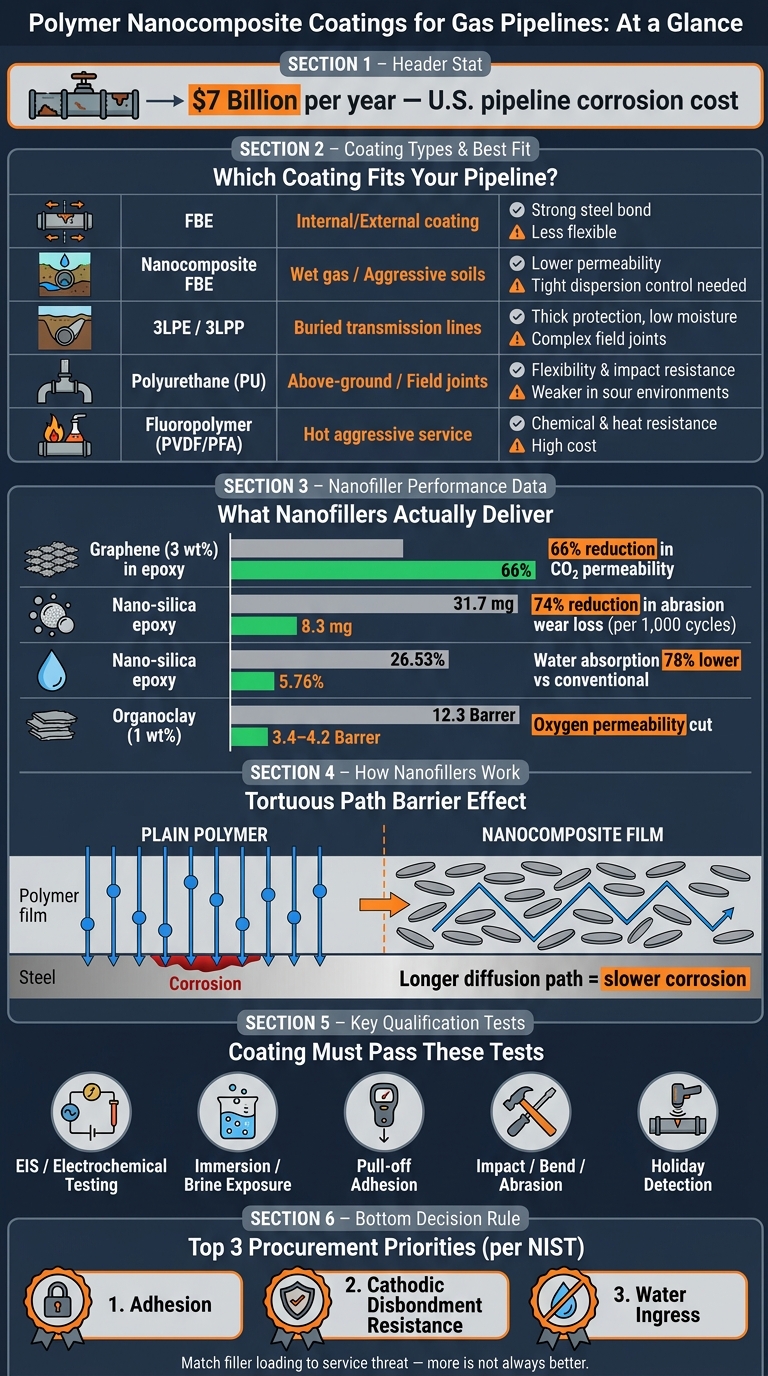
Polymer Nanocomposite Coatings for Gas Pipelines: Performance Comparison
Lecture 48 : Composite Coating
sbb-itb-a92d0a3
Quick comparison
| Coating / Filler | Best fit | Main upside | Main limit |
|---|---|---|---|
| FBE | Internal or external pipeline coating | Strong bond to steel; works with CP | Less flexible than PU |
| Nanocomposite FBE | Wet gas or harsher buried service | Lower permeability; better disbondment resistance | Needs tight filler dispersion control |
| Liquid / novolac epoxy | Internal wet gas or sour service | High chemical resistance | Field application can be harder |
| PU | Above-ground sections and field joints | Good flexibility and impact resistance | Lower resistance in harsh sour exposure |
| 3LPE / 3LPP | Buried transmission lines | Thick outside protection and low moisture pickup | Field-joint work is more involved |
| PVDF / PFA | Hot, aggressive internal service | Strong chemical and heat resistance | High cost |
| Graphene / clay fillers | Barrier-focused systems | Harder for gas and water to pass through film | Clumping can hurt results |
| Nano-silica / ceramic oxide fillers | Abrasive or high-flow service | Higher hardness and lower wear | Viscosity control matters |
Bottom line: I’d treat nanocomposite coatings as a way to improve a polymer system you already trust, not as a fix-all. The best choice is the one that matches service conditions and comes with solid qualification and field QC data.
Material Selection: Choosing the Polymer Matrix and Nanofillers
Common Polymer Matrices for Internal Linings and External Coatings
The polymer matrix does most of the heavy lifting. It sets adhesion, flexibility, and chemical resistance. Nanofillers help fine-tune the coating, but they don’t replace the job of the base resin.
Fusion-bonded epoxy (FBE) is one of the main matrix options for both internal linings and external pipeline coatings. It bonds well to blast-cleaned steel, holds up against CO₂ and moderate H₂S, and works with cathodic protection systems. On the outside of the pipe, FBE is usually applied at 300–500 µm dry-film thickness and can provide 25–40 years of buried service under ISO 21809-1. On the inside, FBE and liquid epoxy systems are often used at 250–400 µm. Add nanofillers to that film, and you can cut permeability and improve wear life.
Polyurethane (PU) is more flexible than epoxy. That makes it a good fit for above-ground pipe sections, field joints, and areas that see vibration, temperature swings, or impact. 100% solids PU systems are widely used for rehabilitation and field-joint coatings.
Three-layer polyethylene (3LPE) and polypropylene (3LPP) systems are common on long buried transmission lines. They use an FBE primer, an adhesive tie-layer, and a thick PE or PP outer layer. That outer layer helps with moisture resistance and physical protection.
Fluoropolymers, including PVDF and PFA, are used where condensates are aggressive, H₂S is high, or temperatures run hot. Their chemical resistance is strong, but material and application costs are higher, so they’re usually reserved for selected sections instead of full-line use.
Nanofillers That Improve Barrier and Mechanical Performance
Once you’ve picked the matrix, filler choice decides how far the coating can go on barrier and abrasion performance. In plain terms, nanofillers change the inside of the polymer film. That makes it harder for water, oxygen, ions, and gas molecules to move through the coating, while also helping the film stand up to wear.
Graphene nanoplatelets (GNPs) are standout barrier fillers. Because the platelets are impermeable, they force water and gas molecules to take a longer, more difficult path through the film. At 3 wt% loading in epoxy, GNPs have delivered a 66% reduction in CO₂ permeability. Even at 0.1–1.0 wt%, they can still improve corrosion-barrier behavior in electrochemical testing. The catch is dispersion. If the particles clump together, performance can drop fast.
Nano-silica is mainly used to improve hardness, scratch resistance, and abrasion resistance. That makes it a strong match for internal coatings in high-velocity service or sand-laden flow, and for external coatings that may get damaged during handling or backfilling. Clay platelets, such as montmorillonite-based organoclays, help barrier performance by making transport paths for water and ions more difficult. Ceramic oxides like nano-alumina and nano-titania add hardness, wear resistance, and thermal stability, which matters when temperatures start climbing.
You can also combine fillers. A hybrid system, such as GNPs plus nano-silica, can give you a better mix of barrier and mechanical performance. In most cases, total filler loading stays low, around 0.1–3 wt%, so the coating still disperses well and remains workable during application.
Matching Coating Chemistry to Service Conditions
The right mix depends on service conditions: gas chemistry, temperature, soil exposure, and mechanical stress all matter. The table below ties common coating systems to typical pipeline use cases.
| Coating System | Typical Use | Suitable Conditions | Key Strengths | Trade-offs |
|---|---|---|---|---|
| FBE (standard) | Internal lining or external coating | Dry to moderately wet gas, CO₂ service | Strong steel adhesion, cathodic protection compatibility, long service life | Requires controlled heat cure; limited flexibility |
| Nanocomposite FBE (GNP or clay) | Internal lining or external coating | Wet gas, CO₂-rich service, aggressive soils | Improved barrier, lower permeability, better disbondment resistance | Stricter QC on filler dispersion; higher formulation cost |
| Liquid epoxy / novolac epoxy | Internal lining | Wet gas, sour service, produced water | High chemical resistance; suitable for elevated temperatures | Pot-life constraints in field; surface prep is critical |
| 3LPE / 3LPP | External buried coating | Buried transmission lines | Excellent mechanical protection, low moisture uptake, multi-decade service life | Complex field-joint coating; higher handling complexity |
| Polyurethane (PU) | External above-ground, field joints | Mechanically loaded, thermally cycled sections | Flexibility, impact resistance, fast field application | Lower chemical resistance than epoxy in sour environments |
| Fluoropolymer (PVDF, PFA) | Internal on critical components | High H₂S, aggressive condensates, high temperatures | Superior chemical resistance, thermally stable | High material and application cost; limited to targeted segments |
| Nanocomposite epoxy (nano-silica or ceramic oxide) | Internal high-velocity or abrasive service | Sand-laden flow, high throughput, elevated temperatures | Improved hardness, abrasion resistance, wear life | Viscosity management needed; filler loading must be controlled |
These options still need lab qualification before field acceptance.
How Nanocomposite Coatings Limit Corrosion
Once the matrix and filler are set, performance comes down to three things: how well the coating slows transport, how well it stays attached to steel, and how well it handles damage. In pipelines, nanocomposites help both internal linings and external coatings by cutting transport, improving bonding, and making the coating harder to wear through.
Barrier Action and Tortuous Diffusion Paths
Pipeline coatings slow corrosion by blocking water, oxygen, CO₂, H₂S, and ions from reaching steel. Those species can get to the metal through defects like holidays and microcracks, or by moving through the coating itself under concentration, pressure, and temperature gradients.
When plate-like fillers such as graphene or nanoclay are well spread through a polymer matrix, they act like tiny roadblocks. Instead of moving straight through the film, molecules have to snake around them along a tortuous diffusion path. That longer route cuts permeability.
The effect can be large. In epoxy–nanoclay systems, adding 1 wt% organoclay cut oxygen permeability from about 12.3 Barrer to 3.4–4.2 Barrer, while 5 wt% pushed it down again to 1.24–2.86 Barrer. For CO₂, graphene-based epoxy coatings have shown up to an order-of-magnitude drop in permeability in autoclave tests that simulate pipeline pressure and temperature conditions. Less permeability means slower electrolyte buildup at the steel surface and more time before corrosion starts.
But barrier action alone isn’t enough. A coating can block transport on paper and still fail if it loses its grip under CP or repeated wet conditions.
Adhesion, Cathodic Disbondment Resistance, and Underfilm Protection
Weak adhesion can wipe out barrier gains fast. Surface-treated nanofillers help by improving bonding at the interface and cutting microvoids inside the coating. Studies on epoxy–nanoclay and epoxy–nano-silica pipeline coatings report higher pull-off adhesion values and slower corrosion creep from scribes during salt spray testing than neat epoxy controls.
Nanocomposites also help resist cathodic disbondment. They do this by making it harder for electrolyte to reach the steel and by helping the coating keep its internal strength around holidays. In cathodic disbondment tests such as ASTM G8/G95, nanocomposite pipeline coatings often show smaller disbonded radii around artificial holes after extended CP exposure than standard FBE or epoxy systems.
That matters because once disbondment starts to spread under the film, corrosion can move under a coating that still looks fine from the outside.
Wear and Moisture Resistance Under Pipeline Service Loads
Pipeline coatings don’t just sit there. They get scraped, hit, dragged, and worn down by pigging, sand, rocks, and handling. That kind of damage creates holidays, and holidays expose steel.
Nanofillers such as nano-silica, nano-alumina, and graphene nanoplatelets help the coating stand up to that wear. In Taber abrasion testing (ASTM D4060), a tar-free epoxy with nano-silica had a wear loss of only 8.3 mg per 1,000 cycles, compared with 31.7 mg per 1,000 cycles for a conventional composite. That’s a 74% drop in wear loss. Graphene/epoxy nanocomposite coatings also showed abrasion resistance gains of up to 70% at tuned graphene loadings compared with neat epoxy. Fewer worn-through spots means fewer holidays and a lower chance of local corrosion starting.
Water uptake matters too. If a coating soaks up moisture, its barrier job gets weaker over time. In one study, a nano-silica epoxy system showed water absorption of 5.76%, compared with 26.53% for a conventional composite. Lower water uptake helps limit underfilm wetting and slows the conditions that let corrosion spread.
These effects don’t work one by one. They stack together. Better barrier performance helps delay steel exposure, stronger adhesion helps keep the film in place, and better wear and moisture resistance helps the coating hold up in service.
| Property | Nanocomposite Effect | Pipeline Result |
|---|---|---|
| Barrier to water/O₂/CO₂ | Tortuous paths; reduced permeability | Slower electrolyte buildup; delayed corrosion initiation |
| Moisture uptake | Lower water absorption; slower diffusion | Less underfilm wetting; reduced corrosion creep |
| Adhesion to steel | Higher pull-off values; better interfacial bonding | Smaller cathodic disbondment areas; better underfilm protection |
| Cathodic disbondment | Limited electrolyte access; higher cohesive strength | More stable long-term protection in CP-managed systems |
| Wear/abrasion resistance | Higher hardness; lower mass loss in ASTM D4060 | Fewer holidays; lower risk of bare steel exposure |
These properties only matter if qualification tests show the same behavior in lab work and field service.
Testing and Qualification of Coating Systems
Lab results are a good starting point. But they don’t prove a coating will hold up in the field.
That’s where qualification testing comes in. It checks barrier performance, adhesion, and resistance to damage on coated steel under conditions meant to mimic pipeline service. The same basic logic applies to both internal linings and external coatings.
Lab Tests for Barrier and Corrosion Performance
Electrochemical impedance spectroscopy (EIS) is one of the main tools for checking barrier quality. It can show water uptake, pore formation, and changes at the coating-steel interface before you can see damage with the naked eye.
In immersion testing, a strong barrier coating will often keep |Z| at 0.1 Hz above 6 × 10⁹ Ω·cm². When that number keeps dropping over time, it usually means electrolyte is getting in or the coating is starting to break down.
EIS is often used alongside immersion or brine exposure testing. In one 2025 study, EVA/ZnO nanocomposite coatings stayed stable during a 28-day immersion period in 3.5% sodium chloride solution. After exposure, teams need to check for clear warning signs, such as blistering, softening, delamination, or adhesion loss.
Nanofiller choice can change results in a big way. For example, adding nanoclay increased corrosion resistance by more than one order of magnitude in EIS and immersion testing in 3.5% NaCl. That’s a good reminder that barrier performance has to be judged as a full coating system, not just by the base polymer.
Barrier testing comes first. Then mechanical testing shows whether the coating can take handling and service without falling apart.
Adhesion, Impact, Bend, Abrasion, and Holiday Testing
Pull-off adhesion testing is the standard way to check bond strength to steel. Cross-hatch testing is a faster screening tool. Both matter. A coating can look chemically tough on paper and still fail if the bond drops off after wet exposure or thermal cycling.
Impact and bend tests are meant to mimic handling damage. Abrasion testing looks at wear resistance, which matters for internal linings in gas streams with entrained particles and for external coatings that may get roughed up during backfilling or pigging.
Holiday detection is also required. Depending on coating thickness, inspectors use either a high-voltage or low-voltage detector to find pinholes, voids, thin spots, and other breaks that leave bare steel exposed. ASTM G62 covers the low-voltage wet-sponge method for thin-film coatings up to 0.508 mm (20 mils).
Only coatings that pass these checks move forward to production approval.
From Qualification to Field Acceptance
A practical workflow starts with surface prep, coating application, and cure checks. After that, teams run barrier, adhesion, mechanical, and holiday tests before giving approval.
In one 3LPE qualification study, teams checked:
- Layer thickness
- Holiday detection
- Peel adhesion
- Impact
- Cathodic disbondment
Surface prep can make or break the whole system. Even a strong nanocomposite coating can fail if the steel wasn’t prepared the right way. Before coating starts, teams should verify blast cleanliness, anchor profile, moisture level, dew point, and that the surface is free of oil, grease, or hydrocarbons.
The table below sums up the core test categories, what each one shows, and where pass/fail calls usually land.
| Test Category | Purpose | Pass/Fail Focus |
|---|---|---|
| EIS / electrochemical testing | Measures barrier quality, water uptake, and early degradation | High impedance retention; stable phase response; low defect growth |
| Immersion / brine exposure | Simulates long-term electrolyte contact | Minimal blistering, delamination, softening, or corrosion increase |
| Pull-off / adhesion | Checks bond strength to steel and between layers | Adequate adhesion after cure and after exposure |
| Impact / bend / abrasion | Confirms mechanical durability during handling and service | No cracking, delamination, or excessive wear |
| Holiday detection | Finds coating discontinuities that expose steel | Zero holidays, or repaired holidays within acceptance limits |
Field acceptance then repeats dry film thickness, holiday, and adhesion checks on production pipe before installation.
Practical Takeaways for Selecting and Evaluating Nanocomposite Pipeline Coatings
What to Prioritize in a Coating Decision
After lab qualification, turn coating performance into buying criteria that fit the job.
A NIST study on pipeline coatings found that adhesion, cathodic disbondment resistance, and water ingress are the three main failure drivers. Start there. Those three metrics should drive the first go/no-go call.
From there, match the coating to the exposure it will face in service. Put the top weight on the property that lines up with the risk:
- Abrasion resistance for solids-laden flow
- Disbondment resistance for buried pipe
- High-temperature stability for compressor-station service
Treat nanofiller loading like a tuning knob, not a “more is better” feature. Push loading too far and the filler can agglomerate, which can hurt performance instead of helping it.
Key Points to Carry into Specification and Procurement
Next, turn formulation choices into acceptance limits you can test and verify. Build the specification around clear thresholds: minimum pull-off adhesion after hot-water immersion, maximum cathodic disbondment radius under defined CP conditions, and stable EIS performance over time.
Ask for full qualification dossiers that show methods, conditions, and results. If a supplier says its nanofiller improves performance, require independent lab verification. And if that supplier can’t show dispersion-quality data like SEM or TEM, along with barrier and mechanical test results, the nanofiller claim isn’t proven.
Last, make sure the field controls are written into the specification itself. Surface prep and application control matter just as much as the coating formula, because even a strong nanocomposite coating can fail if prep or application quality slips.
FAQs
How do nanofillers reduce gas and water permeation?
Nanofillers improve barrier properties by making gas and water molecules take a much longer, more winding path through the coating.
When these high-aspect-ratio, plate-like particles are spread through the polymer matrix, they work like tiny roadblocks. Molecules can’t move straight through. Instead, they have to weave around the particles, which slows diffusion and cuts permeability. That helps protect pipelines from corrosion on both the inside and the outside.
Which coating works best for wet gas or sour service?
The provided information does not name a best coating for wet gas or sour service.
What it does cover is something else entirely: OilpriceAPI’s technical specs and market data services for natural gas and other commodities.
What tests matter most before approving a coating?
Before approving a polymer nanocomposite coating for gas pipelines, teams put it through tests that focus on barrier performance and durability in harsh conditions.
The main checks cover moisture and corrosion resistance, adhesion, wear and abrasion resistance, and accelerated weathering or environmental cycling. The goal is simple: make sure the coating can keep protecting the pipe over the long haul, even as temperature and pressure shift.