Dynamic pricing can protect margin, move inventory, and react to cost swings fast - but it can also confuse customers, trigger legal risk, and spread pricing errors at scale.
If I had to boil this article down to one point, it’s this: commodity-linked pricing works best when live data, price caps, fallback rules, and human review all work together. A fuel retailer might add $0.03 per gallon and turn that into $3,000 per month on 100,000 gallons. But the same system can also underprice, overprice, or damage trust if the feed is stale or the rules are too loose.
Here’s the full picture in plain English:
- 7 gains: better margin control, closer demand pricing, faster stock movement, stronger market response, fewer manual pricing mistakes, better back-testing, and clearer price explanations
- 5 risks: bad data, too many price swings, customer pushback, legal exposure, and pricing models that chase the wrong goal
- Key rule: automation should set prices only inside clear limits
- Best controls: check timestamps, normalize units, cap price moves, keep fallback prices, log every change, and require manual approval for big updates
A few numbers stand out:
- 42 U.S. gallons in one oil barrel
- 3% wholesale move in 4 hours can trigger repricing
- 5%–15% overpayment risk when teams lack live market data
- 15%–20% better fuel budget forecasting with live commodity inputs
- ±2% daily caps or 8% per update caps can help reduce whiplash pricing
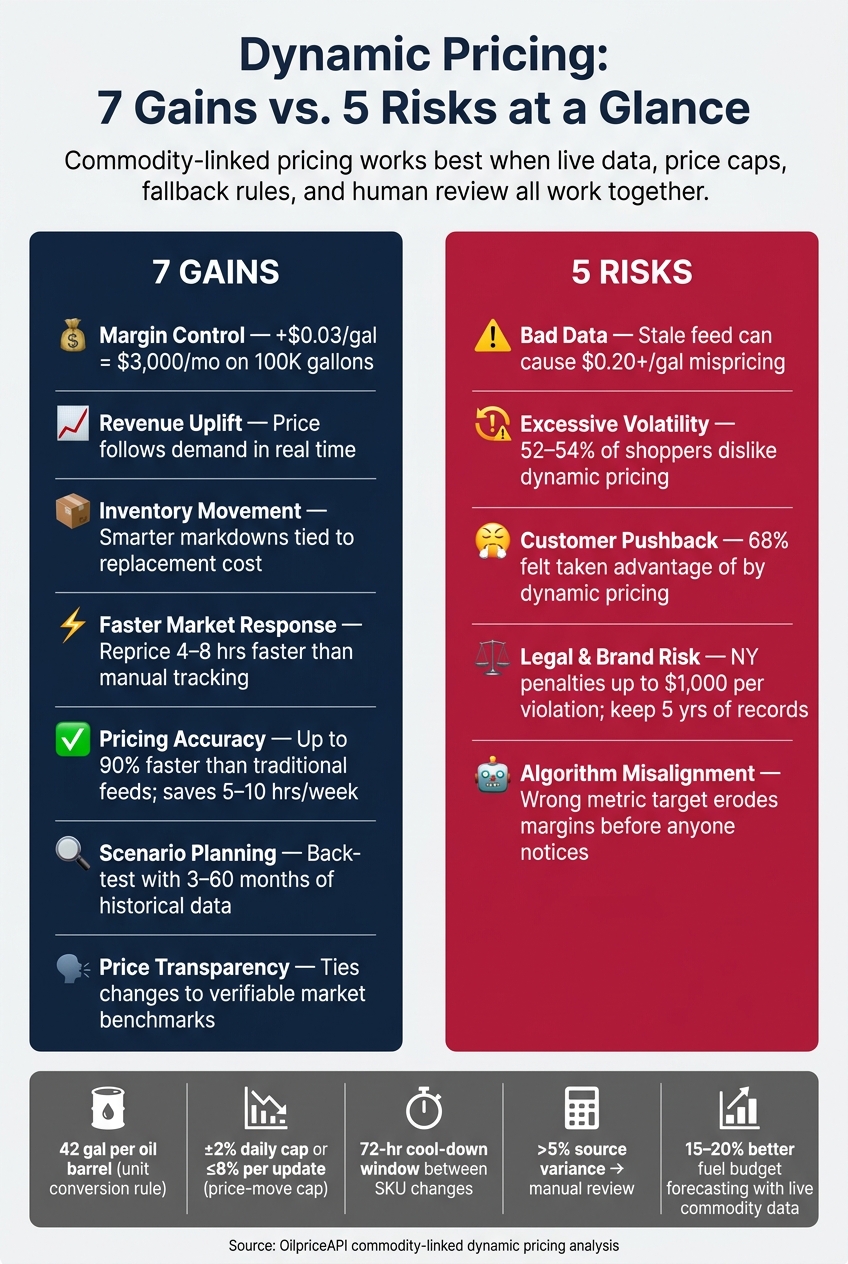
Dynamic Pricing: 7 Gains vs. 5 Risks at a Glance
The Truth About Dynamic Pricing: Is AI Setting Your Prices?
sbb-itb-a92d0a3
Quick Comparison
| Type | What I’d expect to gain or risk | Main takeaway |
|---|---|---|
| Gain 1 | Margin control | Small per-unit gains can add up fast |
| Gain 2 | Revenue lift | Price can follow demand in the moment |
| Gain 3 | Inventory movement | Lower replacement cost can support smarter markdowns |
| Gain 4 | Faster market response | Static pricing falls behind in volatile markets |
| Gain 5 | Better pricing accuracy | Clean data and automation reduce manual mistakes |
| Gain 6 | Better scenario testing | Historical data helps test rules before launch |
| Gain 7 | Clearer price messaging | Customers react better when they see the reason |
| Risk 1 | Bad data | Wrong inputs create wrong prices fast |
| Risk 2 | Too much volatility | Frequent changes can confuse shoppers |
| Risk 3 | Customer backlash | Even correct prices can feel unfair to buyers |
| Risk 4 | Legal and brand risk | Poor records and sharp price moves can lead to claims |
| Risk 5 | Bad model goals | A pricing engine can fail if it chases the wrong metric |
If you use dynamic pricing, I’d treat it like a control system, not a shortcut. Good inputs and tight rules matter more than fast automation alone.
How Commodity-Linked Dynamic Pricing Works in U.S. Retail
Commodity-linked dynamic pricing starts with a live data feed. The pricing engine takes that input, runs it through markup, inventory, and demand rules, and then sends out the retail price. That’s the basic chain that turns raw commodity data into both upside and risk.
The commodity feed is the starting signal. APIs pull rack prices or spot benchmarks, such as WTI crude in USD per barrel, every 5 minutes to 1 hour. Refined products like gasoline, diesel, and heating oil are then converted to USD per gallon before any retail markup is added. That conversion matters because one petroleum barrel holds exactly 42 U.S. gallons. So if a retailer works with barrel-based inputs but sells by the gallon, the pricing logic has to handle that math cleanly. OilpriceAPI provides real-time and historical data for Brent Crude, WTI, Natural Gas, and Gold through a JSON REST API.
Once the commodity cost lands in the engine, markup rules step in. Retailers usually use one of three models:
- Fixed markup, such as $0.30 per gallon
- Percentage markup, often 8% to 12% above wholesale
- Hybrid pricing, which mixes both and adds a minimum margin floor
That hybrid setup is common for multi-region retailers. Why? Shipping and local operating costs can shift from one market to another, so a minimum margin floor helps protect unit economics when those costs change.
After markup, price can still move. The engine may adjust based on demand or stock pressure. For example, a fuel delivery platform might look at current order queue depth or driver availability before locking in the final price. In gold retail, the pace can be even faster. Jewelry retailers update gold prices as often as every minute to track moves in the global spot market.
Once the engine sets the final number, the way that price is shown matters just as much. Retailers should publish changes with a plain-language reason and use U.S.-style line items for commodity cost, delivery fees, and state- or ZIP-level taxes.
1. Gain 1: Margin Control and Profit Optimization
With the pricing engine in place, the first payoff is margin control. When commodity prices jump around, margin erosion can eat into profit fast. API-driven pricing updates retail prices as costs move. And at 100,000 gallons per month, even a $0.03 margin lift adds $3,000 in monthly profit.
Real-time margin monitoring helps retailers stay ahead of that slide. It uses live commodity data to trigger repricing before margins start to weaken. If wholesale prices move 3% within a 4-hour window, the engine recalculates before the retailer absorbs the loss. That matters because small delays can turn into expensive mistakes.
Different pricing models handle this in different ways. Percentage markups move up with cost, which helps keep margins in line. Hybrid models go a step further by adding a minimum margin floor. In plain terms, that floor helps stop pricing from dropping too low when the market gets choppy.
OilpriceAPI supplies live and historical pricing for WTI, Brent Crude, Natural Gas, and Gold through a JSON REST API. That gives pricing engines a steady market signal for margin benchmarking. Without live market data, retailers can overpay 5% to 15% on energy procurement. Live data also helps compare supplier quotes against market prices, so overcharges can be spotted early and margin stays protected.
Once margin is protected, the next objective is matching price to demand.
2. Gain 2: Demand Matching and Revenue Uplift
Once margins are protected, the same pricing engine can go after more revenue when demand picks up. The idea is simple: price to what customers are willing to pay right now.
It does that by reacting to signals like order surges, peak-hour load, resource limits, delivery distance, and commodity threshold breaches. In plain English, pricing stays tied to what's happening on the ground instead of lagging behind it.
The engine can also look at the market's near-term price signals versus later contracts and time inventory purchases based on that spread. So pricing can shift before input costs move, which helps the business bring in more revenue during the strongest demand windows.
Real-time commodity data can improve fuel budget forecasts by 15% to 20%.
3. Gain 3: Inventory and Stock Movement Optimization
Once pricing lines up with demand, the next step is moving stock well. Slow-moving inventory locks up cash. Dynamic pricing tied to commodity data gives retailers a practical way to clear stock without dropping below target margin.
When wholesale replacement costs fall, a pricing engine can trim retail prices just enough to speed up sales. That helps keep discounts tied to unit economics instead of guesswork.
Price changes aren't the only move. The engine can also rebalance stock across locations using live order data. It can look at store-level order volume, queue depth, and past price patterns to shift inventory and spot overstock before it starts piling up.
Doing this at the store level is hard to manage by hand. It gets much easier when live and historical commodity API data feeds directly into repricing decisions that help clear slow-moving stock.
4. Gain 4: Staying Competitive in Volatile Markets
Once margin and inventory are under control, the next job is protecting your price position. In choppy markets, static pricing falls behind fast. If a retailer sticks with fixed markups during a crude oil spike, there are only two outcomes: absorb the margin hit or reprice by hand. Both are slow.
Retail pricing APIs and live commodity feeds change that. Prices can shift as soon as costs do. If WTI or Brent jumps hard - say, 3% in a short window - the engine recalculates retail prices on the spot using pre-set markup logic and margin floors. No one has to step in.
For fuel-heavy retail operations, this matters a lot. Fuel costs usually account for 25%–35% of total operating expenses. And mid-market retailers that don't have live market visibility often overpay 5%–15% on energy and fuel purchasing. That gap doesn't just sting once. It stacks up over time.
Dynamic pricing puts retailers back in control. The engine turns market moves into price actions, fast and with clear rules behind them.
That said, competitive pricing still needs context. If prices go up, customers and partners need a plain-English reason. A posted wholesale-cost increase helps protect trust, and live WTI and Brent feeds give teams current numbers to point to.
That kind of speed only helps if the pricing data is accurate.
5. Gain 5: Pricing Accuracy Through Data and Automation
Speed matters. But if your data is off, fast pricing just means fast mistakes.
Manual checks usually trail the market. Live API inputs help keep prices tied to current costs, which becomes even more important when commodity swings set off automatic repricing.
Accuracy starts with normalization. A solid API normalizes currency, converts barrels to gallons, and lines up timestamps on its own. That’s what makes barrel-based commodity data usable in gallon-based U.S. retail pricing. And that level of precision matters. Even a small conversion mistake can throw off every margin rule that comes after it.
OilpriceAPI provides real-time Brent Crude and WTI feeds that pricing engines can plug straight into markup logic. Automation also makes audits easier. When commodity costs move fast, audit logs show why each price changed. Every price change, trigger, and margin impact is logged automatically, which creates a clear audit trail for customer or regulatory review. If a customer or regulator challenges a surcharge, that timestamped record helps back up the decision.
There’s a catch, though: the same automation that improves accuracy can spread bad inputs just as fast.
6. Gain 6: Scenario Planning With Historical Commodity Data
The same data used for live repricing can also power back-tests. Live pricing helps you react now. Historical data shows whether your rules would have worked during past market swings. That matters because back-testing can catch pricing issues before they show up in the P&L, not after.
A simple way to think about it: live data tells you what's happening today, while historical data lets you pressure-test your pricing logic against what already happened.
Use 3–6 months of history to tune retail markups and surcharges, 12–24 months to spot seasonality, and 36–60 months to test how your pricing holds up during sharp spikes or crashes of 30%–50% or more.
Historical endpoints for Brent Crude, WTI, and Natural Gas support daily or hourly back-tests across 1h, 1d, and 1w intervals. They also use a consistent JSON structure, which makes it easier to plug the data straight into pricing simulations.
The scenario table below shows how each historical metric lines up with a planning use case:
| Scenario Type | Historical Metric Used | What It Tests |
|---|---|---|
| Expected | Historical mean (average) | Baseline margin targets under normal conditions |
| Worst-Case | Historical max / extreme high | Ability to absorb or pass through extreme cost spikes |
| Best-Case | Historical min / low Z-score | Opportunities for competitive pricing or inventory builds |
| Seasonal | Multi-year monthly patterns | Predictable demand shifts and procurement timing |
These limits shouldn't sit off to the side in a separate analytics workflow. They should feed straight into live pricing rules. One practical output is a set of pricing guardrails: minimum margin floors, maximum price-change caps per time window, and automatic alerts when commodity moves would push margins below target bands. Back-testing makes those guardrails measurable instead of guesswork.
7. Gain 7: Cost-Based Pricing Narratives and Price Transparency
Price changes feel less random when retailers say why they happened. A shelf tag or receipt note like "Updated 08/01/2026 for higher freight costs." gives customers a clear reason. That kind of detail shows the price is reacting to market conditions, not a markup pulled out of thin air.
Commodity API data helps retailers tie each change to a live market shift and explain it in plain English. OilpriceAPI offers real-time and historical prices for Brent Crude, WTI, and Natural Gas - benchmarks that often affect transportation, manufacturing, and heating costs. Retailers can also show the cost split between:
- commodity input
- logistics
- margin
That breakdown helps people see the markup has a structure. But clear messaging only helps if the data and the explanation stay accurate.
Retailers should treat commodity-based claims as advertising under U.S. consumer protection rules. Store the supporting API response, including the timestamp, source, commodity, and unit, and have legal review the template. That kind of discipline matters even more when price inputs start moving fast. The next risk is what happens when the data or the message starts to fail.
8. Risk 1: Poor Data Quality and Integration Errors
When the feed is wrong, dynamic pricing stops being a control system and starts making mistakes.
Dynamic pricing is only as good as the data behind it. If a commodity feed is stale, incomplete, or mapped the wrong way, every automated price update carries that same problem forward. The damage hits margins, inventory decisions, and customer trust all at once. And in fuel retail, even small pricing mistakes add up fast.
The most common problems are pretty practical: wrong symbol mapping, unit mismatches, time-zone mismatches, missing timestamps, late API calls, and rate limits. On the day-to-day digital shelf, at the pump, and at the POS, those issues usually show up in ways store teams notice right away. You see sudden price jumps, gaps between in-store and online pricing, and more manual overrides because managers can tell something is off.
If a retailer depends on a single commodity API, one outage, latency spike, or bad update can spread across thousands of SKUs in one shot. A safer setup adds a few guardrails. Use historical data to smooth the signal. Check for outliers before any price goes live. And block updates that move more than 5% from expected values.
When data is missing or wrong, fallback rules matter. A simple chain works well:
- Use the last verified price first
- Then use a moving average
- Then use a fixed cost-plus rule
Trust is often harder to win back than margin. If pump prices don't match posted signs, or if they change between refreshes, shoppers usually blame the retailer, not the feed. That can lead to complaints, social posts, and even price-gouging claims. Strong audit logs help a lot here. Teams should record the commodity value used, the timestamp, and the pricing formula so they can explain what happened and defend valid price changes.
| Data Quality Issue | Retail Impact | Mitigation |
|---|---|---|
| Stale or delayed feed | Prices lag market moves; margin erodes or inflates | Check timestamp before applying any value |
| Unit mismatch (barrel vs. gallon) | Massive over- or underpricing | Normalize units at the integration layer |
| Price spike | Erratic shelf or pump prices | Cross-check and hold the update |
| API outage / no fallback | Prices stop updating or lag the market | Use tiered fallback logic with moving-average backup |
| Time zone mismatch | Prices reflect the wrong trading session | Apply explicit UTC-to-local conversion in the pipeline |
Clean data matters. But by itself, it won't remove price volatility.
9. Risk 2: Excessive Price Swings and Customer Confusion
Even when your commodity feed is accurate, pricing can still swing too much. If prices change often, jump by 3%–5%, and follow no pattern shoppers can spot, cost tracking turns into customer-facing volatility.
Here’s where it goes sideways. If a pricing engine pulls live WTI or Brent data and applies a direct cost-plus formula with no smoothing, the posted price can look arbitrary. The cost signal may be correct, but to shoppers, the number on the shelf can feel random.
That reaction has a business cost. When people can’t predict prices, they may wait to buy, spend less per trip, or switch stores altogether. Research on dynamic pricing found that trust difficulties explain 26.4% of the variance in customer behavior, while price sensitivity explains another 19.8%.
The fix isn’t slower pricing. It’s rule-based smoothing before the customer sees the price.
Without that buffer, volatility can hurt realized margin too. Sharp movement can trigger demand cliffs, make sales data noisier, and weaken forecasting and inventory planning. In plain English: the price moves, customer behavior gets messy, and planning gets harder.
What helps is a policy layer between the commodity feed and the posted price. For example:
- A maximum daily change of ±2%
- No repricing unless WTI moves more than $1.00 per barrel from the last update
These types of volatility caps soak up intraday noise without ignoring real cost moves.
OilpriceAPI’s historical data for Brent, WTI, Natural Gas, and Gold also makes back-testing much easier. Teams can test cap thresholds against years of market data before putting a rule into production. That matters because a pricing rule may look fine on paper and still fail once it meets messy market behavior.
Customer messaging matters too. A short shelf note like "Price reflects daily changes in wholesale fuel costs, updated at 10:30 a.m. ET" gives shoppers a simple explanation they can live with, even when prices change.
10. Risk 3: Perceived Unfairness and Customer Pushback
After volatility comes the fairness issue. Even when a price change makes sense, customers may push back if they can't see why it happened. A price can be accurate and still feel unfair. When a retailer reacts to a WTI spike or a natural gas surge, many shoppers don't see wholesale cost pressure. They see markup or price gouging.
The main issue is a visibility gap. Retailers spot cost swings hours before customers do, so a new price can seem random or arbitrary.
A 40% cancellation or opt-out rate is a strong warning sign that pricing has moved past what the market will accept. This matters even more for B2B or fleet accounts. These customers need budget predictability, and unexplained swings can hurt long-term relationships, not just one sale.
For commodity-linked retail pricing, the answer is simple: use a clear benchmark and give a one-line reason for the change. A short explanation tied to a market reference helps customers check the claim for themselves. For example, "Prices increased 3.8% today due to Gulf Coast supply disruptions".
Retailers can use OilpriceAPI's real-time Brent and WTI data to tie those explanations to a clear market reference. That gives the price change a basis customers can follow, instead of making it sound like a sales pitch.
11. Risk 4: Regulatory, Legal, and Reputational Exposure
Commodity-linked dynamic pricing can open the door to legal, reporting, and brand risk when prices swing fast. That risk gets bigger when you're using live commodity feeds, automatic repricing, and written references to market moves.
Recordkeeping matters most when regulators ask a simple question: Why did this price change? Keep source-timestamped records for every update. Those records show when the price changed and which market input triggered it, which can help defend against price-gouging or manipulation claims. If your pricing engine updates from a WTI or natural gas feed, the record should tie each change to the exact market input at that moment.
Compliance is only one side of the issue. Public reaction can cost just as much. During sharp cost swings, businesses may need current valuation records and steady reference prices for compliance reporting. It helps to connect pricing rules to the same system used for reporting. Keeping at least 5 years of price history also gives you a cleaner record for regulatory audits or customer pushback.
Without hard price ceilings, emergency pricing can trigger gouging claims and long-term brand damage. A few simple guardrails can help:
- Set hard price ceilings to stop runaway increases when markets get unstable
- Keep an audit trail tied to each market-based price update
- Use the same reference data across pricing and reporting systems
OilpriceAPI's real-time and historical Brent, WTI, and natural gas data can support that audit trail. Hard ceilings also limit exposure when markets turn unstable.
Those controls help, but algorithm design still matters.
12. Risk 5: Over-Reliance on Algorithms and Misaligned Goals
Clean data and fast updates don't fix a bad pricing goal. A model can still fail if it's tuned for the wrong outcome. The main risk isn't automation on its own. It's the target the pricing system is trying to hit.
Commodity feeds provide the raw input. But the pricing rules decide what happens next: do they protect margin, or slowly eat it away? If the system is chasing the wrong metric, margin problems and customer friction can show up before anyone notices.
Take competitive price matching. If you match rivals without a margin floor, it's easy to slide into a price war. And once prices drop below break-even, the damage adds up fast.
The flip side can be just as risky. Aggressive surge pricing may lift prices fast, but it can also drive opt-outs higher. That's a big issue for B2B and fleet accounts. Those buyers usually care less about short-term supply swings and more about stable, predictable costs.
There's also the stale-price problem. If the system relies on cached prices and has no failover rules, it may keep selling below current wholesale cost during a sharp market spike when the API signal is out of date. An age-based safety buffer helps lower that risk. For example, adding a margin floor to cached prices older than 30 minutes can help.
So the better approach is simple: use guardrails, not blind automation.
- Set margin floors
- Cap surge multipliers at 1.4x
- Separate consumer and B2B/fleet tiers
- Track opt-out rates closely so the model can be adjusted fast when opt-outs rise
These guardrails frame the trade-offs in the quick reference table below.
Quick Trade-Off Reference Table
Use the table below to compare each gain and risk by impact and data type. Then use it to pick the right controls in the next section.
| Gain/Risk | What It Affects | Business Impact | Role of Commodity API Data |
|---|---|---|---|
| Gain 1: Margin Control and Profit Optimization | Gross margin and per-unit profit | Typical gains of 2–5 cents per gallon for fuel retailers; helps prevent selling below cost during spikes | Live for repricing; historical for guardrails |
| Gain 2: Demand Matching and Revenue Uplift | Sell-through and top-line revenue | Captures peak-period willingness to pay and helps avoid underpricing when demand and costs spike together | Live for demand spikes; historical for elasticity analysis |
| Gain 3: Inventory and Stock Movement Optimization | Inventory turnover, days of supply, and markdown efficiency | Reduces markdown losses and helps time bulk buys before predicted cost increases | Historical for procurement timing |
| Gain 4: Staying Competitive in Volatile Markets | Speed of response to rivals and market shocks | Can move repricing 4–8 hours faster than manual tracking | Live for repricing before rivals move |
| Gain 5: Pricing Accuracy Through Data and Automation | Consistency across channels and manual error | API-driven integration can be up to 90% faster than traditional feeds, saving managers 5–10 hours per week | Live for normalized feeds across locations |
| Gain 6: Scenario Planning With Historical Commodity Data | Forecasting, budget resilience, and pricing stress tests | Supports budget and hedge planning before broad rollout | Historical for back-testing |
| Gain 7: Cost-Based Pricing Narratives and Price Transparency | Customer trust and price justification | Ties retail price changes to verifiable market benchmarks and helps reduce price gouging concerns | Historical for context; live for current explanations |
| Risk 1: Poor Data Quality and Integration Errors | Pricing accuracy, margin calculations, and compliance reporting | A stale or misconfigured feed can cause a fuel retailer to underprice by $0.20/gallon or more | Live for audit trail |
| Risk 2: Excessive Price Swings and Customer Confusion | Customer trust, basket size, and repeat visits | Rapid intraday price changes frustrate shoppers; 52% to 54% of shoppers said they disliked dynamic pricing | Live with caps for smoothing |
| Risk 3: Perceived Unfairness and Customer Pushback | Brand reputation, social media sentiment, and loyalty | A separate survey found 68% of consumers felt taken advantage of when a brand used dynamic pricing | Historical for justifying price moves |
| Risk 4: Regulatory, Legal, and Reputational Exposure | Compliance with price-gouging laws and disclosure rules | New York penalties can reach $1,000 per violation | Historical for audit trail |
| Risk 5: Over-Reliance on Algorithms and Misaligned Goals | Strategic alignment when automation overrides business judgment | Misaligned models can erode margins or trigger opt-outs before anyone notices | Historical for model reviews; live for oversight |
Practical Controls for API-Driven Pricing
The trade-off table above shows where the risk sits. These rules show how to keep it in check. API-driven pricing is far more stable when you put clear guardrails between the incoming feed and the price a customer sees.
Start at ingestion. Validate each commodity payload before it reaches the pricing engine. The system should verify that the payload is complete, properly timestamped, using the right unit of measure, and normalized to USD. If source variance is above 5%, send it to manual review instead of letting it flow through.
Next, limit how often prices can change. If a feed goes down or starts returning suspicious data, hold the last approved price. Don’t freeze the system in panic mode, and don’t let it guess. A practical fallback chain looks like this: live validated price → most recent approved price → manual cost-plus default. Run batch updates once a day at a fixed time, such as 6:00 a.m. ET. And if a change barely affects margin, skip it.
Price-move caps and rounding rules need to work as a pair. A hard cap of about 8% per update, plus a 72-hour cool-down window before another change can hit the same SKU, can stop whiplash pricing. Do the rounding after the cap check, not before. Let the formula follow commodity costs first, then round the final number to a familiar shelf price like $4.99 or $19.95.
Some changes should never go live without a person checking them. If a proposed price move goes past your percentage cap, drops below a minimum margin floor, or touches a high-visibility SKU, route it to a manager before publication. Compliance review should also sit inside the workflow for fuel-related goods, essentials, or multi-state SKUs, since some states now police algorithmic pricing more closely. For every published price, log the source inputs, the calculation steps, and the approver’s identity.
Use the table below as the operating checklist.
| Control | What It Prevents | Practical Setting |
|---|---|---|
| Data validation + variance flag | Bad data reaching the engine | Block update if source variance >5%; check timestamp freshness |
| Fallback price hierarchy | Pricing gaps during feed outages | Hold last approved price; activate fallback mode promptly |
| Update-frequency limit | Customer confusion from constant changes | Max one change per SKU per day; batch at 6:00 a.m. ET |
| Price-move cap | Algorithmic overreaction to spikes | ≤8% per update; 72-hour cool-down window |
| Rounding rule | Psychological price-point erosion | Apply $X.99 rounding after the cap check, not before |
| Human approval threshold | High-impact errors reaching customers | Require manual sign-off for changes >5% or below margin floor |
| Compliance review step | Regulatory and reputational exposure | Review sensitive or jurisdiction-specific SKUs and log inputs plus approver identity |
Conclusion
Dynamic pricing backed by reliable commodity data and market insights can improve margins, smooth demand, and clear inventory faster. But those gains come from good system design and tight oversight, not automation by itself.
That only works when pricing rules stay disciplined. Tools like OilpriceAPI give you real-time and historical commodity data, which helps close the gap between market swings and retail pricing. Use that data to set price floors and ceilings. Then test your rules against past volatility before anything goes live.
The upside also depends on guardrails. The risks here are operational, legal, and reputational. Price confusion and customer backlash can hurt purchase intent, even when the cost logic makes sense on paper. U.S. regulators are also paying closer attention to algorithmic pricing, especially when shared tools or data could create antitrust concerns. So volatility controls, human review, audit trails, and compliance checks are not optional. The strongest pricing systems pair automation with oversight.
The takeaway is simple: use commodity APIs to make pricing more informed, but put guardrails around every automated decision to protect customers, margins, and brand trust. Its value depends on the governance behind it.
FAQs
When should dynamic pricing be updated?
Update dynamic pricing when live market moves, day-to-day triggers, or stock conditions start squeezing margins or weakening your position.
Recalculate prices when live commodity costs pass a set threshold, like a 3% change within 4 hours. Do the same during demand surges, such as rush hours or periods of low regional availability. If you use OilpriceAPI, track source timestamps and webhooks so price changes reflect current data.
How do price caps reduce customer backlash?
Price caps help limit customer backlash by stopping pricing engines from pushing prices to extreme, hard-to-predict levels during spikes in demand or emergencies. With a hard ceiling in place, businesses can keep price jumps within a more reasonable range.
That guardrail also helps protect a company’s reputation and keep customer trust intact. After all, steep charges are often what spark complaints, bad press, and angry feedback.
What should happen if the commodity feed fails?
If the commodity feed fails or the network drops, use retry logic with exponential backoff to get through short outages. Also keep detailed logs and automated monitoring in place so your team spots issues fast.
To keep things steady, serve cached data during interruptions. OilpriceAPI also helps on the reliability side with high uptime targets, automated health checks every five minutes, and failover to backup sources when needed.